
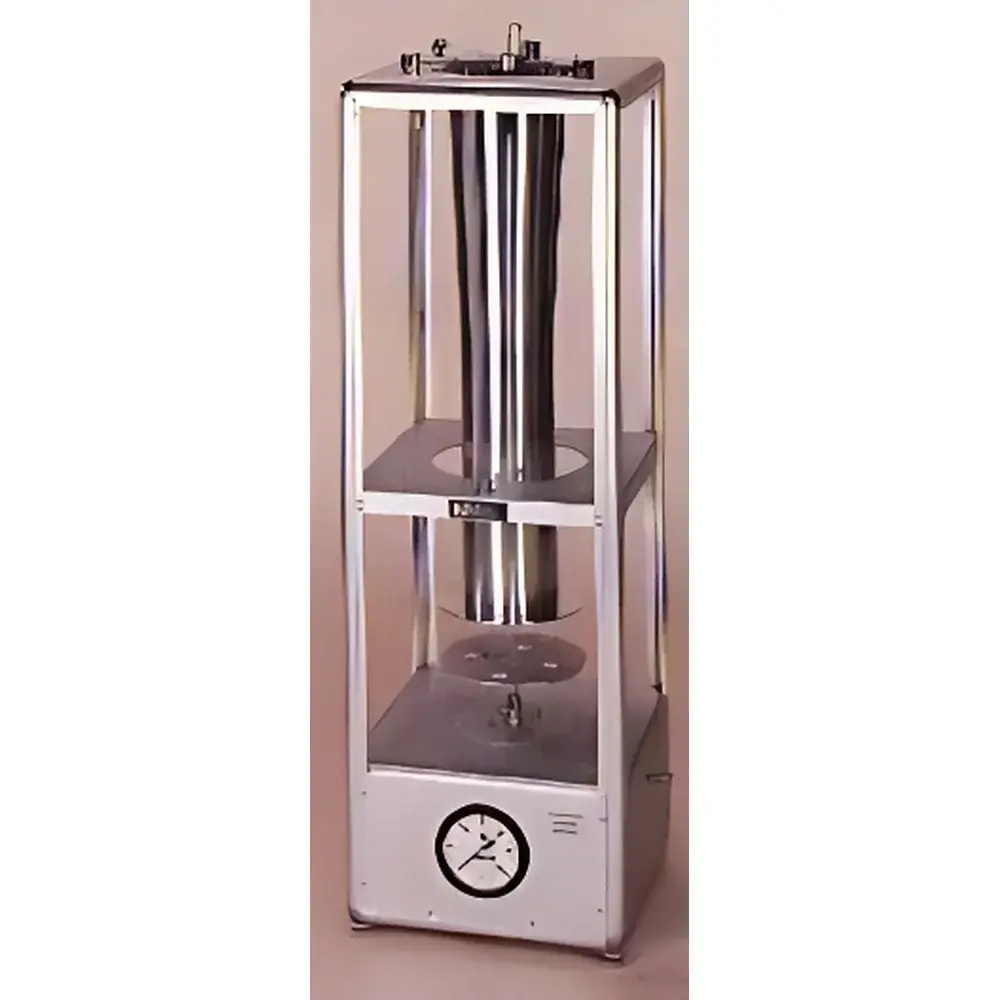
Burkard Potter Spray Tower (PDE0012)
| Origin | UK |
|---|---|
| Manufacturer Type | Authorized Distributor |
| Origin Category | Imported |
| Model | PDE0012 |
| Pricing | Upon Request |
Overview
The Burkard Potter Spray Tower (Model PDE0012) is a precision-engineered laboratory aerosol generation system designed for controlled, reproducible delivery of liquid formulations over a defined 9 cm diameter circular target area. Based on the classical Potter tower principle—utilizing compressed air-driven atomization through a calibrated nozzle—the instrument generates either a direct-contact spray or a sustained, low-velocity mist suitable for exposure studies in entomology, plant pathology, and pesticide toxicology. Its robust stainless-steel and anodized aluminum construction ensures long-term dimensional stability and chemical resistance during repeated use with organic solvents, aqueous emulsions, and suspension concentrates. The device operates within a defined pressure regime (0–2 kg/cm², equivalent to 0–2 bar or 0–30 psi), with a factory-fitted 4-inch analog pressure gauge providing real-time monitoring of delivery pressure—a critical parameter governing droplet size distribution and deposition uniformity per ASTM E1519 and ISO 22866 guidelines.
Key Features
- Calibrated spray head geometry optimized for uniform deposition across a 9 cm circular test surface, validated via gravimetric and fluorescent tracer methods per OECD 170 and EPPO PM 5/118 protocols.
- Integrated pressure regulation system with 0–2 bar (0–30 psi) analog gauge—traceable to NPL (UK) standards—ensuring consistent atomization energy across experimental replicates.
- Reservoir capacity of 24 mL accommodates single-run dosing for standardized bioassays; reservoir design minimizes residual volume and cross-contamination risk.
- Top flange diameter: 15.7 cm; bottom flange diameter: 11.9 cm—enabling secure mounting on standard lab benches and compatibility with containment hoods or laminar flow enclosures.
- Maximum sample disc diameter: 11 cm—compatible with standard Petri dishes, leaf discs, and insect arenas used in WHO-recommended mosquito bioassays and EPA OPPTS 850.3020 test protocols.
- Net weight: 21 kg; gross shipping weight: 32 kg; overall packed volume: 122 × 36 × 36 cm—designed for stable benchtop operation without anchoring requirements.
Sample Compatibility & Compliance
The Potter Spray Tower supports a wide range of formulation types including water-dispersible granules (WDG), emulsifiable concentrates (EC), suspension concentrates (SC), and oil-in-water emulsions. Its inert wetted path—comprising borosilicate glass reservoir, stainless-steel tubing, and PTFE-sealed fittings—ensures compatibility with aggressive agrochemical actives and co-formulants. The system conforms to Good Laboratory Practice (GLP) documentation requirements for equipment qualification (IQ/OQ), supporting audit-ready records for regulatory submissions under US EPA, EU EFSA, and APVMA frameworks. Pressure calibration certificates are provided upon installation, traceable to UKAS-accredited laboratories.
Software & Data Management
While the PDE0012 operates as a manually controlled, non-automated platform, it is fully compatible with external data acquisition systems. Users may integrate digital pressure loggers (e.g., Druck DPI 620) or high-speed imaging setups (e.g., Malvern Spraytec) for droplet size analysis (Dv₁₀, Dv₅₀, Dv₉₀). All operational parameters—including applied pressure, reservoir fill volume, ambient temperature/humidity, and exposure duration—are documented in structured lab notebooks aligned with FDA 21 CFR Part 11-compliant electronic record systems when paired with validated LIMS platforms.
Applications
- Determination of LC₅₀/LC₉₀ values for insecticides, fungicides, and acaricides using standardized contact bioassays on arthropods (e.g., Aedes aegypti, Tetranychus urticae) per WHO and IRAC guidelines.
- Evaluation of foliar deposit uniformity and retention efficiency on plant surfaces under controlled environmental conditions.
- Comparative assessment of spray adjuvant efficacy on droplet spread, evaporation kinetics, and active ingredient penetration.
- Teaching modules in pesticide toxicology, integrated pest management (IPM), and aerosol physics at university-level entomology and agricultural science programs.
- Pre-screening of novel nanopesticide formulations for deposition behavior prior to field-scale trials.
FAQ
What is the recommended maintenance schedule for the Potter Spray Tower?
Routine cleaning after each use with appropriate solvent (e.g., acetone for organic residues, deionized water for aqueous solutions) is required. Annual recalibration of the pressure gauge and visual inspection of O-rings and nozzle orifice are advised.
Can the tower be used with viscous suspensions?
Yes—formulations up to 500 cP may be delivered effectively; however, pre-filtration through a 5 µm syringe filter is strongly recommended to prevent nozzle clogging.
Is the PDE0012 compliant with GLP standards for regulatory testing?
Yes—when operated within its specified pressure range and supported by documented calibration, maintenance, and operator training records, it meets OECD GLP Principles for Test Facilities conducting Tier I toxicity studies.
Does Burkard provide validation protocols for the spray tower?
Yes—Burkard supplies a comprehensive Equipment Qualification Package (IQ/OQ) including pressure linearity verification, deposition uniformity maps, and residue recovery data upon request.
What safety precautions should be observed during operation?
Operation must occur inside a certified fume hood or ventilated containment chamber; users must wear nitrile gloves, safety goggles, and lab coats in accordance with COSHH risk assessments for the applied chemical agents.



