
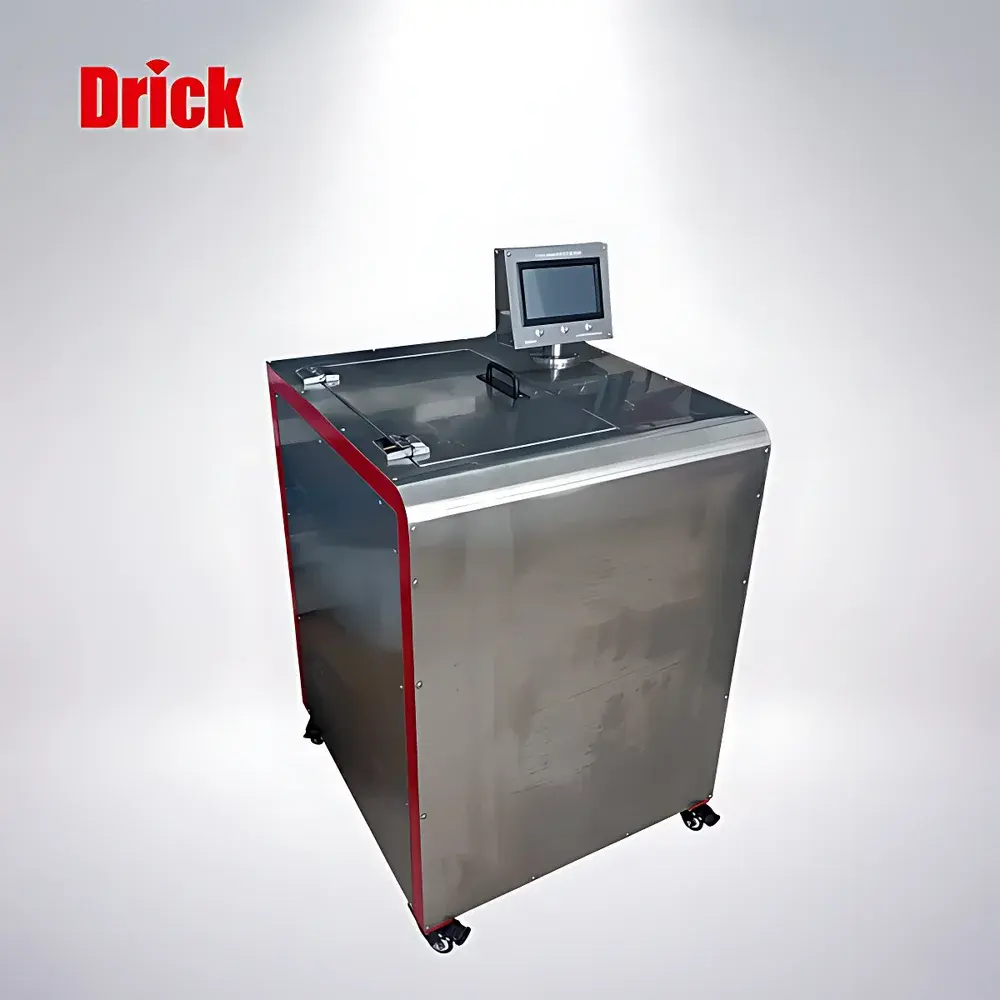
Drick DRK0068 Textile Wash Fastness Tester
| Brand | Drick |
|---|---|
| Origin | Shandong, China |
| Manufacturer Type | Direct Manufacturer |
| Country of Origin | China |
| Model | DRK0068 |
| Maximum Cup Capacity | 8 × 550 mL cups (±50 mL) |
| Rotational Speed | 40 rpm ±2 rpm |
| Motor Power | 200 W |
| Drain Pump Power | 30 W |
| Heating Power | 4000 W |
| Timer Range | 0.1–9999.9 min |
| Timer Accuracy | ±0.1 min |
| Timer Resolution | 0.1 min |
| Temperature Range | Ambient water temperature to 95 °C |
| Temperature Control Accuracy | ±1 °C |
| Temperature Resolution | 0.1 °C |
| Heating Time | ≤10 min (ambient to 40 °C) |
| Heating Method | Electric immersion heating |
| Power Supply | AC 220 V ±10%, 50 Hz |
| Dimensions (W×D×H) | 1000 × 650 × 1060 mm |
| Packaging Dimensions | 1060 × 750 × 1160 mm |
| Net Weight | 80 kg (176.3 lb) |
| Compliance | GB/T 3921.1–5, GB/T 5711, AATCC Test Method 61, ISO 105-C06 |
Overview
The Drick DRK0068 Textile Wash Fastness Tester is a precision-engineered laboratory instrument designed to evaluate the wash fastness of dyed and printed textiles under standardized mechanical, thermal, and chemical stress conditions. Based on the principle of controlled agitation in a heated aqueous detergent bath—mimicking industrial laundering processes—the DRK0068 replicates the combined effects of temperature, time, mechanical action (rotational tumbling), and detergent concentration to quantify color migration, bleeding, staining, and fading behavior. Its architecture conforms to internationally recognized test methodologies including AATCC TM61 (Multiple Laundering Cycles), ISO 105-C06 (Color Fastness to Domestic and Commercial Washing), GB/T 3921.1–5 (Chinese national standards for textile color fastness to washing), and GB/T 5711 (Color fastness to dry cleaning). The unit operates via a robust stainless-steel drum assembly mounted on a precisely regulated rotating frame, ensuring uniform mechanical exposure across all eight test specimens simultaneously.
Key Features
- Eight-position cup holder accommodating standardized 550 mL stainless-steel test cups (±50 mL tolerance), enabling parallel evaluation of multiple samples or replicates per cycle.
- High-stability rotational drive system maintaining 40 rpm ±2 rpm across full load and temperature range—critical for reproducible mechanical abrasion intensity per ISO and AATCC specifications.
- Integrated high-power (4000 W) electric immersion heating with PID-controlled feedback loop, delivering precise temperature regulation from ambient to 95 °C (±1 °C accuracy) and rapid thermal ramp profiles validated per standard heating time requirements.
- Microprocessor-based timer with 0.1-minute resolution and ±0.1-minute accuracy over full 0.1–9999.9-minute range—supporting both short-cycle validation tests and extended durability assessments.
- Dual-pump architecture: dedicated 200 W motor for rotation and a separate 30 W drain pump for controlled post-test effluent removal, minimizing cross-contamination risk between cycles.
- Full-metal enclosure with insulated chamber walls and front-access hinged door for safe, ergonomic loading/unloading; compliant with IEC 61000-6-2 (immunity) and IEC 61000-6-4 (emission) for laboratory electromagnetic environments.
Sample Compatibility & Compliance
The DRK0068 supports diverse textile substrates—including natural fibers (cotton, wool, silk, linen), synthetic fibers (polyester, nylon, acrylic), and blended fabrics—as well as dye intermediates and pigment dispersions used in textile printing. Each test cup accommodates fabric swatches (typically 100 × 40 mm per ISO 105-C06) alongside multifiber adjacent fabrics (e.g., DW, M&L, or SD types) to assess staining propensity. All operational parameters—including dwell time, temperature setpoint, detergent formulation (e.g., ECE reference detergent), and steel ball count—are programmable to match specific clauses within GB/T 3921.3 (soaping), GB/T 3921.4 (alkaline wash), or AATCC TM61 Option 1A/2A/3A. The system’s mechanical and thermal repeatability has been verified against inter-laboratory round-robin data per ISO/IEC 17025 calibration traceability requirements.
Software & Data Management
While the DRK0068 operates via an embedded membrane keypad interface with real-time LCD display (showing elapsed time, current temperature, and setpoints), optional RS-232 or USB-to-serial connectivity enables integration with LIMS or QA documentation systems. Logged parameters—including start/stop timestamps, peak temperature deviation, actual rotational speed average, and total energy consumption per cycle—can be exported as CSV files for audit-ready reporting. When deployed in GLP- or GMP-regulated environments (e.g., textile QC labs supplying automotive or medical textile OEMs), the device supports 21 CFR Part 11-compliant electronic records when paired with validated third-party data acquisition software featuring user access control, electronic signatures, and immutable audit trails.
Applications
- Pre-shipment quality verification of dyed apparel, home textiles, and technical fabrics prior to export compliance (e.g., OEKO-TEX® Standard 100, REACH Annex XVII).
- R&D evaluation of novel reactive dyes, pigment dispersion systems, and eco-friendly detergent formulations under accelerated wash protocols.
- Root-cause analysis of batch-to-batch color variation in woven/knitted goods by correlating wash fastness scores with spectrophotometric ΔE values measured pre- and post-test.
- Validation of finishing treatments (e.g., cationic fixatives, silicone softeners) for enhanced wash durability in functional workwear and flame-retardant textiles.
- Third-party certification testing for ISO 17025-accredited laboratories serving global brands requiring AATCC/ISO-aligned reports.
FAQ
What standards does the DRK0068 fully support out-of-the-box?
It natively implements test conditions required by GB/T 3921.1–5, GB/T 5711, AATCC TM61 (all options), and ISO 105-C06 without hardware modification.
Can the DRK0068 accommodate non-standard cup volumes or custom agitation profiles?
The mechanical design is optimized for 550 mL cups and 40 rpm rotation; deviations require engineering validation and are not covered under warranty or standard calibration.
Is temperature calibration traceable to national metrology institutes?
Yes—factory calibration uses NIST-traceable PT100 sensors; users may perform in-house verification using accredited reference thermometers per ISO/IEC 17025 Clause 6.5.
What maintenance intervals are recommended for long-term reliability?
Drain pump inspection every 200 cycles; heater element resistance check annually; full lubrication of rotary shaft bearings every 12 months.
Does the unit include detergent or multifiber fabric references?
No—these consumables must be sourced separately per AATCC or ISO specifications (e.g., AATCC 1995 Detergent WOB, ISO 105-F10 multifiber fabric).





