
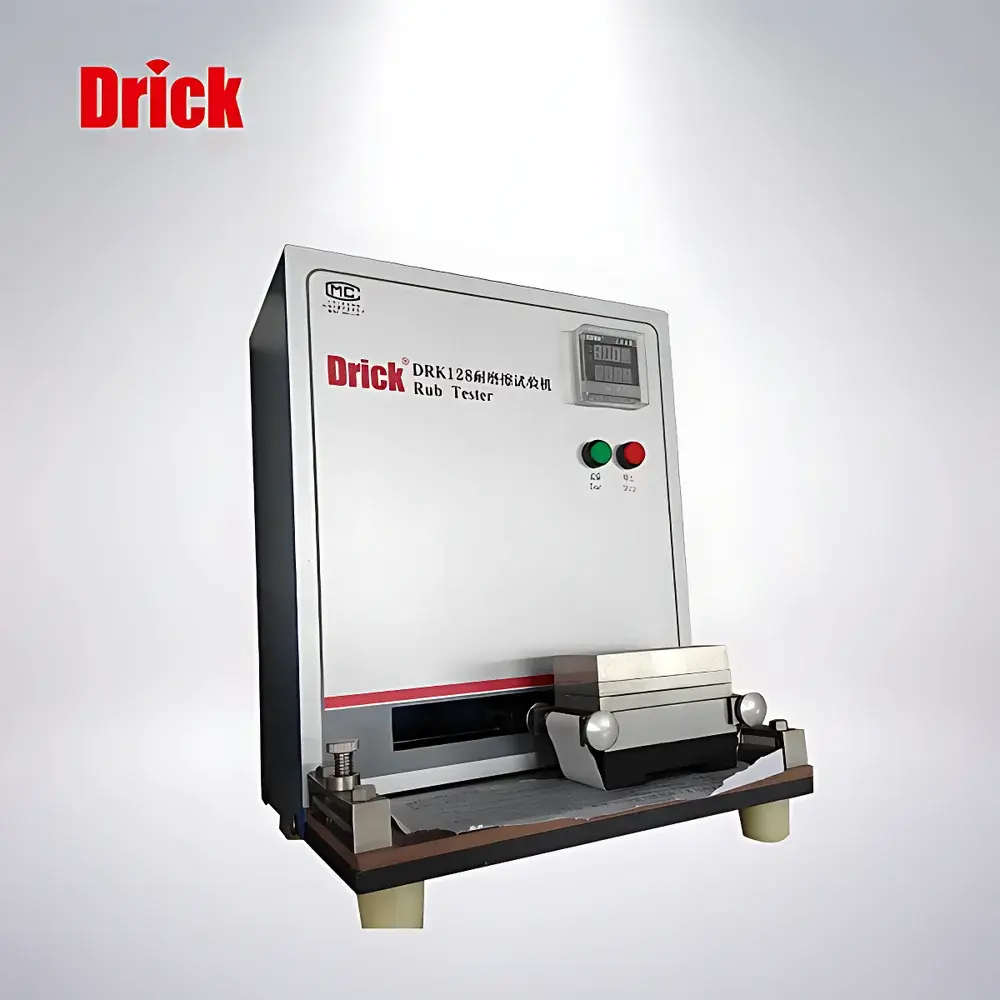
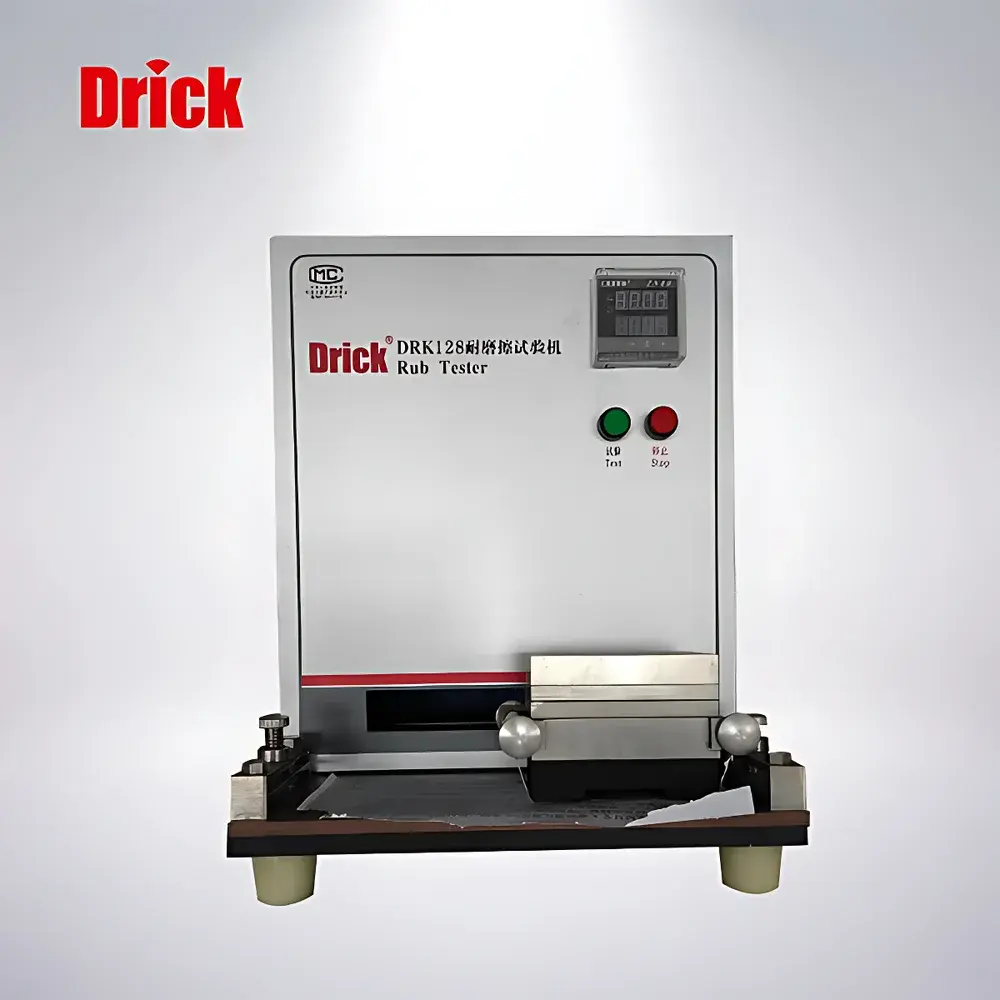
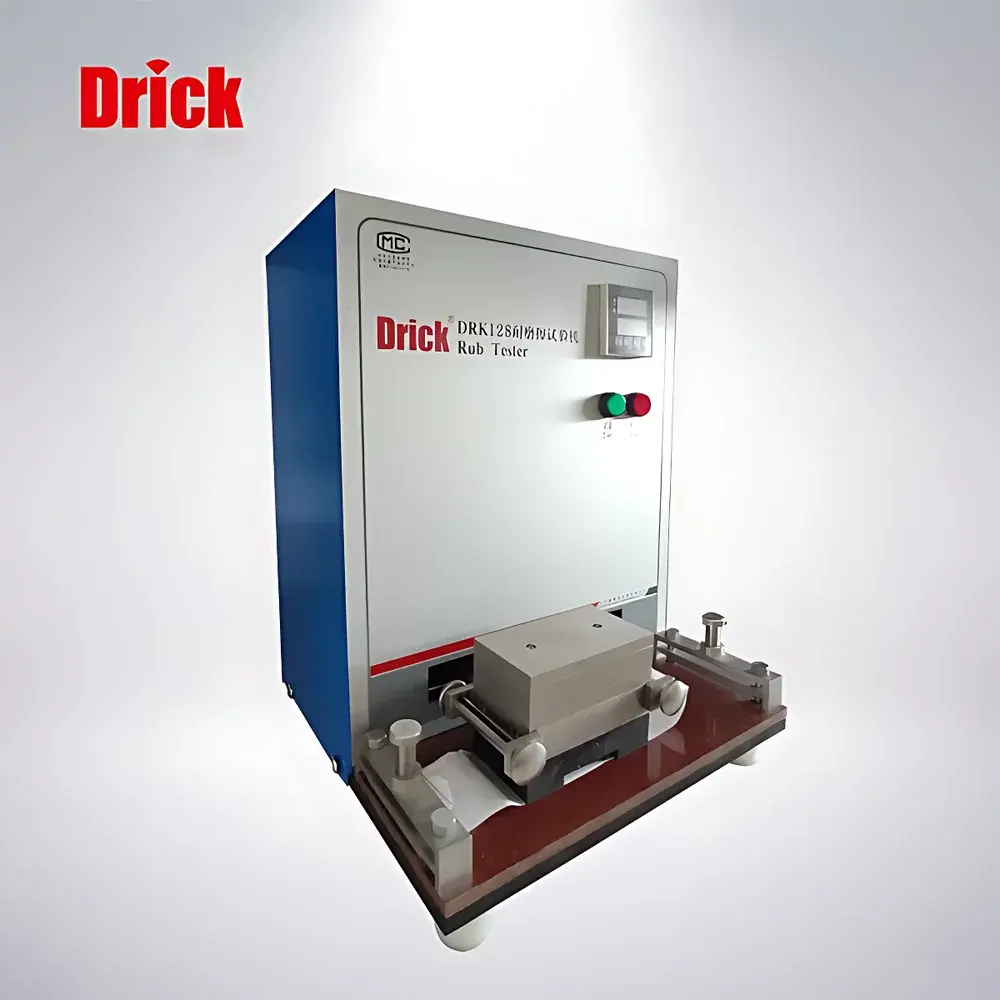
Drick DRK128 ASTM D5264 Ink Rub Resistance Tester
| Brand | Drick |
|---|---|
| Origin | Shandong, China |
| Manufacturer Type | Direct Manufacturer |
| Model | DRK128 |
| Operating Load | 20 ± 0.2 N |
| Stroke Frequency | 43 cycles per minute (cpm) |
| Abrasion Area | 155 mm (L) × 50 mm (W) |
| Test Cycles Range | 1–9999 |
| Specimen Size | 230 mm (L) × 50 mm (W) |
| Power Supply | AC 220 V, 50 Hz |
| Dimensions (W×D×H) | 260 × 245 × 340 mm |
| Net Weight | 17 kg |
| Compliance | ASTM D5264, GB/T 7706, JIS K5701, TAPPI T476 |
Overview
The Drick DRK128 ASTM D5264 Ink Rub Resistance Tester is a precision-engineered instrument designed for quantitative evaluation of surface abrasion resistance in printed materials and coated substrates. It operates on the principle of controlled reciprocating linear motion under standardized normal load, simulating real-world mechanical stress such as finger rubbing, packaging handling, or transport-induced abrasion. The device applies a consistent 20 ± 0.2 N vertical force via a calibrated spring-loaded arm onto a standardized abrasive pad, which traverses a fixed-length stroke (155 mm) at a regulated frequency of 43 cpm. This methodology aligns with the fundamental mechanics described in ASTM D5264—“Standard Test Method for Rub Resistance of Printed Matter”—and provides traceable, repeatable data essential for quality assurance in commercial printing, prepress validation, and packaging R&D laboratories.
Key Features
- Compliance-driven mechanical architecture: Fully conforms to ASTM D5264, GB/T 7706, JIS K5701, and TAPPI T476 test protocols without modification or adapter kits.
- Embedded friction platform with uniform contact geometry: Precision-machined stainless-steel base ensures consistent 155 × 50 mm abrasion area across all test cycles, eliminating edge-effect variability.
- Zero-noise operation: Belt-driven linear actuation system eliminates gear chatter or motor resonance, enabling stable measurement environments in acoustically sensitive labs or QC floors.
- Intelligent cycle control: Programmable test count range (1–9999 cycles) with automatic termination and digital counter retention—even during unexpected power interruption (built-in non-volatile memory).
- Modular specimen fixture: Accommodates standard 230 × 50 mm samples with adjustable clamping force to prevent slippage while preserving substrate integrity during dry, wet, or solvent-assisted rub testing.
Sample Compatibility & Compliance
The DRK128 supports diverse substrate classes including offset-printed paperboard, flexographic film laminates, gravure-coated foils, photopolymer PS plates, and UV-cured digital prints. Its standardized loading and stroke parameters ensure cross-laboratory reproducibility required for supplier qualification audits. Instrument validation documentation includes full traceability to national metrology institutes for applied load calibration (NIST-traceable force sensor), and mechanical timing verification per ISO/IEC 17025 guidelines. Routine operation satisfies GLP-compliant recordkeeping requirements when paired with laboratory information management systems (LIMS), and supports audit-ready reporting for ISO 9001:2015 clause 8.5.1 (Control of production and service provision).
Software & Data Management
While the DRK128 operates as a standalone electromechanical tester, its digital counter output is compatible with RS-232 or optional USB-to-serial interface modules (sold separately) for integration into automated QA workflows. Raw cycle counts, pass/fail thresholds, and operator IDs can be logged directly into validated CSV or Excel templates compliant with FDA 21 CFR Part 11 Annex 11 electronic record requirements. Firmware supports configurable alarm thresholds and auto-generated test logs with time/date stamps—enabling retrospective analysis of process drift in ink formulation batches or press calibration intervals.
Applications
- Quantitative assessment of ink set-off resistance in high-speed web offset printing.
- Evaluation of photopolymer plate durability (e.g., Kodak SONORA, Fujifilm BRILLIANT) under repeated blanket contact conditions.
- Validation of barrier coating adhesion on metallized PET used in pharmaceutical blister packaging per USP .
- Comparative rub testing of water-based vs. solvent-based flexo inks on corrugated board substrates (TAPPI T822).
- Root-cause analysis of print marring in luxury packaging applications where tactile finish integrity impacts brand perception.
FAQ
Does the DRK128 support wet-rub testing per ASTM D5264 Section 7.3?
Yes—the instrument’s sample stage accommodates saturated cotton swabs or standardized abrasive pads preconditioned with deionized water, ethanol, or specified cleaning agents per test method requirements.
Is calibration certification included with shipment?
Each unit ships with a factory-issued calibration report covering load verification (±0.2 N accuracy) and cycle timing (±0.5 cpm), traceable to CNAS-accredited reference standards.
Can the DRK128 be integrated into a networked LIMS environment?
Via optional serial communication module and custom API configuration, raw cycle data and pass/fail flags may be transmitted to enterprise LIMS platforms supporting HL7 or ASTM E1384 message structures.
What maintenance intervals are recommended for long-term repeatability?
Biannual inspection of the linear guide rails and recalibration of the load cell are advised; consumables include replaceable abrasive pads and standardized cotton swabs per ASTM D5264 Annex A1.






