
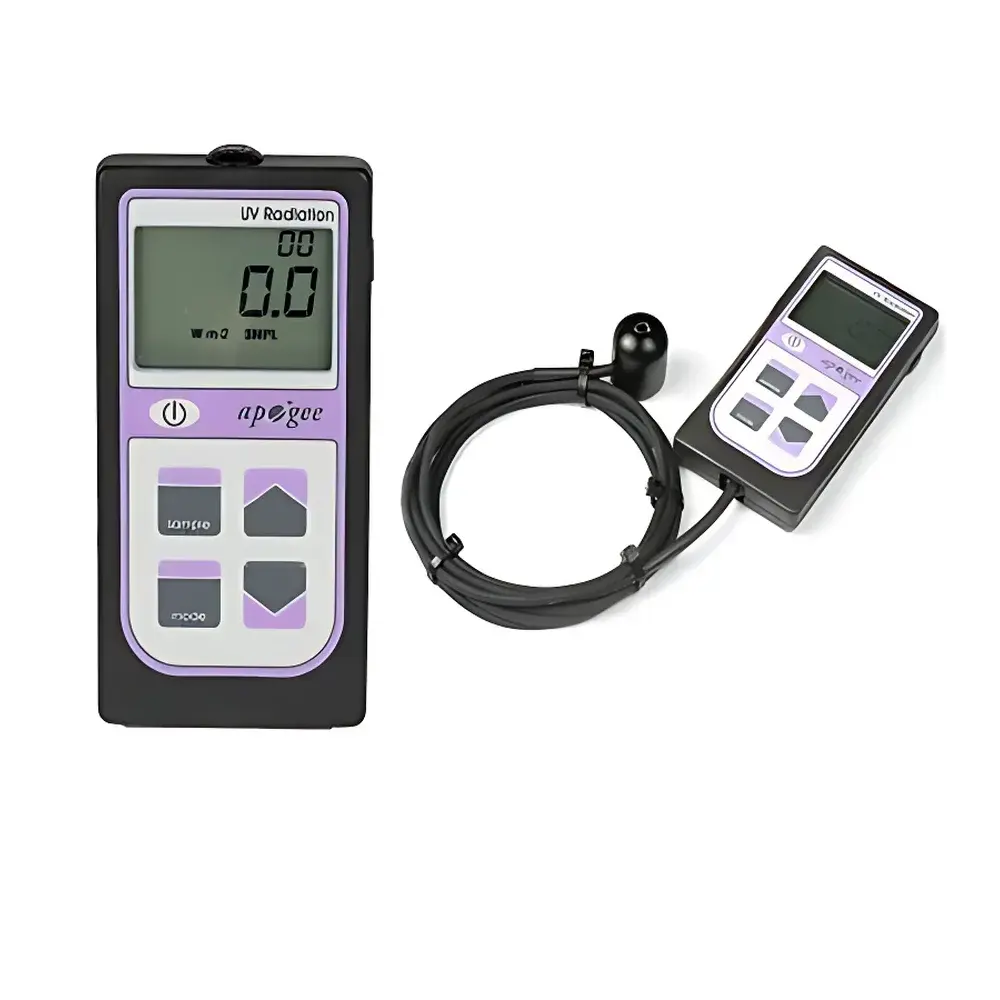
Apogee MU-3414F Handheld UV Radiometer
| Origin | Netherlands |
|---|---|
| Manufacturer Type | Distributor |
| Origin Category | Imported |
| Model | 3414F |
| Pricing | Upon Request |
| Spectral Range | 250–400 nm |
| UVA Range | 315–400 nm |
| UVB Range | 280–315 nm |
| Measurement Units | μmol·m⁻²·s⁻¹ and W·m⁻² |
| Full-Scale Range | 0–200.0 μmol·m⁻²·s⁻¹ |
| Display | Backlit LCD |
| Probe Design | Detachable, IP67-rated waterproof sensor |
| Data Logging | Internal memory with timestamped storage |
| Compliance | ASTM E308, ISO/CIE spectral irradiance standards (CIE S 014/E:2006), NIST-traceable calibration |
Overview
The Apogee MU-3414F Handheld UV Radiometer is a field-deployable optical instrument engineered for quantitative measurement of biologically relevant ultraviolet radiation in agricultural and horticultural environments. It operates on the principle of spectrally filtered photodiode detection, optimized to respond across the 250–400 nm wavelength band—encompassing both UVB (280–315 nm) and UVA (315–400 nm) regions. Unlike broadband radiometers with uncorrected spectral response, the MU-3414F incorporates optical interference filters and cosine-corrected diffusers calibrated to match the CIE erythemal action spectrum and plant photomorphogenic weighting functions. Its design enables direct quantification of photosynthetically active ultraviolet photon flux density (PPFDUV) in μmol·m⁻²·s⁻¹—a unit critical for assessing UV-driven physiological responses such as flavonoid synthesis, stomatal regulation, and photomorphogenesis in controlled-environment agriculture.
Key Features
- Detachable, IP67-rated probe with integrated cosine corrector for angular response compliance per ISO 9060:2018 Class C specifications
- Simultaneous dual-unit output: irradiance (W·m⁻²) and photosynthetic photon flux density (μmol·m⁻²·s⁻¹) for cross-domain data interpretation
- Backlit monochrome LCD with real-time numeric display, auto-ranging, and configurable averaging intervals (1–60 s)
- Onboard non-volatile memory storing up to 10,000 timestamped readings with UTC synchronization via USB interface
- NIST-traceable factory calibration certificate included; optional annual recalibration service aligned with ISO/IEC 17025-accredited laboratories
- Battery-powered operation (4 × AA alkaline, >200 hours continuous use) with low-battery indicator and automatic sleep mode
Sample Compatibility & Compliance
The MU-3414F is validated for use under natural solar irradiance, electric light sources (including fluorescent UV-B lamps, LED-based horticultural fixtures, and germicidal UVC-emitting systems operating above 250 nm), and semi-transparent transmission media such as greenhouse glazing and shade nets. Its spectral responsivity meets the requirements of ASTM E308-22 for spectral irradiance measurement and conforms to the CIE S 014/E:2006 reference action spectra for plant UV-B photoreception. The device supports Good Laboratory Practice (GLP) workflows through audit-ready metadata logging—including operator ID, location tags (via optional Bluetooth GPS module), and environmental ambient temperature compensation (−10 °C to 50 °C operating range). All firmware and calibration files comply with FDA 21 CFR Part 11 electronic record integrity requirements when used with Apogee’s Loggix software suite.
Software & Data Management
Data retrieval and post-processing are enabled via USB-C connection to Windows/macOS platforms using Apogee Loggix v4.2 software. This application provides automated calibration coefficient application, spectral weighting function selection (e.g., UV-B biologically effective dose, UV-A photolysis rate modeling), and export to CSV, Excel, or NetCDF formats compatible with MATLAB, R, and Python-based agronomic modeling pipelines. Raw sensor voltage outputs are accessible for custom algorithm integration. Firmware updates preserve historical calibration traceability, and all logged datasets include embedded hash signatures to ensure data integrity during regulatory audits.
Applications
- Quantifying UV transmission loss through polycarbonate, ETFE, and glass greenhouse coverings to optimize spectral filtering strategies
- Validating UV dosage thresholds for pathogen suppression in hydroponic nutrient film technique (NFT) systems
- Correlating ambient UV-B flux with anthocyanin accumulation kinetics in high-value specialty crops (e.g., red lettuce, purple basil)
- Calibrating UV-emitting supplemental lighting arrays in vertical farms against ISO 21348 space environment irradiance benchmarks
- Field validation of radiative transfer models simulating canopy-level UV exposure under variable cloud cover and aerosol loading
FAQ
Is the MU-3414F suitable for measuring germicidal UVC (200–280 nm)?
No—the detector’s spectral cutoff begins at 250 nm and exhibits negligible responsivity below this threshold; dedicated UVC radiometers with silicon carbide photodiodes are required.
Can the probe be submerged for aquatic UV monitoring?
The probe is IP67 rated for temporary immersion up to 1 m for 30 minutes, but prolonged submersion or pressure cycling may compromise long-term seal integrity.
Does the instrument require external power for data logging?
No—all functions—including memory writing, timekeeping, and display illumination—are powered exclusively by internal AA batteries.
How often should calibration be verified in high-UV-exposure environments?
Annual verification is recommended; however, users conducting critical UV stress trials should perform quarterly checks using a secondary NIST-traceable reference source.
Is spectral mismatch error corrected in firmware?
Yes—built-in spectral correction algorithms compensate for deviations from ideal CIE UV-B weighting curves based on factory-measured quantum efficiency profiles.





