
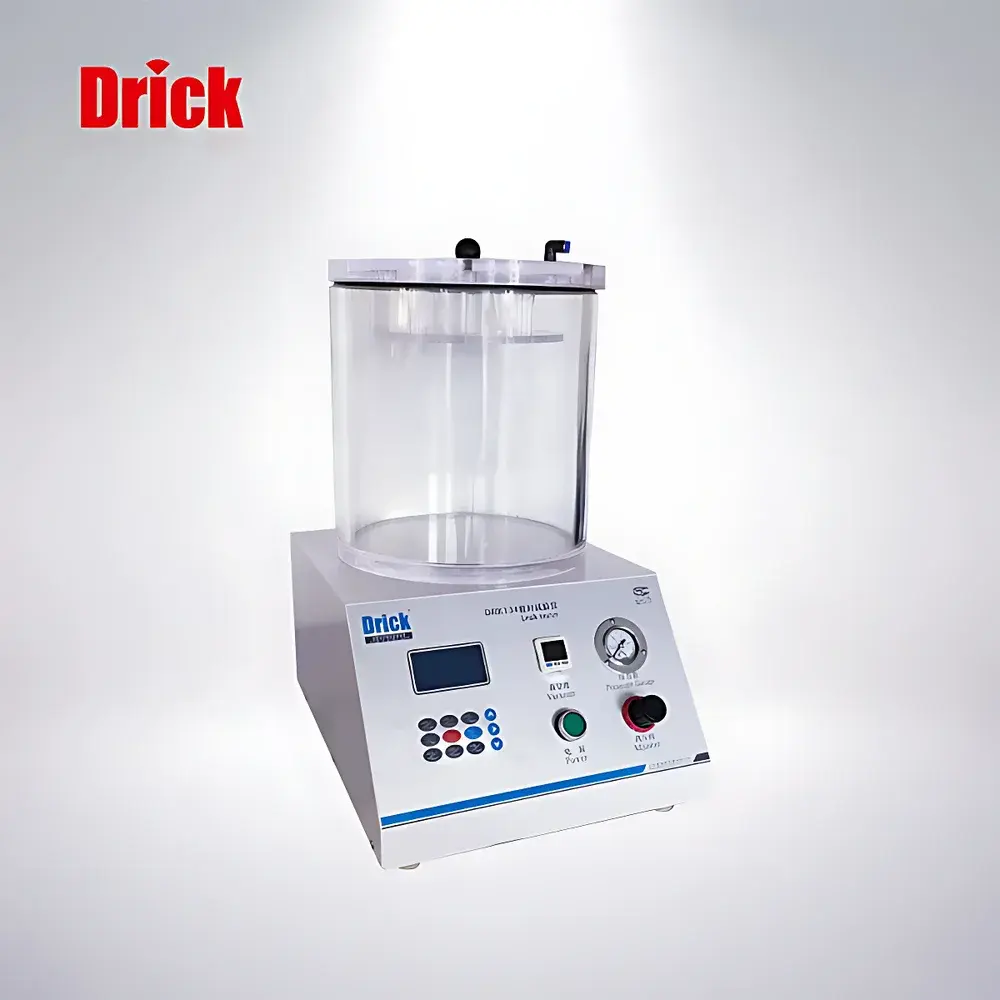
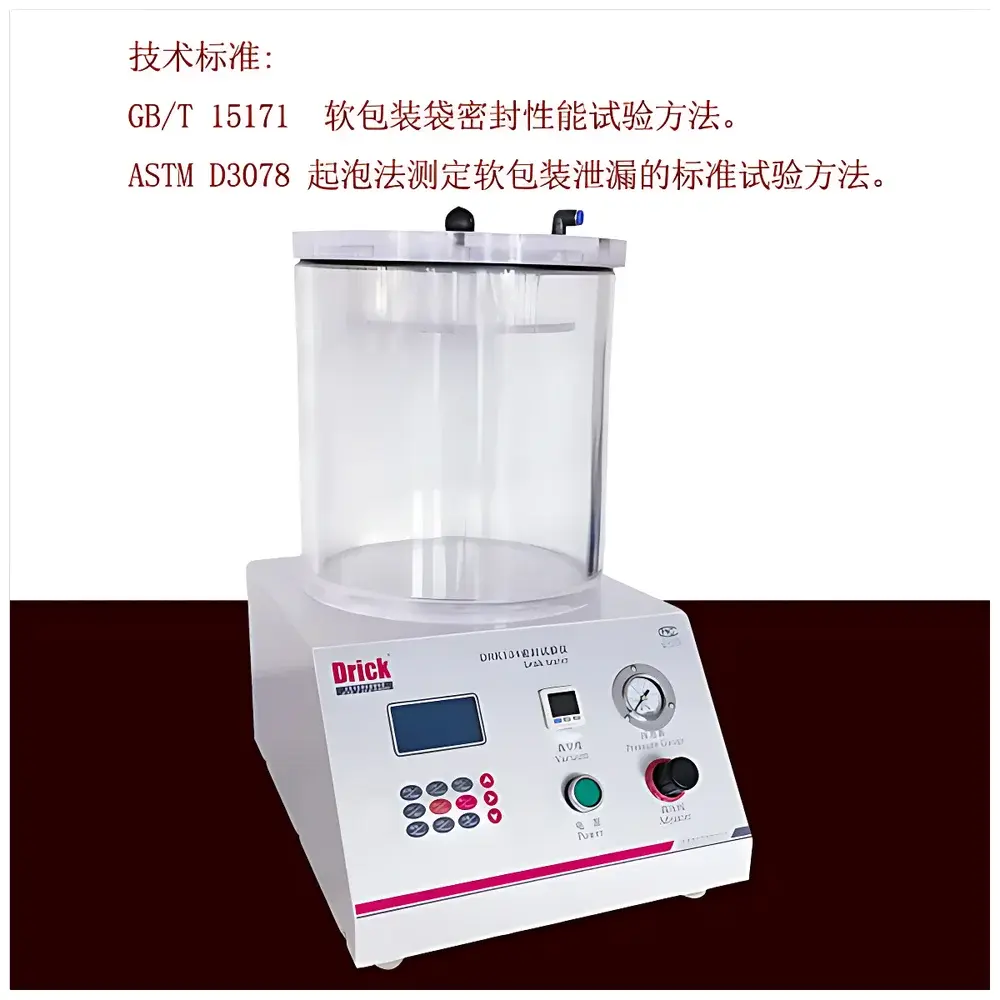
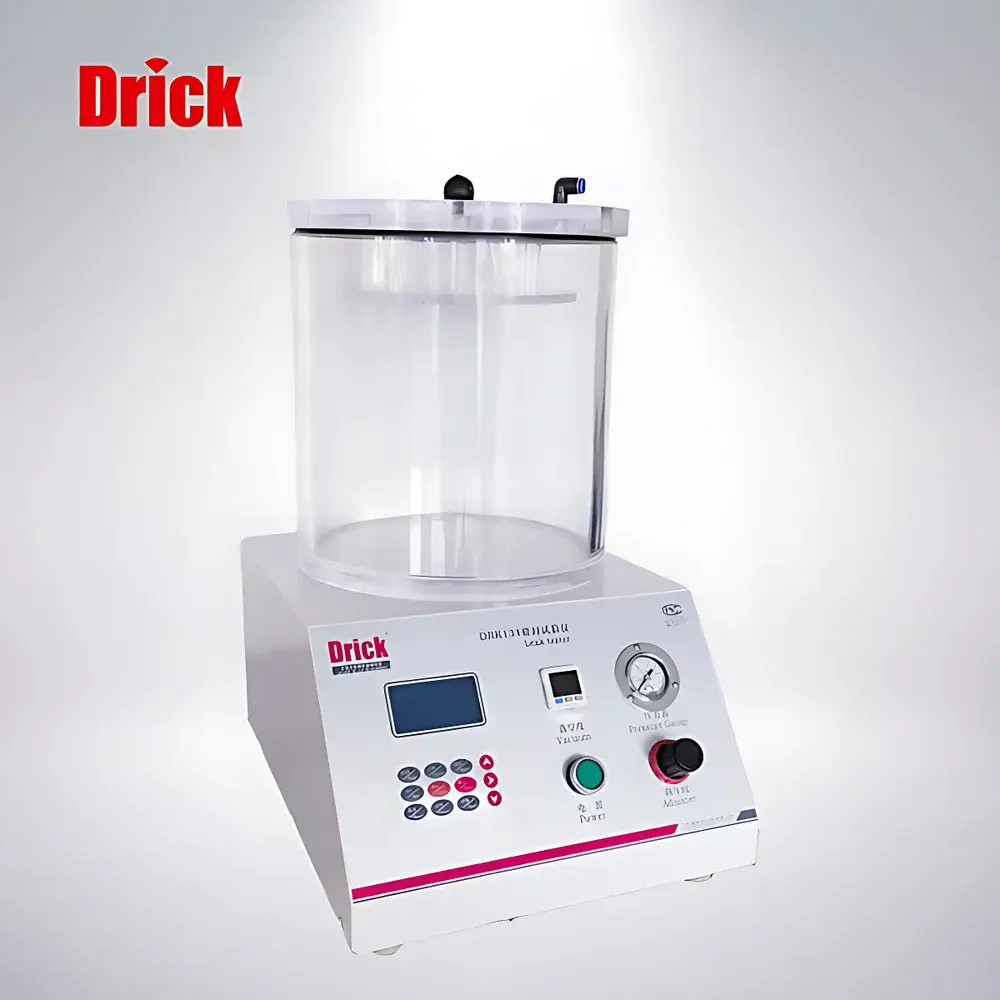
Drick DRK134 Yili Milk Pouch Seal Integrity Tester
| Brand | Drick |
|---|---|
| Origin | Shandong, China |
| Manufacturer Type | Direct Manufacturer |
| Product Category | Domestic Instrument |
| Model | DRK134 |
| Vacuum Range | 0 to –90 kPa |
| Vacuum Chamber Dimensions (Standard) | Φ270 mm × 210 mm (H) |
| Optional Chambers | Φ360 mm × 585 mm (H), Φ460 mm × 330 mm (H) |
| Air Supply Pressure | 0.7 MPa (user-supplied) |
| Air Inlet Fitting | Φ8 mm Polyurethane Tubing |
| Overall Dimensions | 300 mm (L) × 380 mm (B) × 450 mm (H) |
| Power Supply | AC 220 V ±5%, 50 Hz |
| Net Weight | ~12 kg |
| Accuracy Class | Class 1 |
| Compliant Standards | GB/T 15171, ASTM D3078 |
Overview
The Drick DRK134 Yili Milk Pouch Seal Integrity Tester is a precision-engineered vacuum decay-based instrument designed for non-destructive, quantitative assessment of seal integrity in flexible packaging—particularly laminated polyethylene, aluminum foil, and multilayer coextruded pouches used for ultra-high-temperature (UHT) processed dairy products such as Yili-brand milk. It operates on the principle of controlled vacuum application within a sealed test chamber, followed by real-time monitoring of pressure stabilization or deviation over time. A measurable rise in chamber pressure during the hold phase indicates micro-leakage at seal interfaces, heat-sealed edges, or material defects—enabling objective pass/fail evaluation per internationally recognized leakage detection protocols. The system meets the physical measurement requirements of GB/T 15171–1994 “Test Method for Seal Integrity of Flexible Package” and ASTM D3078–22 “Standard Test Method for Determination of Leaks in Flexible Packaging by Bubble Emission,” supporting both vacuum bubble emission and pressure decay modalities depending on chamber configuration and operator selection.
Key Features
- Class 1 accuracy certified vacuum generation and measurement system, calibrated traceable to national metrological standards
- Dual-mode operation: supports both visual bubble emission inspection (with transparent chamber option) and quantitative vacuum decay analysis
- Modular vacuum chamber design with three standardized configurations (Φ270×210 mm standard; optional Φ360×585 mm and Φ460×330 mm) for varying pouch dimensions and stacking requirements
- Integrated analog vacuum gauge with dual-scale reading (kPa and inHg) for immediate operator verification independent of digital interface
- Robust mechanical architecture featuring stainless steel frame, corrosion-resistant aluminum alloy chamber housing, and reinforced silicone gasket sealing system
- Plug-and-play pneumatic interface compliant with ISO 8573-1 Class 4 compressed air quality requirements (0.7 MPa nominal supply pressure)
- Compact footprint (300 × 380 × 450 mm) optimized for QC laboratory benchtop deployment without dedicated utility infrastructure
Sample Compatibility & Compliance
The DRK134 accommodates a wide range of soft-packaged food and pharmaceutical unit-dose formats, including stand-up pouches, pillow packs, spouted bags, and gusseted sachets up to 300 mm in width and 250 mm in height (within standard chamber). It is routinely deployed for post-fill, post-seal, and shelf-life stability validation in dairy processing facilities adhering to HACCP and ISO 22000 frameworks. Regulatory alignment includes full technical compatibility with GB/T 15171, ASTM D3078, and supplementary guidance from USP “Packaging Integrity Evaluation” for sterile and non-sterile product containers. While not intrinsically 21 CFR Part 11 compliant, the device supports audit-ready documentation when integrated into validated workflows with external electronic lab notebooks (ELN) or LIMS systems that enforce user authentication, electronic signatures, and change control.
Software & Data Management
The DRK134 operates as a standalone hardware platform with manual parameter setting and analog readout. No embedded firmware or proprietary software is included; all operational logic is implemented via electro-mechanical controls and calibrated analog instrumentation. This architecture eliminates cybersecurity vulnerabilities associated with networked devices and ensures long-term operational continuity without software updates or license dependencies. Test records—including vacuum setpoint, dwell time, observed pressure drift, and pass/fail determination—are documented manually in paper-based or LIMS-integrated logbooks. For laboratories requiring digital data capture, third-party pressure data loggers (e.g., Omega DP25B series) may be connected via the 0–10 V analog output port (optional accessory) to enable time-stamped trend recording and statistical process control (SPC) charting in accordance with ISO 9001 clause 8.5.2.
Applications
- Final seal validation for UHT milk pouches prior to palletization and distribution
- In-process verification of heat seal parameters (temperature, dwell time, pressure) on vertical form-fill-seal (VFFS) lines
- Root cause analysis of field complaints related to package bloating, moisture ingress, or microbial spoilage
- Comparative evaluation of alternative sealant materials or adhesive formulations
- Stability testing under accelerated aging conditions (e.g., 40°C/75% RH for 14 days) followed by seal integrity retest
- Supplier qualification audits for contract packaging organizations serving dairy OEMs
FAQ
What compressed air specifications are required for operation?
A clean, dry, oil-free air supply at 0.7 MPa (±0.05 MPa) is mandatory. Users must provide an ISO 8573-1 Class 4-compliant source; moisture traps and particulate filters are strongly recommended upstream of the Φ8 mm polyurethane tubing connection.
Can the DRK134 detect leaks smaller than 50 µm in diameter?
Under controlled ambient conditions and using the standard chamber with ≥60-second dwell time, the system reliably identifies leaks ≥75 µm in equivalent hydraulic diameter per ASTM D3078 sensitivity thresholds. Detection of sub-50 µm defects requires complementary methods such as helium mass spectrometry or dye penetration.
Is calibration certification included with shipment?
Yes—a factory-issued calibration report traceable to CNAS-accredited reference standards is supplied with each unit, covering vacuum gauge linearity, pressure decay repeatability (n=5 at –70 kPa), and chamber leak rate verification (<0.1 kPa/min at –90 kPa).
Does the instrument support automated reporting or CSV export?
No. The DRK134 is a manually operated analog instrument. Digital data acquisition requires integration with external logging hardware and compatible software platforms.
What maintenance intervals are recommended?
Silicone chamber gaskets should be inspected before each shift and replaced every 12 months or after 5,000 cycles. Vacuum pump oil (if equipped with optional rotary vane pump) requires replacement every 2,000 operating hours per manufacturer specifications.






