
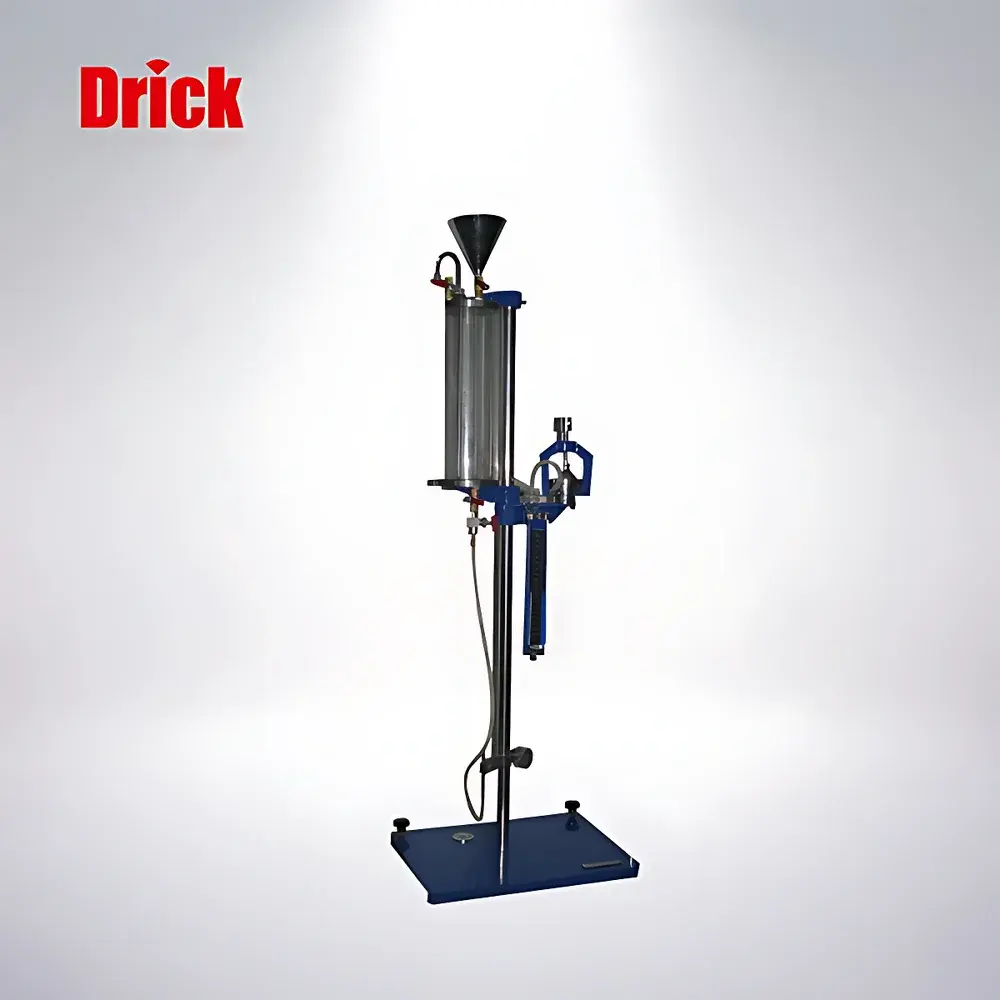
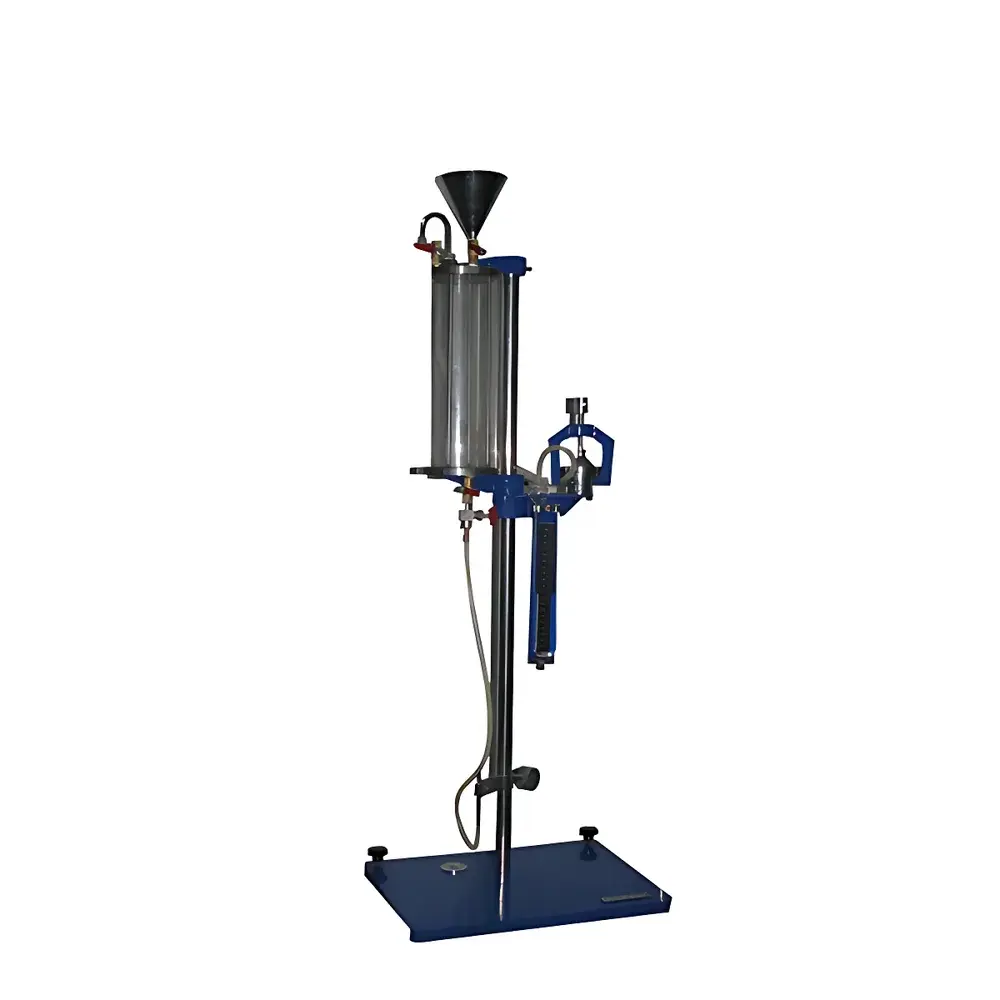
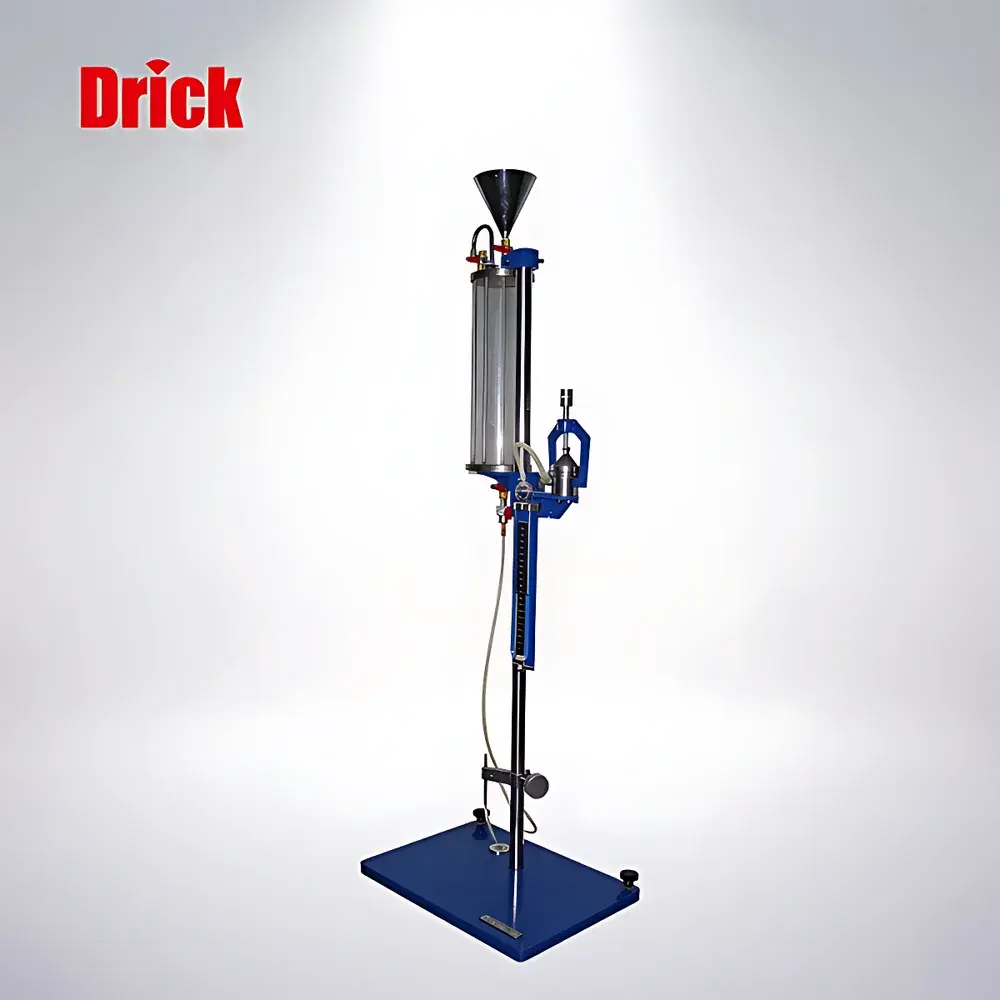
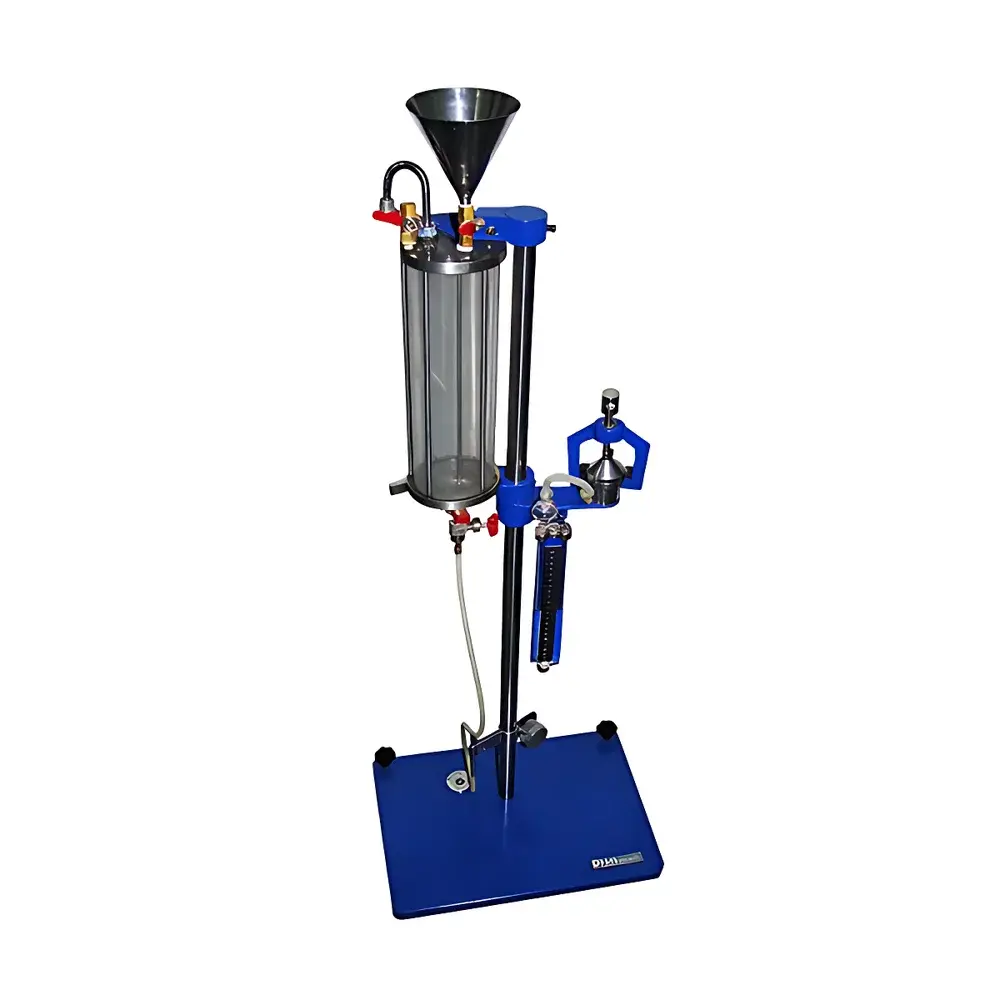
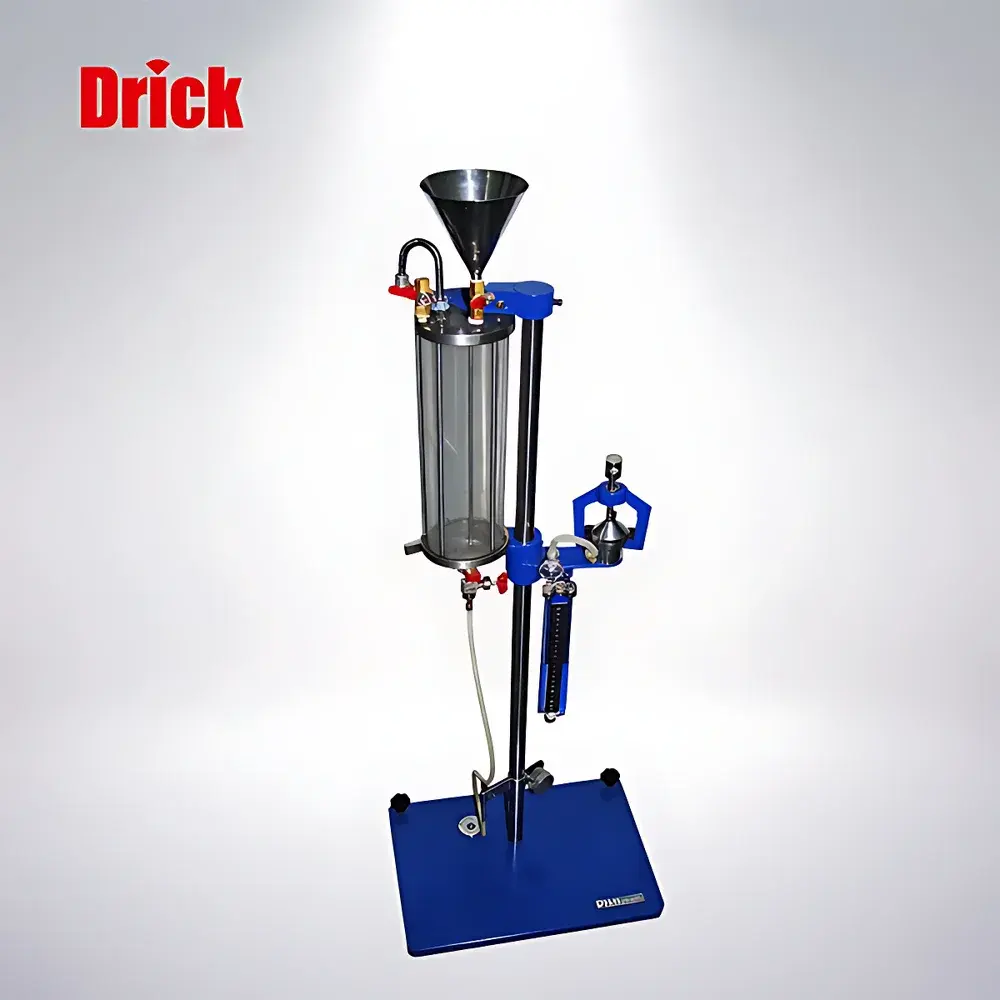
Drick DRK121 Cement Bag Paper Air Permeability Tester
| Brand | Drick |
|---|---|
| Origin | Shandong, China |
| Manufacturer Type | Direct Manufacturer |
| Country of Origin | China |
| Model | DRK121 |
| Price Range | USD 1,400 – 4,200 |
| Measurement Range | 0–17 µm/(Pa·s) |
| Test Area | 10.0 ± 0.05 cm² |
| Pressure Differential | 1.00 ± 0.01 kPa |
| Sample Size | 60 × 100 mm |
| Clamp Coaxiality Tolerance | ≤ 0.05 mm |
| Dimensions (W×D×H) | 350 × 250 × 1160 mm |
| Weight | ~32 kg |
| Operating Environment | 20 ± 10 °C, clean ambient air, stable bench-mounted installation |
Overview
The Drick DRK121 Cement Bag Paper Air Permeability Tester is a precision-engineered instrument designed specifically for the quantitative evaluation of air permeance in industrial paper substrates used in high-demand packaging and filtration applications. It operates on the principle of standardized differential-pressure airflow measurement—applying a controlled, constant pressure differential (1.00 ± 0.01 kPa) across a defined test area (10.0 ± 0.05 cm²) and measuring the volumetric flow rate of air passing through the specimen under steady-state conditions. The resulting permeance value is expressed in micrometers per pascal-second (µm/(Pa·s)), a unit directly traceable to ISO 5636-2:2013 and GB/T 458–2008 (the updated revision of GB/T 458–1989). This method—commonly referred to as the “Shopper” or “Gurley-type” principle—ensures high reproducibility across laboratories when calibrated and operated per established procedural rigor. The DRK121 is optimized for papers with relatively smooth surfaces and moderate to high permeability, including cement sack paper, multi-wall bag stock, cable wrapping paper, carbon copy paper, and industrial filter media. Its design excludes highly textured or heavily calendered grades where edge leakage or non-uniform flow paths compromise measurement fidelity.
Key Features
- Compliant dual-standard architecture supporting QB/T 1667–1998, GB/T 458–2008, ISO 5636-2:2013, and QB/T 1670–1992 test protocols
- Precision-machined concentric clamping system with ≤0.05 mm coaxiality tolerance to eliminate sealing gaps and ensure uniform pressure distribution
- Stable 1.00 ± 0.01 kPa regulated differential pressure source, independently verified via calibrated digital manometer
- Dedicated 10.0 ± 0.05 cm² test orifice with hardened stainless-steel aperture plate for long-term dimensional stability
- Manual volumetric collection mode with dual-range accuracy: ±1 mL for volumes <100 mL; ±5 mL for volumes ≥100 mL
- Robust aluminum-alloy frame and vibration-damped base, enabling reliable operation on standard laboratory benches without active isolation
- Compact footprint (350 × 250 × 1160 mm) and modular assembly for ease of transport and integration into QC workflows
Sample Compatibility & Compliance
The DRK121 is validated for use with flat, non-porous or semi-porous paper specimens meeting the surface smoothness requirements of ISO 5636-2. It accommodates standard sample dimensions of 60 × 100 mm—compatible with routine sampling from roll stock or sheet lots. Excluded materials include embossed, creped, laminated, or fiber-flocked papers where surface topography exceeds allowable deviation thresholds for laminar flow assumption. All test procedures align with Good Laboratory Practice (GLP) documentation requirements, and raw data (time, volume, ambient temperature, barometric pressure) are recorded manually in accordance with audit-ready recordkeeping practices. While the instrument itself does not incorporate electronic data logging, its mechanical design supports full traceability when used within FDA 21 CFR Part 11–compliant quality systems via controlled logbooks and operator sign-offs.
Software & Data Management
The DRK121 is a fully manual, analog-operated permeability tester with no embedded microprocessor or digital interface. Data acquisition relies on stopwatch timing and calibrated glass burette or graduated cylinder readings—methods explicitly endorsed in ISO 5636-2 Annex A and GB/T 458–2008 Section 6.2. This architecture eliminates firmware validation burdens and ensures compatibility with legacy QA/QC environments where software qualification is impractical. Users calculate permeance using the formula: K = (V × t × P) / (A × Δp), where V = measured air volume (mL), t = elapsed time (s), P = atmospheric pressure (kPa), A = test area (cm²), and Δp = applied pressure differential (kPa). Supporting calculation worksheets and uncertainty propagation templates are provided in the operator manual to facilitate ISO/IEC 17025-compliant uncertainty budgeting.
Applications
This instrument serves critical quality control functions across cement packaging manufacturing, specialty paper production, and industrial filtration component suppliers. In cement sack production, consistent permeance ensures optimal dust containment during filling and handling while permitting sufficient breathability to prevent moisture entrapment and bag degradation. Cable paper manufacturers rely on DRK121 measurements to verify barrier integrity against environmental ingress without compromising dielectric performance. Copy paper producers use it to monitor coating uniformity and calendering effectiveness. Filter paper vendors apply it as an intermediate release test prior to full-scale DOP or sodium flame testing. Its fixed-pressure, fixed-area methodology delivers inter-laboratory comparability essential for supplier qualification programs governed by ASTM D726, ISO 5636, and EN 20563.
FAQ
What standards does the DRK121 comply with?
It conforms to QB/T 1667–1998, GB/T 458–2008, ISO 5636-2:2013, and QB/T 1670–1992.
Can the DRK121 test corrugated board or coated composites?
No—it is restricted to single-layer, planar paper specimens with low surface roughness; structured or laminated materials invalidate laminar flow assumptions.
Is calibration certification included?
The instrument ships with factory verification of clamp geometry, pressure regulation, and orifice area; NIST-traceable calibration certificates for auxiliary tools (manometer, stopwatch, burette) must be obtained separately per lab SOP.
What maintenance is required?
Routine cleaning of clamping surfaces and orifice plate with lint-free cloth and isopropyl alcohol; annual verification of pressure regulator output and orifice dimensional stability is recommended.
Does the DRK121 support automated data export?
No—it is a manual measurement system; all data entry, calculation, and reporting are performed externally using lab-defined templates.






