MAEC-18 Meat Water-Holding Capacity Analyzer
| Origin | Jiangsu, China |
|---|---|
| Manufacturer Type | Authorized Distributor |
| Origin Category | Domestic (PRC) |
| Model | MAEC-18 |
| Price Range | USD 1,400 – 7,200 |
| Measurement Range | 0–1000 N (0–100 kgf) |
| Resolution | 0.1 N (0.01 kgf) |
| Accuracy | ±1% FS |
| Test Speed | 1–100 mm/min |
| Return Speed | 1–100 mm/min |
| Parallelism of Compression Plates | <0.05 mm |
| Compression Duration | 1–3600 s |
| Deformation Range | 1–70 mm |
| Max. Plate Separation | ≥70 mm |
| Dimensions (L×W×H) | 290 × 303 × 392 mm |
| Weight | ~30 kg |
| Power Supply | AC 110–240 V, 50 Hz |
Overview
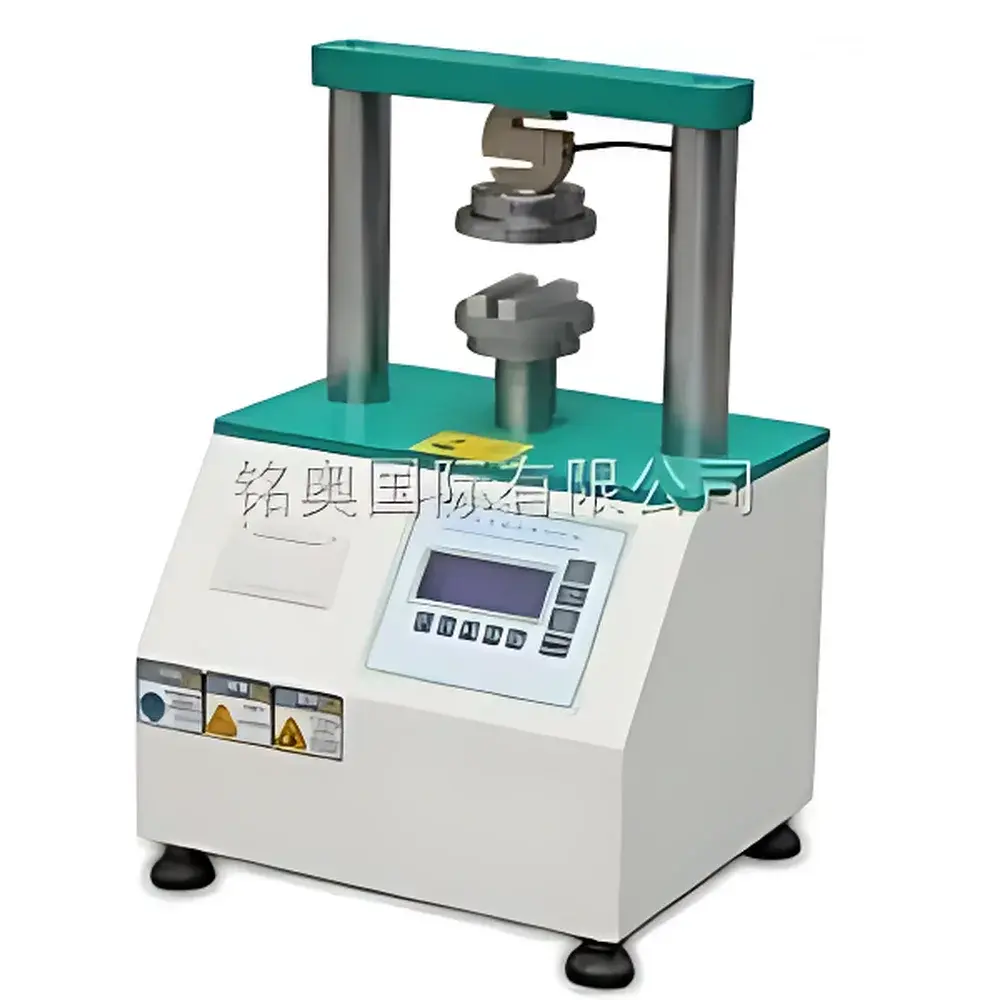
The MAEC-18 Meat Water-Holding Capacity (WHC) Analyzer is an engineered mechanical compression instrument designed for standardized quantitative assessment of water retention in fresh and processed meat tissues. It operates on the principle of controlled uniaxial compression—applying a precisely regulated force to a cylindrical meat sample placed between parallel stainless-steel plates—and measuring the expressed fluid volume or mass loss under defined load, dwell time, and deformation parameters. WHC is a critical functional property directly correlated with post-mortem pH decline kinetics, myofibrillar protein conformational stability, and sarcomere integrity. As such, this analyzer supports objective evaluation of meat quality attributes including tenderness, juiciness, processing yield (e.g., curing uptake, cooking loss), and shelf-life stability. The device complies with widely adopted empirical protocols—including the Chinese National Standard GB/T 9695.15–2008 (Meat and Meat Products—Determination of Water-Holding Capacity) and aligns methodologically with ASTM E2771–22 (Standard Guide for Sensory Evaluation of Meat and Poultry), enabling traceable, inter-laboratory comparable data generation in food science, quality assurance, and regulatory verification contexts.
Key Features
- High-accuracy load cell calibrated to ≤±0.5% full-scale error at factory—exceeding ISO 7500-1 Class 1 requirements (±1%) for static force measurement.
- Precision-ground ball-screw actuation system ensures repeatable displacement control and minimal hysteresis across the full 1–100 mm/min test speed range.
- Corrosion-resistant 304 stainless-steel compression plates with <0.05 mm parallelism tolerance guarantee uniform stress distribution and eliminate edge-effect bias during sample deformation.
- Integrated 7-inch capacitive touchscreen interface with multilingual firmware (English default), supporting programmable test profiles: user-defined force setpoints, dwell durations (1–3600 s), target deformation limits (1–70 mm), and automatic termination logic.
- Onboard statistical engine computes WHC (%) per ASTM/GB methodology: WHC (%) = [(Winitial − Wexpressed) / Winitial] × 100, where Winitial is pre-compression sample mass and Wexpressed is mass loss after controlled pressure application.
- Thermal-stable aluminum chassis and reinforced structural frame ensure long-term dimensional stability under continuous laboratory use conditions.
Sample Compatibility & Compliance
The MAEC-18 accommodates standard cylindrical meat specimens (diameter: 15–25 mm; height: 10–20 mm), compatible with porcine longissimus dorsi, bovine semimembranosus, ovine m. biceps femoris, and poultry pectoralis major tissues. Sample preparation follows standardized trimming, equilibration (4°C, 24 h post-rigor), and moisture equilibrium protocols per ISO 2917:2021 (Meat—Determination of water-holding capacity by centrifugation method—Reference method). While the instrument itself is not certified to GLP or GMP, its measurement outputs are fully auditable and support compliance with HACCP prerequisite programs, BRCGS Food Safety Issue 9 (Section 4.9.3), and IFS Food v7 (Clause 4.12.2) when integrated into documented QC workflows. Data export formats (CSV, PDF) facilitate alignment with FDA 21 CFR Part 11–compliant LIMS environments when paired with validated third-party software.
Software & Data Management
The embedded firmware provides real-time force-displacement curve visualization, auto-saves raw test data (timestamp, operator ID, sample ID, load history, final mass loss) to internal flash memory (≥10,000 records), and enables USB export to external storage. Optional PC-based analysis suite (sold separately) extends functionality with batch statistical reporting (mean, SD, CV%, outlier detection per Grubbs’ test), trend charting across production lots, and customizable report templates compliant with ISO/IEC 17025 documentation requirements. Audit trails record all parameter modifications, calibration events, and user logins—supporting laboratory accreditation readiness.
Applications
- Quantitative comparison of WHC across genetic lines, feeding regimens, and pre-slaughter handling variables.
- Validation of antemortem interventions (e.g., dietary electrolyte modulation, stunning method optimization) on post-rigor water-binding kinetics.
- QC release testing for raw material acceptance in sausage, ham, and restructured meat manufacturing.
- Stability monitoring of frozen/thawed meat batches to detect freeze-thaw-induced myofibrillar damage.
- Method development and cross-validation against alternative WHC assays (centrifugation, filter paper press, NMR relaxometry).
- Academic research in muscle biochemistry, relating WHC to troponin-T degradation patterns, calpain activity, and sarcoplasmic reticulum Ca²⁺-ATPase function.
FAQ
What standards does the MAEC-18 comply with for WHC testing?
It implements test logic consistent with GB/T 9695.15–2008 and methodologically parallels ISO 2917:2021, though formal certification is lab-specific and requires independent validation per ISO/IEC 17025.
Can the instrument measure WHC without requiring sample weighing before and after compression?
No—gravimetric input remains essential. The device measures applied force and displacement; users must weigh samples pre- and post-test using an external analytical balance (0.001 g resolution recommended) to calculate WHC (%).
Is calibration traceable to national metrology institutes?
Yes—factory calibration uses NIST-traceable deadweight standards; annual recalibration with accredited providers is recommended to maintain ±1% accuracy.
Does the system support network connectivity or LIMS integration?
Native Ethernet/Wi-Fi is not included, but USB-host mode enables scripted data ingestion into LIMS via Python or LabVIEW drivers (available upon request).
What maintenance intervals are recommended for sustained accuracy?
Monthly visual inspection of plate surfaces and lubrication of ball-screw assembly; biannual load cell linearity verification; full mechanical recalibration every 12 months or after 5,000 test cycles.