
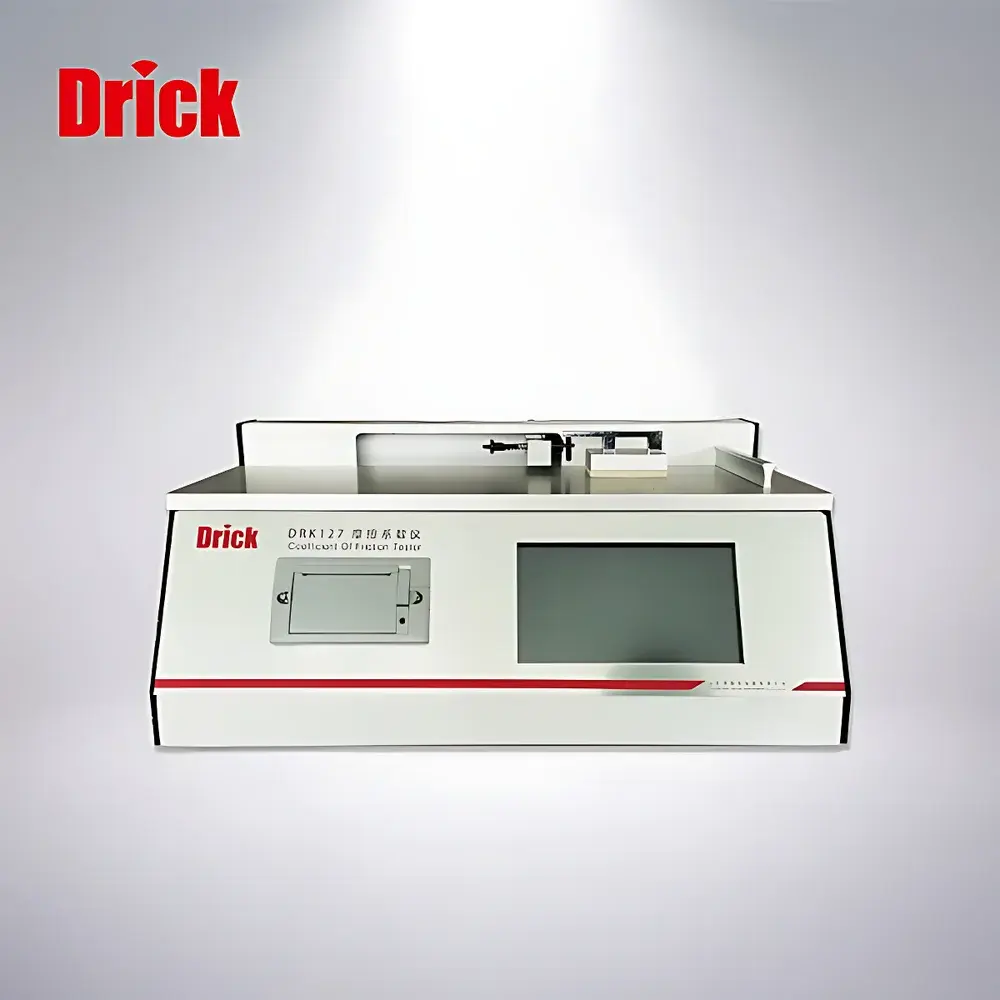
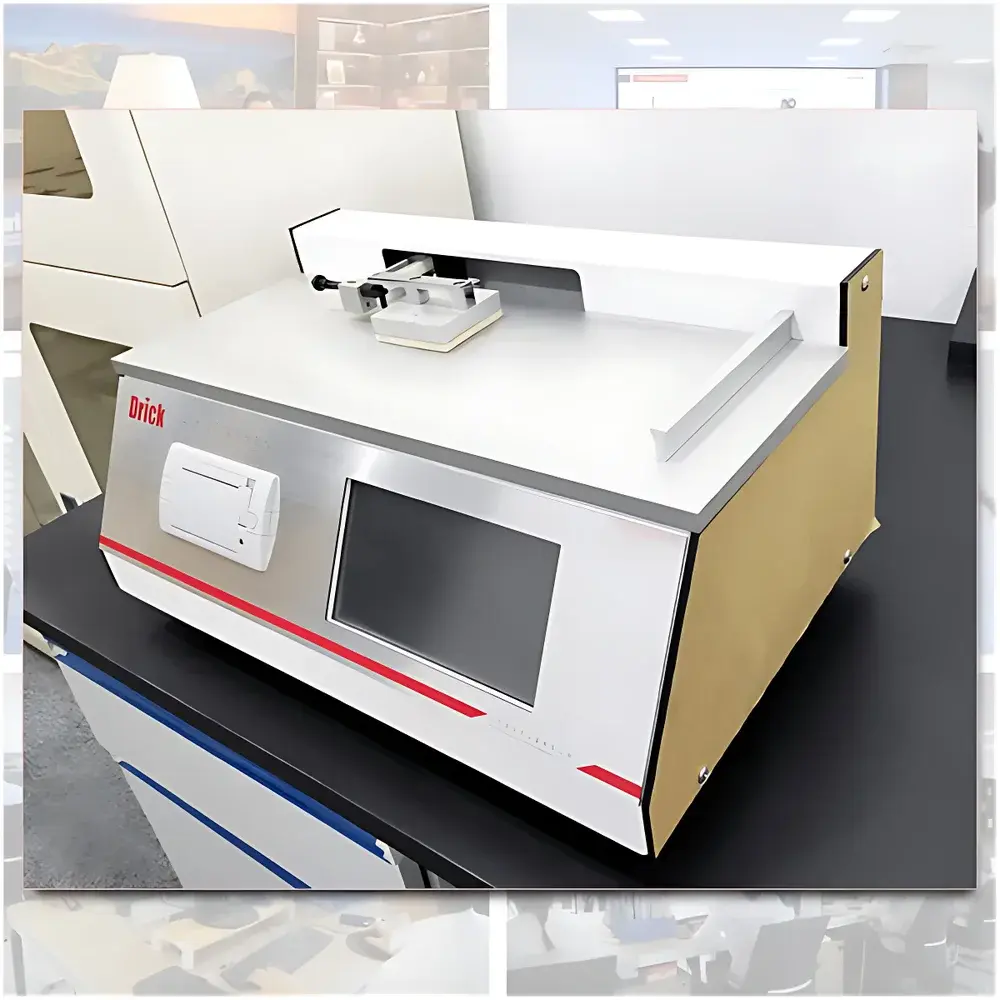
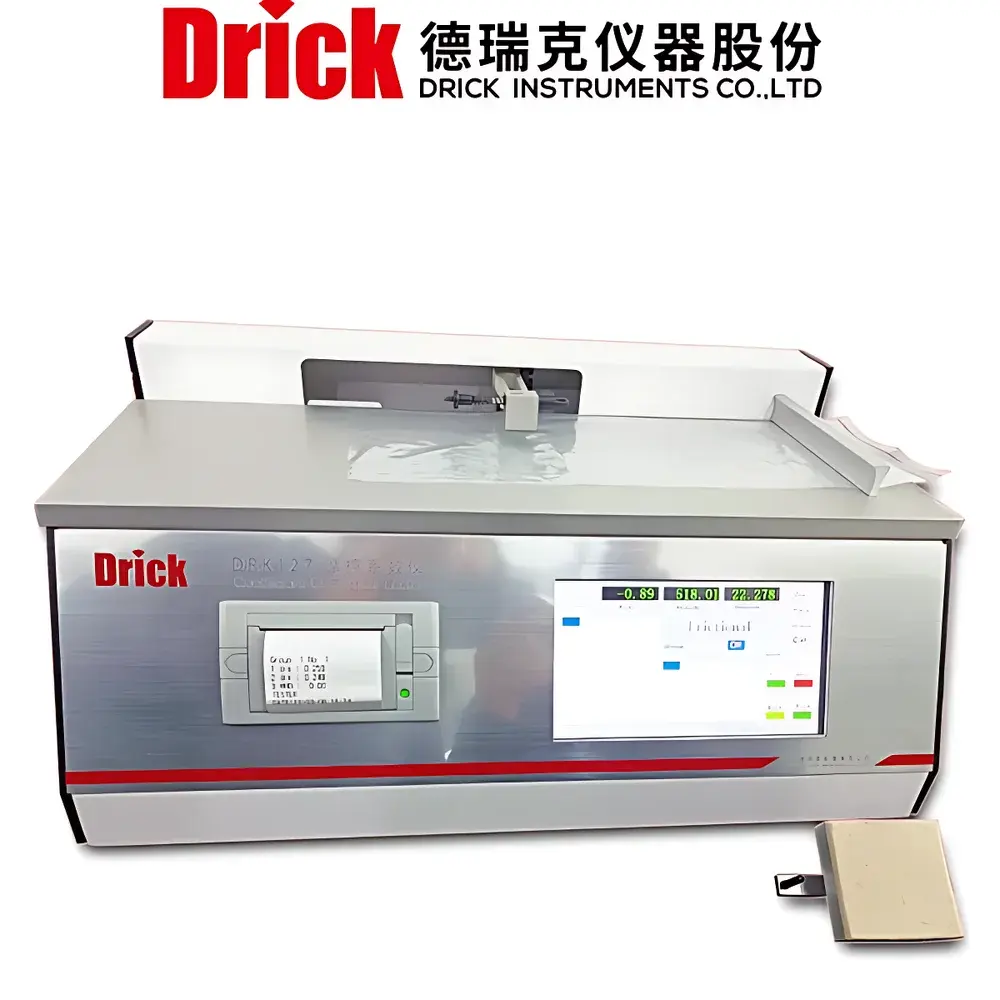
Drick DRK127 Coefficient of Friction Tester for Paper, Paperboard & Flexible Packaging Materials
| Brand | Drick |
|---|---|
| Origin | Shandong, China |
| Manufacturer Type | Direct Manufacturer |
| Country of Origin | China |
| Model | DRK127 |
| Load Range | 0–5 N (Accuracy Class 0.5) |
| Traverse Distance | 70 mm or 140 mm |
| Standard Sled Mass | 200 g |
| Test Speed | 150 mm/min |
| Ambient Operating Conditions | 15–30 °C, 20–80 % RH |
| Dimensions (L×W×H) | 470 × 300 × 190 mm |
| Net Weight | 20 kg |
| Compliance | GB 10006, GB/T 17200, ISO 8295, ASTM D1894, TAPPI T816 |
Overview
The Drick DRK127 Coefficient of Friction (COF) Tester is a precision-engineered instrument designed specifically for quantitative evaluation of static and kinetic friction behavior in planar, flexible materials used across packaging, papermaking, printing, and industrial manufacturing sectors. It operates on the fundamental principle of horizontal pull testing: a standardized sled is placed atop a stationary test specimen and drawn at a controlled linear velocity while force transducers continuously measure the peak (static) and sustained (kinetic) resistance to motion. This methodology conforms rigorously to internationally recognized tribological test protocols—including ASTM D1894 (Standard Test Method for Coefficient of Friction of Plastic Film and Sheeting), ISO 8295 (Plastics—Film and Sheeting—Determination of the Coefficients of Friction), and GB/T 10006 (Chinese national standard for plastic film and sheeting)—ensuring data traceability, inter-laboratory comparability, and regulatory acceptability in quality assurance workflows.
Key Features
- Simultaneous dual-mode measurement: automatic acquisition and differentiation of both static coefficient of friction (μs) and kinetic coefficient of friction (μk) within a single test cycle.
- Integrated microprocessor control with real-time digital display: LCD panel shows instantaneous force values (in Newtons), calculated μs and μk, elapsed dwell time prior to motion initiation, and test status indicators.
- Electromagnetically neutralized test platform and sled: all metallic contact surfaces undergo certified demagnetization and residual magnetism verification to eliminate spurious electromagnetic interference that may distort low-force tribological measurements.
- Programmable dwell timing: automatic countdown and trigger for static friction onset ensures consistent surface conditioning and eliminates operator-dependent variability in contact stabilization.
- Zero-point auto-calibration: dynamic reset of force baseline immediately before sled movement guarantees accurate separation of adhesion-related static peak from sliding resistance.
- RS-232 serial interface: enables bidirectional communication with external PCs for automated data logging, report generation, and integration into LIMS or QA documentation systems compliant with GLP/GMP requirements.
- Thermal and humidity-stable mechanical architecture: aluminum alloy frame, hardened steel guide rails, and precision-ground linear motion system ensure long-term repeatability under ambient lab conditions (15–30 °C, 20–80 % RH).
Sample Compatibility & Compliance
The DRK127 accommodates a broad spectrum of planar substrates up to 150 mm wide and 300 mm long, including but not limited to: paper grades (kraft, coated, uncoated), corrugated board, plastic films (LDPE, BOPP, PET, PVC), laminates, metallized foils, woven/nonwoven textiles, rubber sheets, conveyor belt materials, automotive interior trims, and medical device packaging substrates. Its design fully satisfies the dimensional, mass, and procedural stipulations outlined in ISO 8295 Annex A (200 g sled, 150 mm/min speed), ASTM D1894 Section 7 (standard sled mass and base plate preparation), and GB/T 17200 (electromechanical performance verification). Optional 500 g sleds are available for high-normal-force applications such as heavy-duty industrial belts or abrasive-coated composites—subject to recalibration per ISO/IEC 17025 metrological guidelines.
Software & Data Management
While the DRK127 operates autonomously via its embedded firmware, its RS-232 port supports connection to validated third-party data acquisition software compatible with Windows-based laboratory environments. Raw force-time datasets can be exported in CSV format for statistical analysis (e.g., mean μs/μk, standard deviation, confidence intervals) using tools such as Minitab, JMP, or Python-based SciPy workflows. The built-in thermal printer generates audit-ready reports containing test ID, date/time stamp, operator ID (manually entered), sample description, sled mass, traverse distance, measured forces, derived coefficients, and pass/fail status relative to internal specification limits. All printed outputs include unique sequential numbering for full document control under ISO 9001 and FDA 21 CFR Part 11–aligned electronic record retention policies.
Applications
This instrument serves critical functions in R&D laboratories, incoming material inspection (IQC), in-process quality control (IPQC), and final product release testing. Typical use cases include: optimizing slip agent concentration in extrusion coatings; verifying consistency of corona treatment efficacy on polyolefin films; validating anti-blocking performance of metallized pouches; assessing tactile “hand” properties of premium packaging boards; evaluating coefficient uniformity across roll-to-roll production batches; supporting root-cause analysis of jamming incidents in high-speed filling lines; and generating comparative COF profiles for regulatory submissions (e.g., USP <661>, EU Directive 2002/72/EC). Its adaptability extends to non-packaging domains—including characterization of ophthalmic solution viscosity effects on dropper tip glide, cosmetic cream spreadability on applicator surfaces, and brake pad–rotor interface modeling under simulated low-load conditions.
FAQ
What standards does the DRK127 comply with?
It meets the mechanical, procedural, and reporting requirements of GB 10006, GB/T 17200, ISO 8295, ASTM D1894, and TAPPI T816.
Can the instrument measure both static and kinetic friction in one test?
Yes—automated dwell timing and force threshold detection enable concurrent μs and μk determination without manual intervention.
Is calibration traceable to national standards?
Force transducer calibration is performed using NIST-traceable deadweight standards; annual verification is recommended per ISO/IEC 17025.
What environmental conditions are required for valid operation?
Ambient temperature must be maintained between 15 °C and 30 °C, with relative humidity between 20 % and 80 %, in accordance with ISO 291 conditioning protocols.
Are custom sled masses supported?
A 500 g sled is available as an optional accessory; users must validate test method equivalence when deviating from standard 200 g configuration per ASTM D1894 Section 10.
Related Products






