
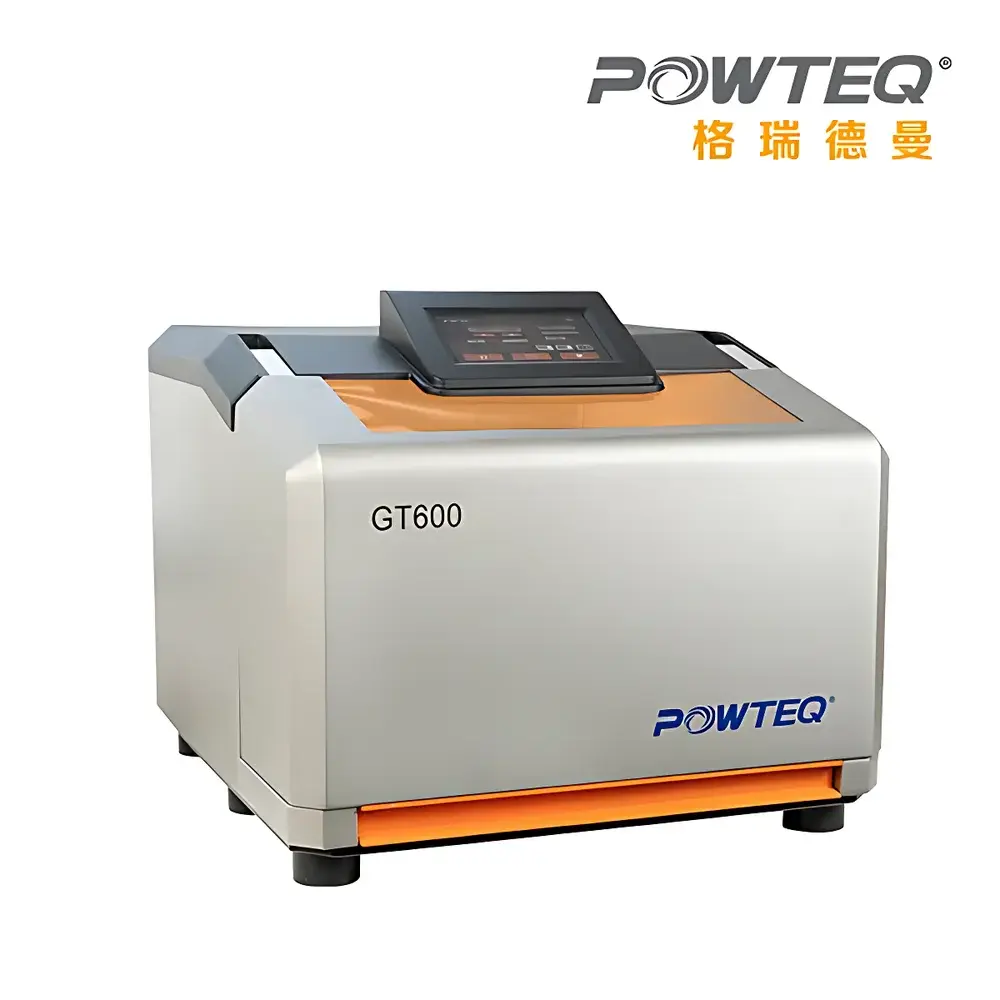
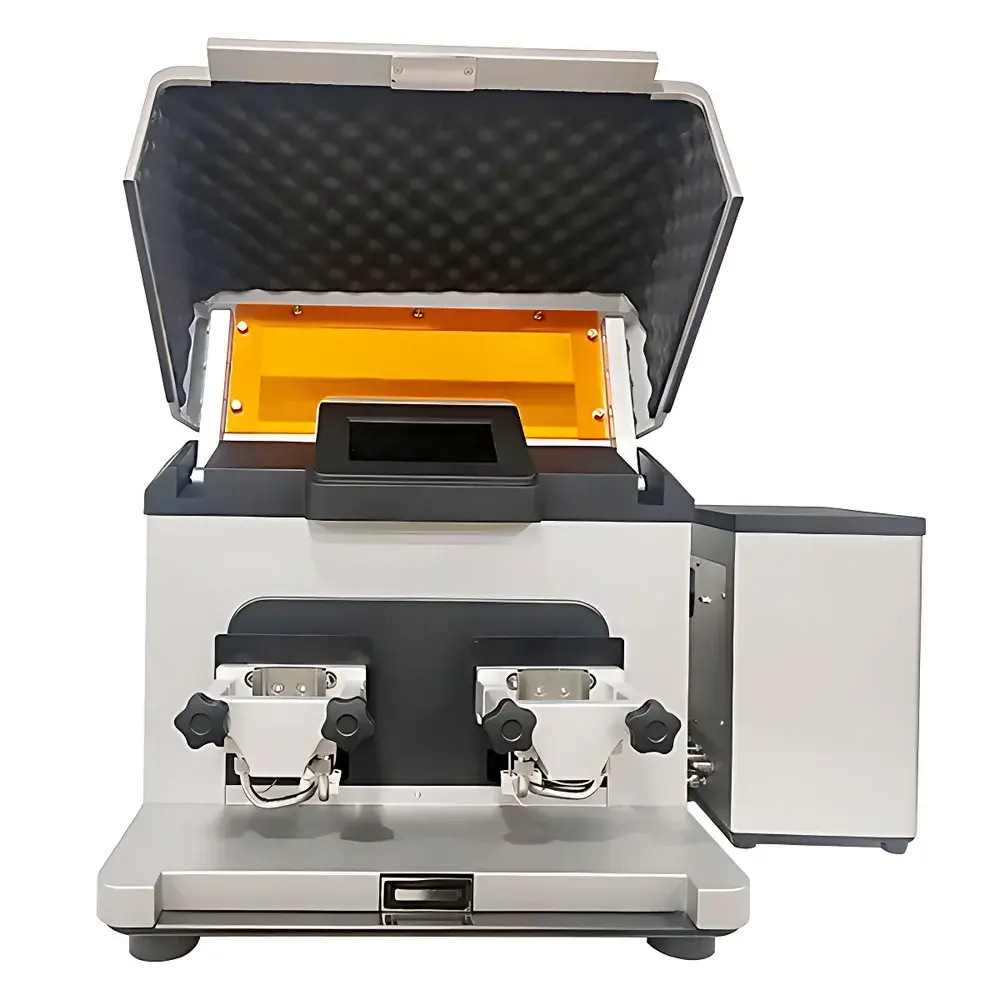
Grinderman GT600Control Temperature-Controlled Vibratory Ball Mill
| Brand | Grinderman |
|---|---|
| Origin | Beijing, China |
| Manufacturer Type | Direct Manufacturer |
| Country of Origin | China |
| Model | GT600Control |
| Instrument Type | Vibratory Ball Mill |
| Sample Applicability | Hard, Brittle, Fibrous, Elastic & Soft Materials |
| Feed Size | < 10 mm |
| Final Particle Size | < 0.01 mm (10 µm) — down to < 100 nm under cryogenic conditions |
| Batch Capacity | 2 × 45 mL |
| Operating Frequency | 180–1800 rpm (3–30 Hz) |
| Temperature Control Range | −100 °C to +100 °C |
| Real-time Temperature & Pressure Monitoring | Yes |
| Safety Features | Interlocked Lid, Pressure Relief Valve, Torque-Limited Clamping Ring |
| Grinding Vessel Options | Stainless Steel, Tungsten Carbide, Zirconia, Hardened Steel (10–125 mL) |
| Power Consumption | 1.8 kW |
| Data Storage | 20 User-Defined Protocols |
| Cycle Repetition | Up to 99 Cycles |
| Programmable Parameters | Time, Intermittent Mode, Pause Duration, Ramp Profiles |
| Compliance | Designed for GLP/GMP-aligned workflows |
Overview
The Grinderman GT600Control is a high-energy, temperature-regulated vibratory ball mill engineered for reproducible, controlled-size reduction of diverse solid materials—from hard ceramics and metallic alloys to biological tissues and polymeric waste. Unlike planetary or rotary mills, the GT600Control operates on a radial arc oscillation principle: its dual grinding stations undergo high-frequency horizontal pendular motion (3–30 Hz), inducing intense impact, shear, and compression forces between grinding media (balls) and sample particles inside sealed vessels. This mechanism enables efficient comminution across brittle, fibrous, elastic, and temperature-sensitive matrices. Critically, the integrated thermal management system—capable of active cooling (down to −100 °C via liquid nitrogen or recirculating chiller) and heating (up to +100 °C)—suppresses thermal degradation, prevents agglomeration, and stabilizes metastable phases during mechanical alloying or nanomaterial synthesis. The instrument is purpose-built for applications demanding strict thermal history control, including mechanochemical synthesis, cryogenic cell lysis, and amorphous phase generation.
Key Features
- Two independent grinding stations accommodating vessels from 2 mL cryo-tubes (via 18-position adapter) up to 125 mL stainless steel jars—enabling parallel processing of heterogeneous samples or method optimization studies.
- Precise temperature regulation (−100 °C to +100 °C) using three configurable modes: tap-water cooling, external recirculating chiller integration, or direct liquid nitrogen injection—each monitored in real time via embedded PT100 sensors within the grinding chamber.
- Integrated pressure sensing and digital display for in-situ monitoring of internal vessel pressure—essential for reactive milling (e.g., solvent-free catalytic coupling) or inert-atmosphere processing using optional gas-purged lids.
- Programmable operational logic: users define total duration, rest intervals, cycle repetitions (up to 99), ramp-up/down profiles, and automatic shutdown—ensuring method transferability across labs and operators.
- Optical observation window with safety-interlocked lid: motor halts instantly if lid is lifted or improperly seated; clamping rings feature torque-limiting design to prevent over-tightening and vessel deformation.
- 20 programmable method slots with timestamped parameter logging—facilitating compliance with ISO/IEC 17025 documentation requirements and supporting traceability in regulated environments (e.g., pharmaceutical QC or environmental testing labs).
Sample Compatibility & Compliance
The GT600Control processes materials spanning multiple sectors: mineral ores (quartz, feldspar), metallurgical alloys (Al-, Mg-, Ti-based), biological specimens (bone, muscle, plant tissue), polymers (rubber, PET, epoxy composites), pharmaceutical actives (APIs, excipients), and electronic waste (PCBs, solder alloys). Its versatility stems from interchangeable grinding vessels—available in stainless steel (316L), hardened tool steel, tungsten carbide, and yttria-stabilized zirconia—each selected to minimize cross-contamination and wear-induced elemental leaching. For regulated applications, the system supports GLP-compliant operation when paired with validated electronic lab notebooks (ELNs) or LIMS platforms. While not pre-certified to FDA 21 CFR Part 11, its parameter-locked protocols, audit-ready event logs, and hardware-enforced safety interlocks align with key elements of computerized system validation (CSV) frameworks. All vessel materials comply with USP Class VI biocompatibility standards where applicable.
Software & Data Management
The GT600Control features an embedded microcontroller interface with intuitive numeric keypad navigation and LCD status display. All operational parameters—including frequency, duration, temperature setpoint, pressure threshold, and cycle count—are digitally preset and stored with user-defined labels. Timestamped execution logs (start/stop time, actual temperature/pressure traces, error codes) are retained onboard for retrieval via USB export. No proprietary software is required; exported CSV files integrate natively with common laboratory data analysis tools (e.g., Python/Pandas, MATLAB, JMP). For enterprise deployment, the instrument’s RS-232/USB-C interface permits integration into centralized monitoring systems compliant with IEEE 11073 or ASTM E2500-07 standards. Firmware updates are performed offline via secure firmware signing protocol to maintain integrity in GxP environments.
Applications
- Mechanochemical Synthesis: Solid-state synthesis of MOFs, perovskites, and metal oxide nanocomposites without solvents—enabled by cryogenic suppression of side reactions and precise energy input control.
- Nanoparticle Production: Top-down fabrication of sub-100 nm metal, ceramic, and polymer particles for catalysts, conductive inks, and drug delivery carriers.
- Cryogenic Biomass Processing: Rapid, contamination-free homogenization of frozen tissue, seeds, or microbial pellets for genomic, proteomic, or metabolomic analysis—preserving labile biomolecules.
- Recycling & Waste Valorization: Size reduction and phase homogenization of e-waste, rubber tires, and composite plastics prior to hydrometallurgical or pyrolytic recovery.
- Pharmaceutical Development: Amorphization of crystalline APIs to enhance solubility and bioavailability; blending of low-dose actives with excipients at trace-level uniformity.
FAQ
What temperature control methods does the GT600Control support?
It supports three configurations: ambient tap-water cooling, external recirculating chiller (−40 °C to +150 °C range), and direct liquid nitrogen injection for ultra-low-temperature operation (−100 °C). All modes include real-time PT100 feedback and PID-controlled regulation.
Can the instrument operate under inert or reactive atmospheres?
Yes—optional gas-tight lids with septum ports and pressure-relief valves enable purging with N₂, Ar, or reactive gases (e.g., NH₃, H₂) for oxidation-sensitive or catalytic milling.
Is the final particle size guaranteed to reach 100 nm?
Sub-100 nm median particle size is achievable for brittle, homogeneous materials (e.g., graphite, SiO₂) under optimized cryogenic conditions; however, final size distribution depends on material hardness, ductility, grinding media selection, and dwell time—and must be verified empirically for each sample type.
How is method reproducibility ensured across different operators?
By storing full parameter sets—including frequency ramp profiles, rest intervals, temperature setpoints, and vessel geometry—within the instrument’s non-volatile memory, eliminating manual setup variability and enabling SOP-driven operation.
Does the GT600Control meet international electrical safety standards?
The unit complies with IEC 61010-1:2010 for laboratory electrical equipment, including protection against electric shock, mechanical hazards, and thermal risks. CE marking is applied per EU Machinery Directive 2006/42/EC and EMC Directive 2014/30/EU.
Related Products



