
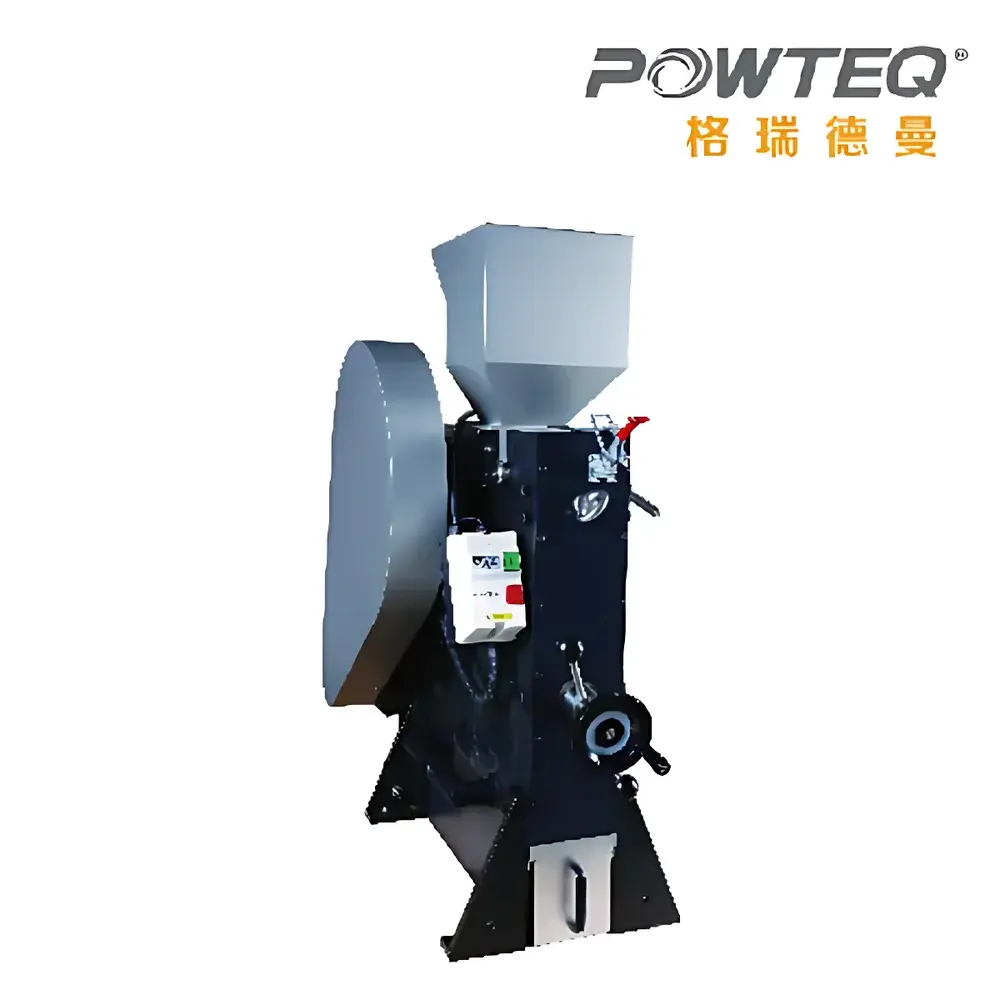
Grinderman JC5 Jaw Crusher
| Brand | Grinderman |
|---|---|
| Origin | Beijing, China |
| Manufacturer Type | Direct Manufacturer |
| Country of Origin | China |
| Model | JC5 |
| Instrument Type | Jaw Crusher |
| Sample Applicability | Hard and Brittle Materials |
| Feed Size | < 90 mm |
| Discharge Size (d90) | < 2 mm |
| Final Output Particle Size | 0.01–0.5 mm |
| Batch Throughput | ~300 kg |
| Jaw Plate Dimensions | 320 × 100 mm |
| Adjustable Gap Range | 0–30 mm (continuous) |
| Hopper Capacity | 5 L |
| Power Supply | 3-phase, ~380 V, 50–60 Hz |
| Drive Motor Power | 2.2 kW |
| Jaw Plate Material Options | Manganese Steel, Stainless Steel, Tungsten Carbide, Zirconia, Heavy-Metal-Free Steel, Industrial Plastic |
Overview
The Grinderman JC5 Jaw Crusher is a heavy-duty laboratory-scale primary crushing instrument engineered for reproducible, controlled size reduction of hard, brittle, and moderately tough solid samples. It operates on the classical jaw crushing principle—based on compressive force generation between two opposing surfaces: one fixed and one dynamically oscillating via an eccentric shaft drive. This mechanism subjects feed material to progressive mechanical compression within a tapered crushing chamber, enabling efficient fracturing along natural cleavage planes without excessive heat generation or amorphous phase formation. Designed for pre-processing prior to downstream analytical steps—including XRF, XRD, ICP-MS, or sieve analysis—the JC5 delivers consistent d90 particle sizes below 2 mm while preserving sample integrity and minimizing cross-contamination risk. Its robust cast-iron frame, precision-machined jaw alignment system, and modular jaw plate architecture ensure long-term dimensional stability and operational repeatability across high-throughput laboratory environments.
Key Features
- Continuous, stepless adjustment of jaw gap (0–30 mm) via calibrated zero-point correction mechanism—enabling precise control over discharge particle size distribution and compensation for jaw wear over time.
- High-capacity throughput: rated for up to ~300 kg per batch, supporting extended unattended operation in central lab or core facility settings.
- Six interchangeable jaw plate material options—manganese steel (standard), stainless steel, tungsten carbide, zirconia, heavy-metal-free steel, and industrial-grade polymer—to accommodate diverse sample chemistries, regulatory requirements (e.g., trace metal analysis), and contamination-sensitive applications.
- Optimized crushing geometry with 320 × 100 mm active jaw surface area and engineered wedge-shaped feed chamber to minimize bridging and ensure uniform material flow under gravity-assisted descent.
- Integrated splash guard hopper and removable 5 L collection bin with ergonomic slide-out rails—designed for rapid sample recovery, cleaning validation, and GLP-compliant documentation of batch handling.
- 2.2 kW three-phase induction motor with thermal overload protection and CE-compliant electrical interface (380 V, 50–60 Hz), ensuring stable torque delivery across variable load conditions.
Sample Compatibility & Compliance
The JC5 is validated for processing geological specimens (e.g., ores, core samples, basalt, granite), metallurgical intermediates (alloys, slags), ceramics, refractory materials, construction aggregates, and environmental matrices (soils, sediments, fly ash). Its mechanical design conforms to ISO 17025-relevant equipment qualification principles for sample preparation instrumentation. Jaw plate material selection supports compliance with ASTM D2234 (coal sampling), ISO 13320 (laser diffraction particle sizing prerequisites), and USP (particle size determination for pharmaceutical excipients). Optional tungsten carbide and zirconia jaw sets meet stringent low-background requirements for ICP-MS trace elemental analysis (per EPA Method 6020B). All structural components are fabricated to IP54 ingress protection standards for dust resistance during dry crushing operations.
Software & Data Management
The JC5 is a standalone electromechanical instrument without embedded digital control or data logging firmware. However, its mechanical adjustability and deterministic performance enable full integration into laboratory information management systems (LIMS) via external process documentation protocols. Users may record jaw gap setting, batch ID, feed mass, ambient temperature, and operator signature in standardized SOP templates aligned with FDA 21 CFR Part 11 audit trail requirements. Calibration certificates for jaw alignment tools and gap measurement gauges are provided upon request, supporting GMP Annex 15 and ISO/IEC 17025 clause 6.4.3 equipment verification workflows.
Applications
- Geological laboratories: Reduction of drill core and rock specimens to sub-2 mm fractions for geochemical assay preparation.
- Metallurgical R&D: Pre-crushing of alloy ingots and furnace slags prior to fusion bead preparation for XRF quantification.
- Environmental testing labs: Homogenization of heterogeneous soil composites for TCLP extraction or heavy metal leaching studies.
- Cement and construction materials testing: Size reduction of clinker and refractory bricks for Blaine fineness or BET surface area analysis.
- Academic research: Controlled comminution of ceramic precursors and battery electrode materials where phase preservation is critical.
FAQ
What is the maximum feed size the JC5 can accept?
The JC5 accepts feed particles up to 90 mm in largest dimension; oversized material must be pre-screened or manually broken prior to loading.
How is jaw wear compensated during long-term use?
The zero-point calibration system allows real-time repositioning of the movable jaw to maintain consistent gap width—documented in maintenance logs per ISO/IEC 17025 clause 6.4.5.
Can the JC5 be used for wet or cryogenic crushing?
No—the JC5 is designed exclusively for dry, ambient-temperature crushing. Moisture or frozen samples may cause jamming, accelerated wear, or safety hazards.
Is the 0.01–0.5 mm output range achievable in a single pass?
No—this represents the final particle size after secondary grinding (e.g., using a planetary mill or disc mill); the JC5’s primary function is coarse reduction to d90 < 2 mm.
Are jaw plates supplied with the base unit?
Yes—standard delivery includes one set of manganese steel jaw plates; alternative materials are available as configurable options at time of order.



