
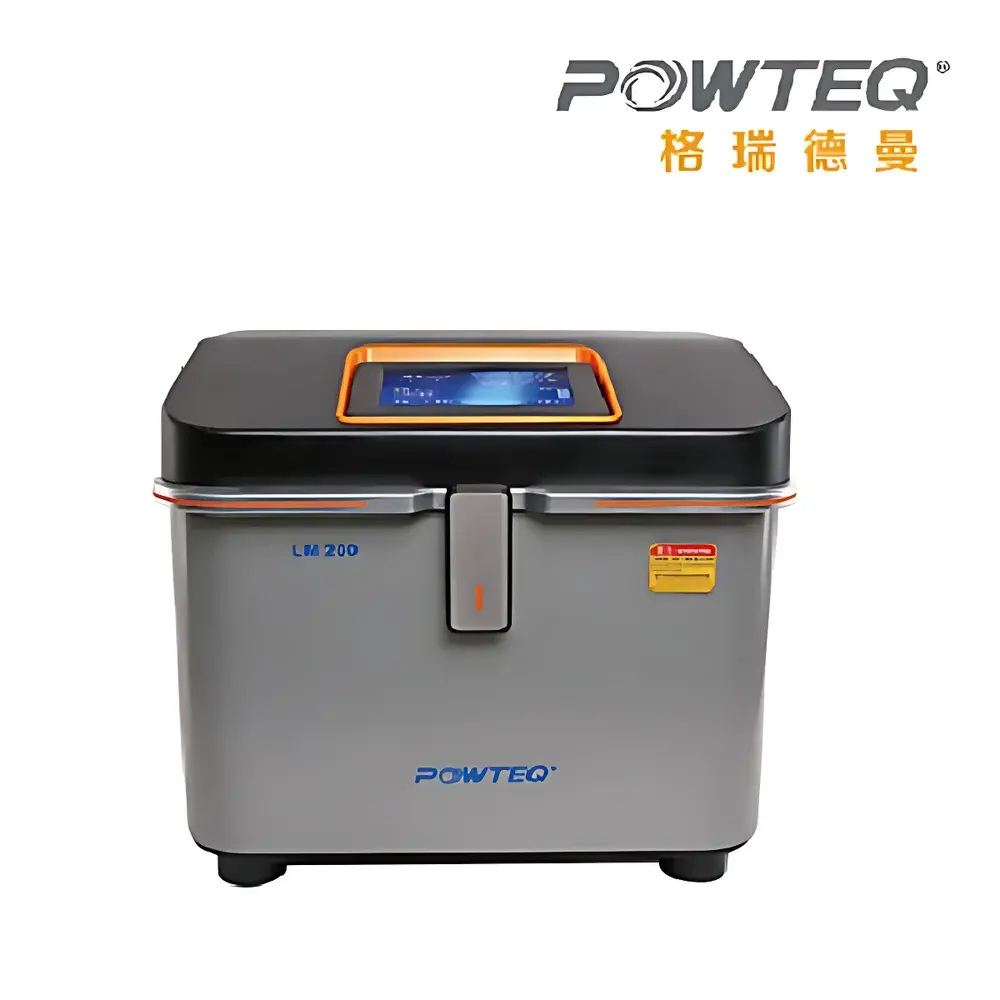
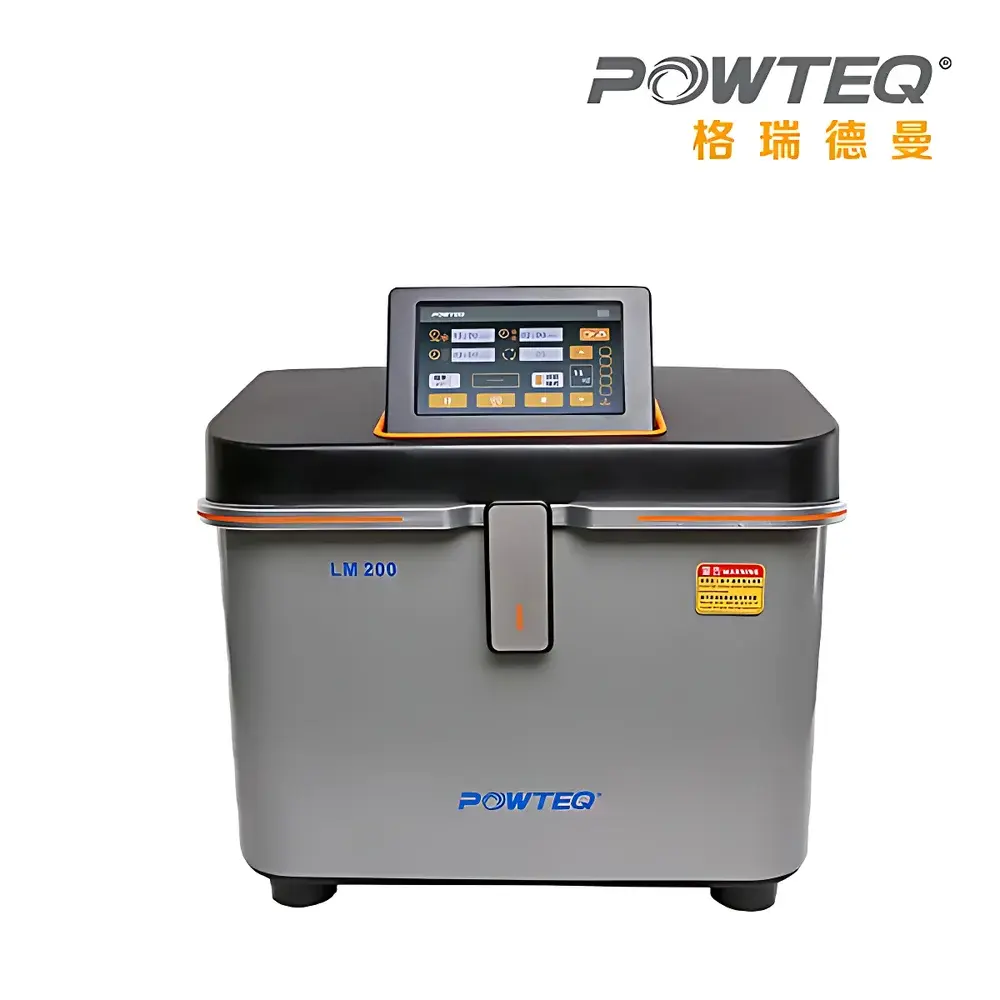
Grindemann LM200 Automated Cryogenic Ball Mill
| Brand | Grindemann |
|---|---|
| Origin | Beijing, China |
| Manufacturer Type | Direct Manufacturer |
| Country of Origin | Domestic (China) |
| Model | LM200 |
| Instrument Type | Cryogenic Ball Mill |
| Sample Applicability | Frozen & Heat-Sensitive Samples |
| Output Particle Size | 0.01–0.5 mm |
| Feed Particle Size | ≤10 mm |
| Final Ground Particle Size | ≤75 µm |
| Batch Processing Capacity | 0.1–100 g |
| Electromagnetic Frequency Range | 5–15 Hz |
| Pre-cooling Chamber Volume | 200 mL |
| Grinding Chamber Volume | 200 mL |
| Minimum Pre-cooling Time | 4.5 min |
| Single Grinding Cycle Duration | 2 min |
| Power Supply | 450 W / 230 V, 50 Hz |
| Dimensions (W×D×H) | 510 × 440 × 450 mm |
| Optional Grinding Vial Kits | 4 sets (12 vials total) — micro, small, medium, and large configurations |
Overview
The Grindemann LM200 Automated Cryogenic Ball Mill is an engineered solution for high-fidelity sample preparation of thermolabile, elastic, fibrous, or tough biological and polymeric materials. It operates on the principle of electromagnetic-driven oscillatory impact grinding under sustained cryogenic conditions—specifically, immersion in liquid nitrogen (−196 °C)—to embrittle samples prior to mechanical comminution. This dual-phase approach—pre-cooling followed by high-frequency horizontal reciprocating motion of stainless-steel impact elements—ensures structural integrity preservation of nucleic acids (DNA/RNA), proteins, metabolites, and polymer crystallinity during size reduction. Unlike conventional planetary or vibratory mills, the LM200 maintains a fully enclosed, nitrogen-saturated environment throughout pre-cooling, grinding, and post-grinding hold phases, eliminating thermal drift and volatile loss. Its architecture is purpose-built for laboratories requiring reproducible, contamination-controlled, low-temperature milling in compliance with ISO 17025-accredited workflows and GLP/GMP-aligned sample handling protocols.
Key Features
- Electromagnetic oscillation system delivering precise, adjustable frequency control (5–15 Hz) for optimized impact energy transfer and particle size distribution control.
- Integrated auto-fill liquid nitrogen dosing system with level sensing and closed-loop replenishment—eliminating manual handling hazards and ensuring consistent thermal stability across sequential batches.
- Industrial-grade 7-inch capacitive touchscreen HMI enabling programmable parameters: pre-cooling duration (0–30 min), grinding cycle time (0.5–10 min), number of cycles, and frequency ramping profiles.
- Interlocked safety enclosure: motor activation is physically inhibited unless the lid is fully seated and mechanically locked—meeting IEC 61000-6-2 EMC and EN 61000-6-4 safety requirements.
- Modular vial system supporting four interchangeable configurations—micro (0.1–1 g), small (1–10 g), medium (10–50 g), and large (50–100 g)—with optimal fill ratio guidance (5–25% vial volume) to balance impact efficiency and heat dissipation.
- Streamlined ergonomic chassis (510 × 440 × 450 mm) designed for benchtop integration, featuring corrosion-resistant stainless-steel housing and nitrogen-compatible seals rated to −196 °C.
Sample Compatibility & Compliance
The LM200 accommodates diverse matrices including but not limited to: soft tissues (muscle, skin, liver), hard tissues (bone, teeth, nails), fibrous plant matter (leaves, stems, seeds), synthetic polymers (PE, PP, rubber compounds), pharmaceutical tablets, forensic specimens (hair, dried blood spots), and environmental samples (soil aggregates, biofilms). All grinding vials are certified for trace-metal-free operation (ASTM D5688-compliant stainless steel) and validated for nucleic acid yield retention per ISO/IEC 17025 method validation guidelines. The instrument supports audit-ready operation through optional timestamped event logging (start/stop, LN₂ consumption, lid status, error codes), aligning with FDA 21 CFR Part 11 data integrity expectations when paired with validated LIMS integration.
Software & Data Management
The embedded firmware stores up to 100 user-defined grinding protocols with version-stamped metadata (date/time, operator ID, vial ID, LN₂ usage estimate). Exportable CSV logs include real-time temperature proxy readings (via integrated cryo-sensor array), cycle count, and electromagnetic coil duty cycle—facilitating retrospective correlation between process parameters and downstream analytical outcomes (e.g., qPCR Ct values, SEC-MALS molecular weight distributions). No proprietary software installation is required; configuration and diagnostics are accessible via local web interface (HTTP/HTTPS) or direct USB export. Firmware updates follow ISO 13485-aligned change control documentation.
Applications
- Genomic & transcriptomic sample prep: high-yield, low-degradation homogenization of frozen tissue for DNA extraction, RNA-seq library construction, and methylation analysis.
- Pharmaceutical QA/QC: uniform micronization of active pharmaceutical ingredients (APIs) and excipients without thermal degradation or polymorphic transition.
- Polymer characterization: cryo-milling prior to DSC, TGA, or GPC to preserve crystallinity and prevent shear-induced chain scission.
- Forensic toxicology: reproducible pulverization of hair/nail specimens for LC-MS/MS multi-analyte screening.
- Food authenticity testing: homogenization of heterogeneous matrices (spices, dairy powders, meat products) for stable isotope ratio mass spectrometry (IRMS) or elemental fingerprinting.
- Materials science: preparation of brittle composites (e.g., carbon-fiber-reinforced polymers) for SEM-EDS cross-section analysis.
FAQ
What types of cryogenic grinding vials are included with the LM200?
The standard configuration includes four vial kits: 12 micro-vials (0.5–2 mL), 4 small vials (5–10 mL), 1 medium vial (25 mL), and 1 large vial (50 mL)—all constructed from vacuum-annealed 316L stainless steel with PTFE-sealed caps.
Can the LM200 operate without liquid nitrogen?
Yes—the instrument supports ambient-temperature dry grinding for robust, non-thermolabile samples; however, all cryogenic-specific features (auto-LN₂ dosing, sub-zero chamber sealing) remain inactive unless LN₂ is detected via integrated level sensor.
How is method reproducibility ensured across multiple users?
Each protocol is stored with immutable parameter sets and operator-assigned identifiers; combined with mechanical interlock verification and real-time coil current monitoring, inter-operator variability is reduced to <±2.3% RSD in median particle size (x₅₀) across 30 consecutive runs (n=5 per batch, measured by laser diffraction per ISO 13320).
Is remote monitoring supported?
Local Ethernet/Wi-Fi connectivity enables live status viewing and protocol initiation via browser-based interface; full remote control (including LN₂ valve actuation) requires on-premise network segmentation and TLS 1.2 authentication—available under enterprise support contract.
What maintenance intervals are recommended?
Biannual inspection of electromagnetic coil insulation resistance (≥100 MΩ @ 500 V DC), quarterly calibration of LN₂ level sensor against NIST-traceable cryogenic probe, and routine cleaning of vial seating surfaces with ethanol/IPA—documented per ISO/IEC 17025 maintenance log templates.



