
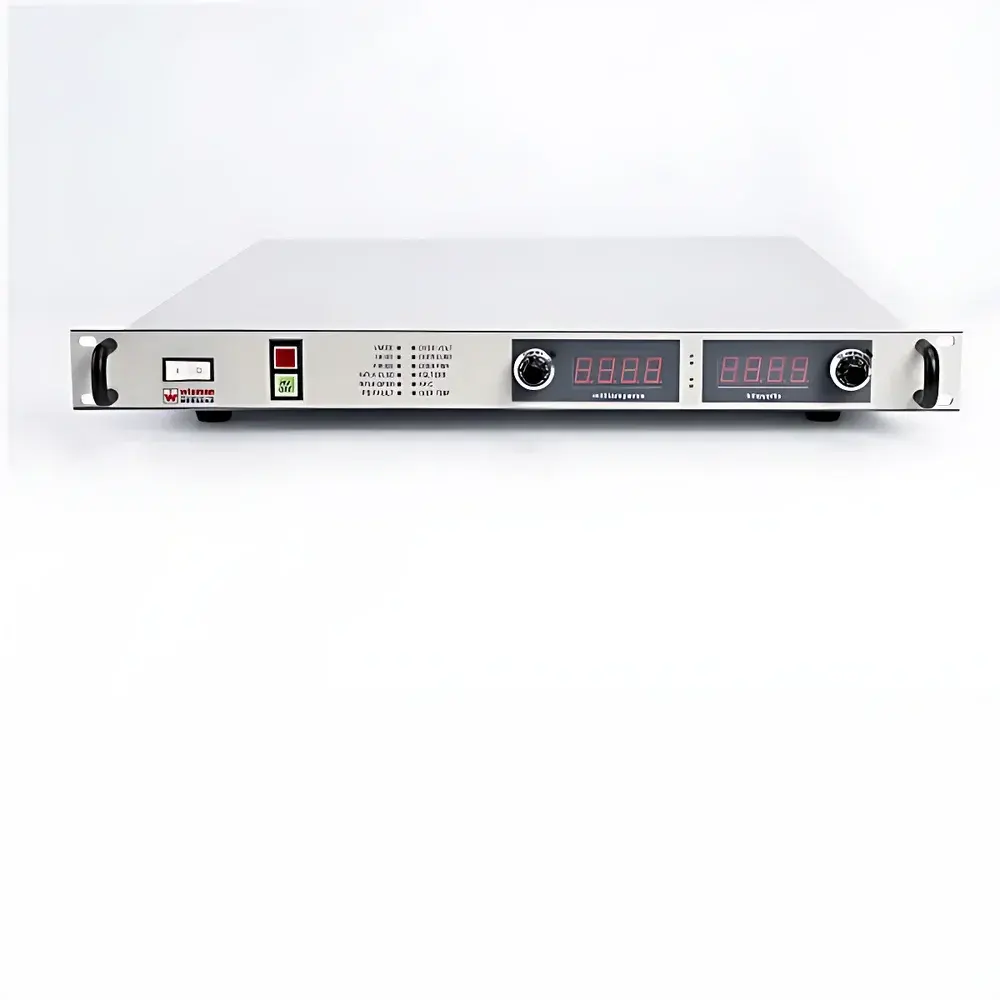
Wisman MSB Series Multi-Channel High-Voltage Power Supply System – 30 kV / 20 W
| Brand | Wisman |
|---|---|
| Origin | Shaanxi, China |
| Model | MSB |
| Output Channels | Up to 512 (configurable 2–512) |
| Output Voltage Range | 1–30 kV DC |
| Output Power per Channel | 2–20 W |
| Ripple Voltage | < 2 ppm (typ. 10 mV) |
| Stability | 10 ppm/hour, 20 ppm/8 hours, 100 ppm/1000 hours |
| Temperature Coefficient | ≤10 ppm/°C |
| Input | AC 220 V ±5% |
| Communication Interface | RS-485 (standard) |
| Protection | Overcurrent, Arc Detection, Short-Circuit |
| Compliance | Designed for GLP/GMP-aligned instrumentation environments |
| Application Domain | Mass Spectrometry, PMT Biasing, Solid-State Detectors, Electrophoresis, ESD Testing, Semiconductor Characterization, and Precision Electrostatic Systems |
Overview
The Wisman MSB Series is a modular, multi-channel high-voltage DC power supply system engineered for precision biasing, signal conditioning, and stable excitation in advanced analytical and scientific instrumentation. Based on linear power conversion architecture—distinct from switched-mode topologies—the MSB delivers ultra-low output ripple (<2 ppm), exceptional long-term stability (100 ppm over 1000 hours), and minimal electromagnetic interference (EMI). Each channel operates independently with fully isolated high-voltage outputs, supporting configurable voltage ranges from 1 kV to 30 kV and power levels from 2 W to 20 W per channel. The system is purpose-built for integration into mass spectrometry platforms, where stable detector biasing (e.g., for electron multipliers, microchannel plates, or photomultiplier tubes) directly impacts signal-to-noise ratio, dynamic range, and quantitative reproducibility. Its linear regulation architecture ensures deterministic transient response and negligible switching noise—critical for low-current, high-impedance sensing applications common in nuclear instrumentation, electrostatic lens control, and time-resolved detection systems.
Key Features
- Modular scalability: Supports 2 to 512 independent high-voltage channels in a single chassis; individual modules are field-replaceable and can operate as standalone units.
- Precision regulation: Voltage stability of 10 ppm/hour (after 30-minute warm-up), with temperature coefficient ≤10 ppm/°C and load/input regulation better than ±0.01%.
- Ultra-low noise performance: Ripple voltage <2 ppm (as low as 10 mV RMS), verified under full-load conditions—enabling sub-picoampere current measurement fidelity.
- Dual-control interface: Local front-panel adjustment via calibrated potentiometers with integrated digital voltage/current meters; remote operation via industry-standard RS-485 serial protocol (Modbus RTU compatible).
- Comprehensive protection suite: Real-time arc detection, programmable overcurrent limiting, auto-recovery short-circuit protection, and thermal foldback safeguarding sensitive downstream components.
- High-reliability mechanical design: SHV connectors for ≤10 kV outputs; proprietary Wisman CA60 high-voltage connectors rated for >10 kV; operating temperature range 0–50 °C; storage range −35–85 °C.
Sample Compatibility & Compliance
The MSB Series is routinely deployed in ISO/IEC 17025-accredited laboratories and FDA-regulated analytical workflows—including LC-MS, MALDI-TOF, and ion mobility spectrometry systems—where voltage source integrity directly affects calibration traceability and data auditability. While not certified to IEC 61010-1 or UL 61010B as a complete system (due to end-user integration variability), all modules comply with reinforced insulation requirements per IEC 60664-1 and creepage/clearance distances validated for 30 kV working voltage. Firmware supports timestamped parameter logging and command history—facilitating 21 CFR Part 11-compliant audit trails when integrated with validated LIMS or instrument control software. Mechanical and electrical interfaces align with common OEM integration standards for mass spectrometer detector stacks, electrostatic lens arrays, and semiconductor test fixtures.
Software & Data Management
The MSB communicates via ASCII-based RS-485 commands, enabling seamless integration with LabVIEW, Python (PySerial), MATLAB, or custom C/C++ host applications. A comprehensive command set allows per-channel voltage/current setpoint programming, real-time readback of actual output values, status flag interrogation (e.g., arc fault, overtemp), and firmware version reporting. Optional Wisman-provided configuration utilities support batch parameter loading, channel grouping, and stability trending over extended acquisition periods. All communication packets include CRC-16 error checking; no proprietary drivers or OS-specific binaries are required. For GxP environments, customers may implement application-layer logging to satisfy ALCOA+ principles—ensuring attributable, legible, contemporaneous, original, accurate, and complete electronic records.
Applications
- Mass spectrometry: High-stability biasing for electron multipliers, continuous dynode electron multipliers (CDEM), and microchannel plate (MCP) detectors.
- Radiation detection: Bias supply for scintillation photomultipliers, silicon photomultipliers (SiPM), and gas proportional counters.
- Electrophoresis & DNA sequencing: Precision voltage control for capillary electrophoresis (CE) and nanopore-based analyzers.
- Semiconductor characterization: Gate biasing for high-k dielectric testing, charge trapping analysis, and breakdown voltage mapping.
- Electrostatic systems: Active control of electrostatic chucks (ESCs), electrospinning nozzles, and ESD immunity test fixtures.
- Optical instrumentation: Voltage tuning of Pockels cells, deformable mirrors, and electro-optic modulators requiring sub-millivolt drift tolerance.
FAQ
Is the MSB Series suitable for use in regulated pharmaceutical QC labs?
Yes—when integrated with validated instrument control software and operated within documented SOPs, the MSB’s stability, traceable calibration paths, and audit-ready communication protocol support compliance with USP , ASTM E2500, and Annex 11 requirements.
Can individual channels be calibrated independently?
Yes—each module includes factory-trimmed voltage and current feedback networks; NIST-traceable calibration certificates are available per channel upon request.
What is the maximum safe distance between the MSB chassis and remote HV loads?
For optimal noise immunity and stability, Wisman recommends keeping HV cabling ≤2 m for ≤10 kV and ≤1 m for >10 kV configurations; shielded, double-insulated coaxial cables with proper grounding are mandatory.
Does the system support synchronization across multiple channels?
No native hardware sync trigger is provided; however, synchronized ramping or stepping can be achieved via coordinated RS-485 command sequencing with sub-millisecond timing resolution using external timing controllers.
Are firmware updates available, and how are they applied?
Firmware upgrades are distributed as signed binary files and installed via RS-485 using a documented bootloader sequence—no hardware modification or service visit required.



