
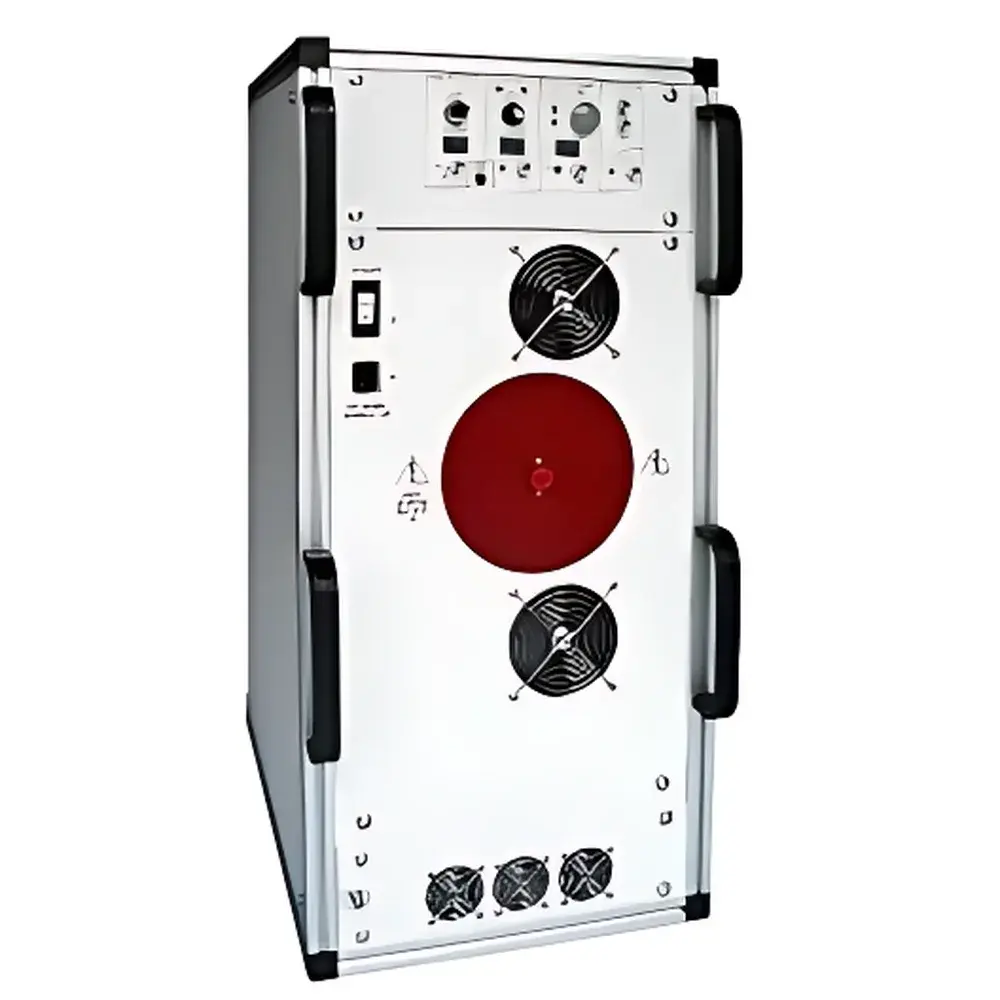
Wiseman AMZ Series ±50 kV / 600 W High-Voltage Power Amplifier
| Brand | Wiseman |
|---|---|
| Model | AMZ |
| Output Voltage | ±50 kV DC or AC peak |
| Output Power | 600 W |
| Output Current | ±12 mA DC or AC peak |
| Input Signal Range | ±10 V DC or AC peak |
| Voltage Gain | 5000 V/V (DC) |
| Gain Accuracy | < ±0.1% of full scale |
| Output Noise | < 10 V RMS |
| Slew Rate | > 350 V/µs (10–90%) |
| Large-Signal Bandwidth | DC to > 1.4 kHz |
| Small-Signal Bandwidth (−3 dB, 1% THD) | DC to > 20 Hz |
| Stability | < 50 ppm/hr (non-cumulative) |
| Temperature Coefficient | < 25 ppm/°C |
| Operating Temperature | 0–40 °C |
| Humidity | ≤75% RH (non-condensing) |
| Altitude | Up to 2000 m |
| Dimensions | 1473.5 × 628.7 × 948.4 mm |
| Weight | 125–136 kg |
| Input Impedance | 25 kΩ |
| Output Impedance | 47 Ω |
| Voltage Display Ratio | 5000:1 |
| Current Display Ratio | 0.5 V/mA |
| Short-Circuit Protection | Active, programmable |
| Quadrant Operation | Four-quadrant active output (source/sink) |
| Load Compatibility | Resistive, capacitive, and reactive loads |
| Compliance | Designed for GLP/GMP-adjacent research environments |
Overview
The Wiseman AMZ Series ±50 kV / 600 W High-Voltage Power Amplifier is a fully solid-state, four-quadrant high-voltage instrumentation amplifier engineered for precision biasing, dynamic actuation, and closed-loop control in advanced scientific and industrial applications. Based on high-efficiency insulated-gate bipolar transistor (IGBT) and MOSFET hybrid architecture, the AMZ delivers stable, low-noise, high-slew-rate amplification across its full ±50 kV output range. Its core operating principle relies on linear voltage gain modulation with active current sourcing and sinking—enabling true bidirectional power delivery into highly reactive or capacitive loads without oscillation or instability. Unlike conventional high-voltage DC supplies, the AMZ functions as a true analog amplifier: input signal fidelity is preserved through wide bandwidth (DC to >1.4 kHz large-signal), minimal phase shift, and sub-0.1% gain linearity. This makes it suitable not only for static biasing but also for real-time waveform replication—including sinusoidal, pulsed, ramp, and arbitrary waveforms—critical in fields such as electro-optic modulation, ion beam steering, and ferroelectric polarization cycling.
Key Features
- Four-Quadrant Active Output: Simultaneously sources and sinks current across the entire ±50 kV range, enabling precise control of both polarity and direction of energy flow into complex loads (e.g., piezoelectric actuators, electrophoretic cells, plasma electrodes).
- Ultra-Low Output Noise: <10 VRMS broadband noise floor ensures signal integrity in sensitive measurements such as mass spectrometry detector biasing and electrostatic deflection systems where signal-to-noise ratio directly impacts resolution.
- High Slew Rate & Wide Dynamic Bandwidth: >350 V/µs slew rate and >1.4 kHz large-signal bandwidth support rapid transient response required for pulse-width modulated (PWM) biasing, time-of-flight ion acceleration, and fast electro-optic switching.
- Programmable Short-Circuit Protection: Real-time current limiting with configurable thresholds and auto-recovery logic safeguards connected instrumentation (e.g., TOF-MS detectors, Langmuir probes) without manual intervention.
- Full Solid-State Design: No oil, gas, or vacuum insulation—eliminates maintenance, leakage risks, and environmental constraints associated with traditional transformer-based HV systems.
- Integrated Precision Monitoring: Dual high-resolution analog meters (voltage and current) with 5000:1 and 0.5 V/mA scaling, respectively; calibrated accuracy better than ±0.1% FS (voltage) and ±2% FS (current), traceable to NIST-traceable standards.
Sample Compatibility & Compliance
The AMZ amplifier interfaces seamlessly with a broad spectrum of laboratory and industrial devices requiring stable, programmable high-voltage excitation. It is routinely deployed as the bias source for time-of-flight mass spectrometers (TOF-MS), quadrupole mass filters, electrostatic lenses, and electron/ion beam optics. Its four-quadrant capability enables direct integration into feedback-controlled systems—such as electrostrictive material characterization rigs or dielectric barrier discharge (DBD) reactors—where load impedance varies dynamically with voltage polarity and frequency. The unit complies with IEC 61010-1:2010 for safety in measurement, control, and laboratory equipment. While not certified for medical or aerospace use, its design adheres to electromagnetic compatibility (EMC) principles aligned with EN 61326-1:2013 and thermal management requirements consistent with ISO 17025-compliant calibration laboratories. All internal diagnostics, gain calibration data, and operational logs are timestamped and structured to support audit-ready documentation under GLP and GMP-aligned quality systems.
Software & Data Management
The AMZ supports analog remote control via standard ±10 V input with 25 kΩ input impedance, ensuring compatibility with arbitrary waveform generators (AWGs), DAQ systems (e.g., National Instruments PXI), and PID controllers. Optional digital interface modules (RS-232, USB-CDC, or Ethernet TCP/IP) enable remote configuration of protection thresholds, gain offset trimming, and status monitoring. Firmware implements non-volatile parameter storage and supports firmware updates via signed binary packages. All voltage/current readbacks are provided as scaled analog outputs (0–10 V), facilitating integration into SCADA or LabVIEW-based supervisory control architectures. For regulated environments, optional audit trail logging—recording operator actions, setpoint changes, and fault events with ISO 8601 timestamps—is available to meet FDA 21 CFR Part 11 requirements when paired with validated host software.
Applications
- Mass spectrometry: High-stability DC/AC bias for TOF reflectrons, ion guides, and detector multipliers
- Electro-optic modulation: Driving LiNbO3 and PLZT modulators with minimal harmonic distortion
- Ferroelectric & piezoelectric characterization: Bipolar polarization hysteresis loop acquisition (P–E loops)
- Electrophoresis & microfluidics: Precise electrode potential control in capillary and chip-based separation systems
- Plasma physics: Biasing of DBD electrodes, atmospheric pressure plasma jets, and Langmuir probes
- Particle accelerator subsystems: Fast-ramping kicker magnets and electrostatic beam deflectors
- Materials science: Electric-field-assisted sintering, electrorheological fluid actuation, and space-charge-limited current (SCLC) measurements
FAQ
What load types can the AMZ drive reliably?
The AMZ is specifically designed for resistive, capacitive, and reactive loads—including those with >10 nF capacitance—thanks to its four-quadrant output stage and active damping compensation.
Is the AMZ compatible with common mass spectrometer platforms?
Yes. It is widely integrated with TOF-MS systems (e.g., Waters SYNAPT, Bruker maXis, JEOL AccuTOF) as a replacement or upgrade for OEM high-voltage supplies, offering superior stability and programmability.
Can the AMZ be used in closed-loop feedback systems?
Absolutely. Its low output impedance (47 Ω), fast slew rate, and real-time current monitoring make it ideal for outer-loop control with external PID hardware or FPGA-based controllers.
Does the unit include calibration documentation?
Each shipped unit includes a factory calibration certificate (traceable to national standards), full test report, and uncertainty budget per ISO/IEC 17025 Annex A. On-site recalibration services are available globally.
What cooling method does the AMZ employ?
Forced-air convection with intelligent thermal throttling; no liquid cooling or external chillers required. Ambient airflow clearance of ≥150 mm on all sides is recommended.



