
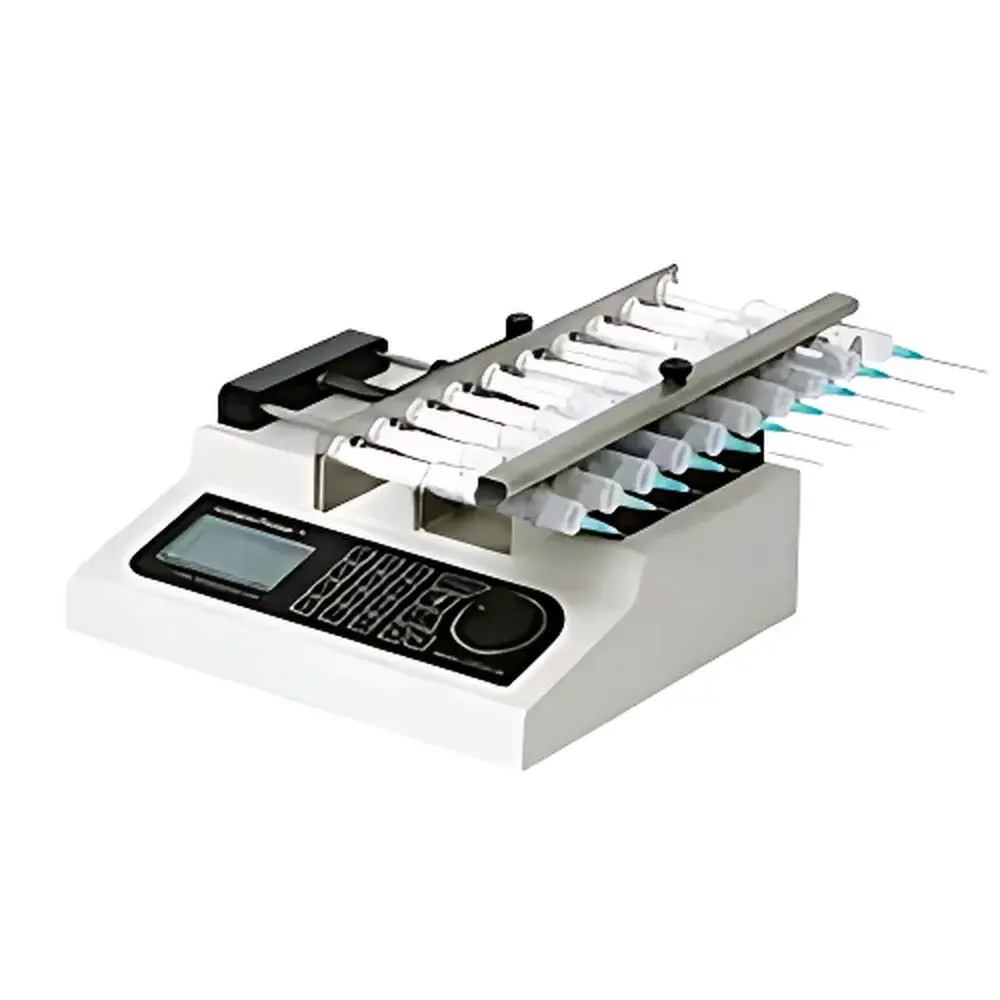
Longer LSP10-1B Ten-Channel Laboratory Syringe Pump
| Brand | LongerPump |
|---|---|
| Origin | Hebei, China |
| Model | LSP10-1B |
| Instrument Type | Micro-syringe Pump |
| Max Channels | 10 |
| Flow Range | 0.001 µL/min – 28.135 mL/min |
| Syringe Capacity | 10 µL – 10 mL |
| Stroke Resolution | 0.156 µm |
| Linear Force | >180 N |
| Power Supply | AC 90–260 V, 20 W |
| Dimensions | 280 × 330 × 140 mm |
| Weight | 5.3 kg |
| Communication Interface | RS-485 |
| Operating Temperature | 0–40 °C |
| Relative Humidity | <80% |
| Compliance | CE-marked design for laboratory use under IEC 61010-1 |
Overview
The Longer LSP10-1B is a precision-engineered ten-channel syringe pump designed for high-accuracy, low-flow liquid delivery in research-grade biological and analytical laboratories. Based on linear stepper motor actuation and calibrated plunger displacement, the LSP10-1B operates on volumetric displacement principles—where flow rate is derived from motor-driven linear velocity multiplied by the cross-sectional area of the syringe barrel. This deterministic relationship ensures traceable, repeatable fluid delivery without reliance on pressure feedback or closed-loop flow sensing. Its integrated monolithic chassis supports simultaneous operation of up to ten independent channels, each programmable with distinct parameters—including direction (infuse or withdraw), volume, time, and sequencing logic—making it suitable for complex multi-reagent protocols such as gradient elution in microfluidic chromatography, sequential cell culture media dosing, or parallelized assay reagent dispensing.
Key Features
- Ten fully independent channels with synchronized or asynchronous control—each capable of infuse, withdraw, infuse-then-withdraw, withdraw-then-infuse, or continuous bidirectional operation.
- Wide syringe compatibility: accepts standard glass or plastic syringes from 10 µL to 10 mL (inner diameters 0.5–16.6 mm), with built-in database for major manufacturers (e.g., Hamilton, BD, SGE) and manual ID entry for custom barrels.
- High-resolution linear actuation: 0.156 µm per microstep, enabling sub-nanoliter per minute flow resolution when paired with small-diameter syringes (e.g., 0.001 µL/min with 10 µL syringe).
- Robust mechanical architecture: rated linear thrust >180 N ensures stable performance even with viscous solutions or high-backpressure microfluidic systems.
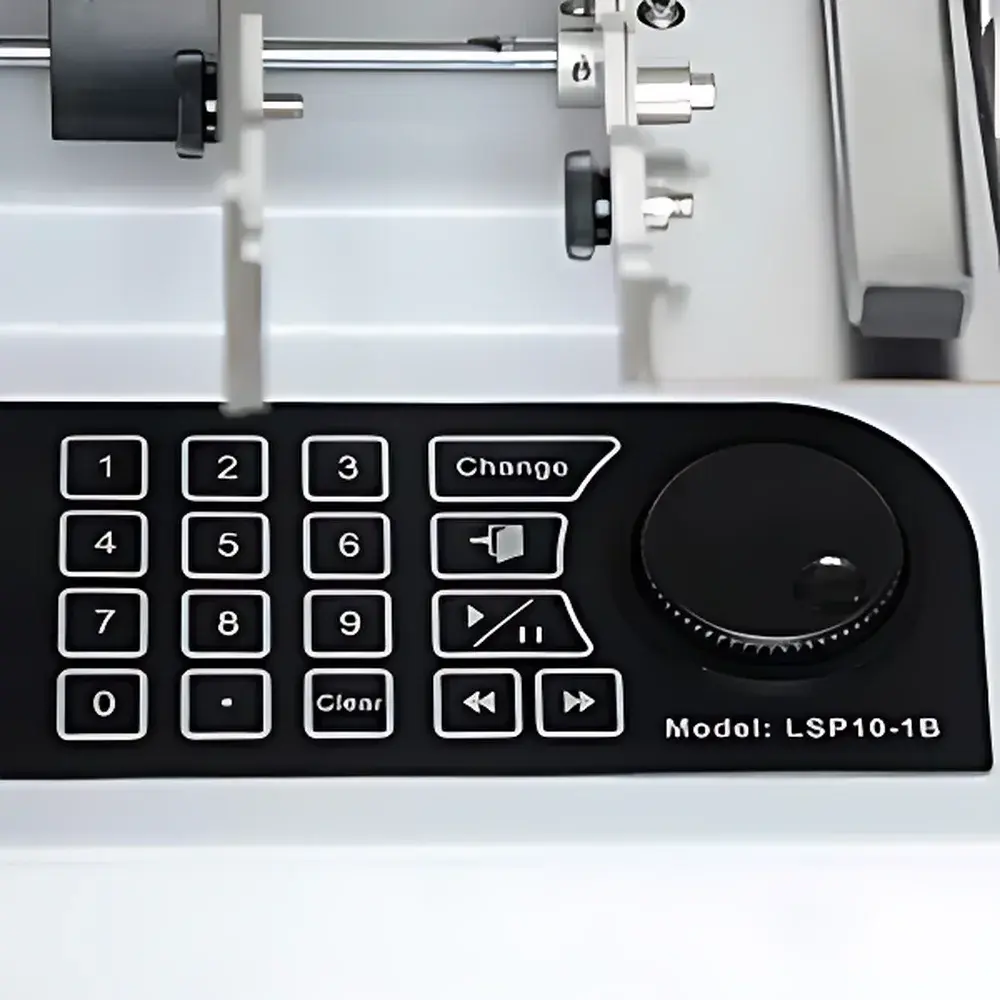
- Intuitive human-machine interface: large LCD display with rotary encoder and membrane keypad allows rapid parameter entry, real-time status monitoring, and mode selection without external software.
- Non-volatile EEPROM storage retains all user settings—including flow profiles, syringe IDs, and calibration offsets—across power cycles; optional resume-on-power-up functionality maintains protocol continuity after interruption.
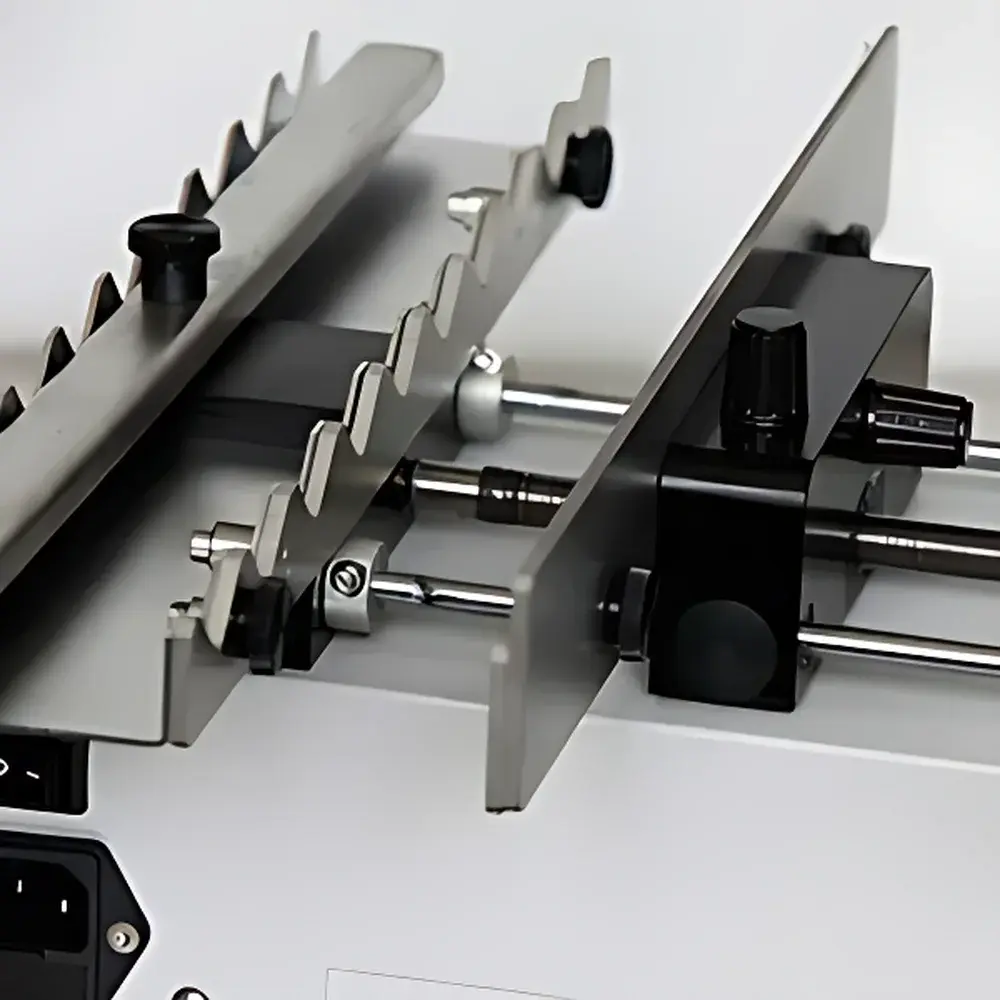
- Integrated safety mechanisms: stall detection halts motion and triggers audible alarm upon mechanical obstruction; adjustable mechanical limit stops prevent syringe barrel over-travel and plunger damage.
Sample Compatibility & Compliance
The LSP10-1B accommodates sterile, non-corrosive aqueous and organic solvents commonly used in life science workflows—including PBS, cell culture media, enzyme buffers, fluorescent dyes, and HPLC mobile phases. It is compatible with disposable plastic syringes (e.g., BD Plastipak), borosilicate glass syringes (e.g., Hamilton Gastight), and luer-lock microsyringes. While not certified for ISO 13485 or FDA 21 CFR Part 11 out-of-the-box, its RS-485 interface supports integration into validated environments via third-party SCADA or LIMS platforms that implement audit trail, electronic signature, and role-based access control per GLP/GMP requirements. The unit complies with IEC 61010-1 for electrical safety in laboratory equipment and meets EMC directive 2014/30/EU for electromagnetic compatibility.
Software & Data Management
The pump supports ASCII-based command protocol over RS-485 (Modbus RTU compatible), enabling integration with LabVIEW, Python (pySerial), MATLAB, or custom C++ applications. A Windows-based configuration utility (provided separately) allows batch programming of multi-step sequences, flow calibration curve generation, and firmware updates. All operational parameters—including elapsed time, delivered volume, current flow rate, and channel status—are accessible via serial query. Two opto-isolated OC outputs provide hardware-level run/stop and direction signals for interlocking with external devices (e.g., valve manifolds or detector triggers), while two TTL-compatible inputs accept start/stop commands—supporting both edge-triggered and level-sensitive control schemes.
Applications
- Multi-analyte calibration in clinical chemistry analyzers requiring precise, staggered reagent addition.
- Controlled perfusion in organ-on-chip and microphysiological systems where independent flow control across multiple tissue compartments is essential.
- Automated sample preparation for LC-MS or CE-MS, including derivatization reagent infusion, internal standard spiking, and fraction collection timing.
- Time-resolved kinetic assays in enzymology or immunoassay development, where reproducible sub-microliter dosing at defined intervals improves signal-to-noise ratio.
- Parallel synthesis in medicinal chemistry labs—delivering catalysts, substrates, or quenching agents to multiple reaction vessels simultaneously.
FAQ
What syringe sizes are supported?
The LSP10-1B supports syringes ranging from 10 µL to 10 mL, corresponding to inner diameters of 0.5 mm to 16.6 mm. A built-in lookup table includes common models from Hamilton, BD, and SGE; custom diameters can be entered manually.
Does the pump support flow calibration?
Yes—users may perform gravimetric or volumetric calibration using the onboard procedure, generating correction factors applied in real time to improve volumetric accuracy beyond nominal mechanical resolution.
Can channels operate with different syringe types simultaneously?
Yes. Each channel independently accepts any compatible syringe size and type, allowing heterogeneous configurations—for example, one channel with a 10 µL syringe for nanoliter dosing and another with a 10 mL syringe for bulk buffer delivery.
Is remote control possible without a PC?
Yes—external TTL or contact-closure signals can initiate, pause, or stop individual channels or all channels collectively, enabling standalone automation in instrument-integrated setups.
What happens during unexpected power loss?
All settings are preserved in EEPROM. Upon power restoration, the pump defaults to standby mode but retains prior configuration; users may choose to resume interrupted runs or begin anew via the front panel or host command.



