
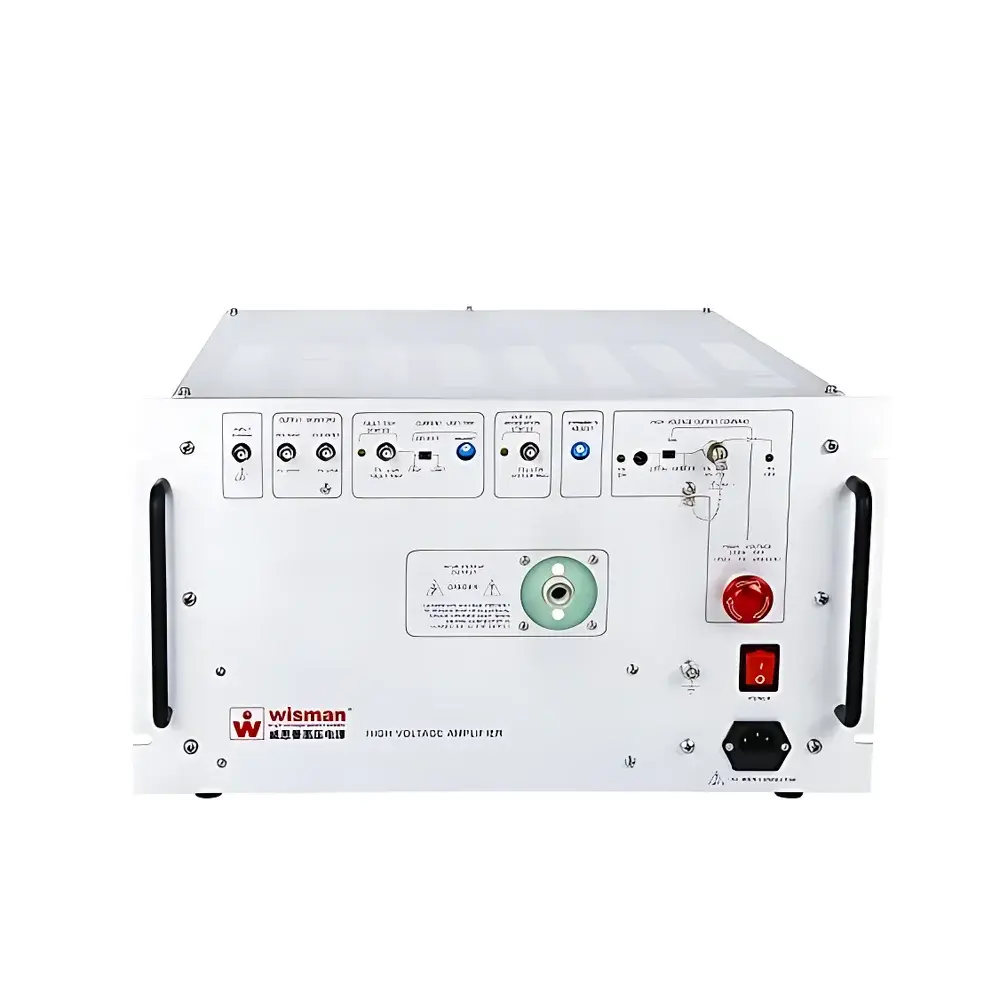
Wisman AMU ±10 kV / 400 W High-Voltage Power Amplifier
| Brand | Wisman |
|---|---|
| Model | AMU |
| Output Voltage Range | ±10 kV DC or AC peak |
| Output Power | 400 W |
| Output Current Range | ±40 mA DC or AC peak |
| Slew Rate | >900 V/µs |
| Small-Signal Bandwidth | DC to >25 kHz (−3 dB) |
| Large-Signal Bandwidth | DC to >9 kHz (1% THD) |
| Voltage Gain | 1000 V/V (±0.1% FS accuracy) |
| Output Noise | <0.5 V RMS (voltage), <10 mV RMS (monitored), <30 mV RMS (current monitor) |
| Stability | <50 ppm/hr (non-cumulative) |
| Temperature Coefficient | <25 ppm/°C |
| Input Impedance | 25 kΩ |
| Display Resolution | 1000:1 (voltage), 1 V/12 mA (current) |
| Dimensions | 264 mm H × 483 mm W × 635 mm D |
| Weight | 25 kg |
| Compliance | Designed for laboratory-grade instrumentation in regulated R&D environments |
Overview
The Wisman AMU ±10 kV / 400 W High-Voltage Power Amplifier is a precision-engineered, fully solid-state, four-quadrant amplifier designed for demanding scientific and industrial applications requiring stable, low-noise, high-slew-rate bipolar high-voltage excitation. Operating on the principle of linear amplification with active current sourcing and sinking capability across the full output voltage range, the AMU delivers exceptional dynamic fidelity when driving highly capacitive, reactive, or nonlinear loads—such as electrostatic deflectors, piezoelectric actuators, ferroelectric polarization stages, or mass spectrometer ion optics. Its architecture eliminates reliance on vacuum tubes or oil-filled transformers, ensuring long-term reliability, zero maintenance, and immunity to dielectric aging. The amplifier accepts standard analog input signals (e.g., ±10 V) and scales them with a fixed gain of 1000 V/V, enabling precise closed-loop control in feedback systems where nanosecond-scale transient response and sub-0.1% DC gain linearity are critical.
Key Features
- Four-quadrant active output stage enabling simultaneous sourcing and sinking of up to ±40 mA into resistive, capacitive, or inductive loads—essential for bidirectional electrostatic actuation and real-time impedance compensation.
- Ultra-high slew rate (>900 V/µs, 10–90%) and wide small-signal bandwidth (DC to >25 kHz, −3 dB) support fast transient response in time-resolved material characterization and pulsed biasing experiments.
- Low output noise (<0.5 V RMS, broadband) and ultra-stable DC performance (<50 ppm/hr drift, non-cumulative; <25 ppm/°C tempco) ensure reproducible results in sensitive measurements such as dielectric spectroscopy or electrophoretic mobility analysis.
- Integrated high-resolution analog monitoring: voltage output displayed at 1000:1 scaling (0.1% FS accuracy, <±2.5 mV offset); current output scaled at 1 V per 12 mA (0.5% FS accuracy, <±10 mV offset).
- Robust front-panel and remote analog/digital interface support (0–10 V, ±10 V, TTL-compatible enable/disable) for integration into automated test benches, vacuum chamber control systems, or OEM instrumentation platforms.
- Compliant with IEC 61010-1 safety standards for laboratory equipment; rated for continuous operation at altitudes up to 2000 m and ambient conditions of 0–40 °C, RH ≤85% non-condensing.
Sample Compatibility & Compliance
The AMU is routinely deployed in configurations requiring precise high-voltage biasing of insulating or semi-conductive samples—including thin-film ferroelectrics, polymer electrolytes, atmospheric plasma reactors, and microfluidic electrophoresis chips. Its four-quadrant capability ensures stable operation under rapid load capacitance changes (e.g., during scanning probe microscopy tip approach or variable-gap electro-optic modulator tuning). For regulated laboratories, the AMU supports audit-ready workflows: its analog monitoring outputs facilitate third-party data logging compatible with GLP/GMP-compliant acquisition systems, and its stable DC output meets the traceability requirements of ISO/IEC 17025-accredited calibration protocols. While not FDA 21 CFR Part 11-certified out-of-the-box, its deterministic analog interface allows integration with validated software platforms that implement electronic signature and audit trail functionality.
Software & Data Management
The AMU operates as a standalone analog instrument with no embedded firmware or proprietary software dependency. All control and monitoring is performed via calibrated analog voltage inputs and isolated BNC-monitor outputs, ensuring compatibility with industry-standard DAQ systems (e.g., National Instruments PXI, Keysight U2300A, or MATLAB Data Acquisition Toolbox). Voltage and current monitor signals are referenced to chassis ground and buffered for direct connection to oscilloscopes, lock-in amplifiers, or PID controllers. For automated sequencing, users commonly integrate the AMU into LabVIEW or Python-based control frameworks using programmable power supplies or function generators as master signal sources. No driver installation, USB enumeration, or firmware updates are required—reducing validation overhead in regulated QC environments.
Applications
- Electrostatic beam steering and focusing in time-of-flight and quadrupole mass spectrometers.
- Biasing of ferroelectric hysteresis loops (P–E loops) and piezoelectric strain mapping under AC/DC superposition.
- Driving electro-optic modulators (LiNbO₃, KTP) and spatial light modulators requiring low-distortion ±kV-level modulation.
- Dielectric barrier discharge (DBD) plasma actuation and atmospheric pressure plasma jet control.
- Electrophoretic separation systems requiring programmable high-voltage ramping and polarity reversal.
- Material polarization fatigue testing and space-charge-limited current (SCLC) measurements in organic semiconductors.
- Ion trap stabilization and particle accelerator injection stage pre-biasing.
FAQ
What load capacitance can the AMU drive stably?
The AMU is optimized for loads up to 10 nF with full bandwidth retention; for loads exceeding 20 nF, external RC snubbing or current-limiting may be advised to maintain phase margin in closed-loop systems.
Is the output referenced to earth ground?
Yes—the output is floating but chassis-ground-referenced by default; optional isolation kits are available for true floating operation in differential measurement setups.
Can the AMU be used in a feedback-controlled system?
Yes—its low output impedance (47 Ω), fast slew rate, and four-quadrant current capability make it suitable for integration with external PID controllers or lock-in amplifiers for adaptive biasing.
Does the AMU include overvoltage or overtemperature protection?
Yes—it features automatic foldback current limiting, thermal shutdown with front-panel indicator, and short-circuit protection that preserves output stage integrity without fuse replacement.
What is the recommended warm-up time for specified accuracy?
For optimal DC stability and gain accuracy, a minimum 30-minute warm-up period is recommended prior to high-precision measurements.



