
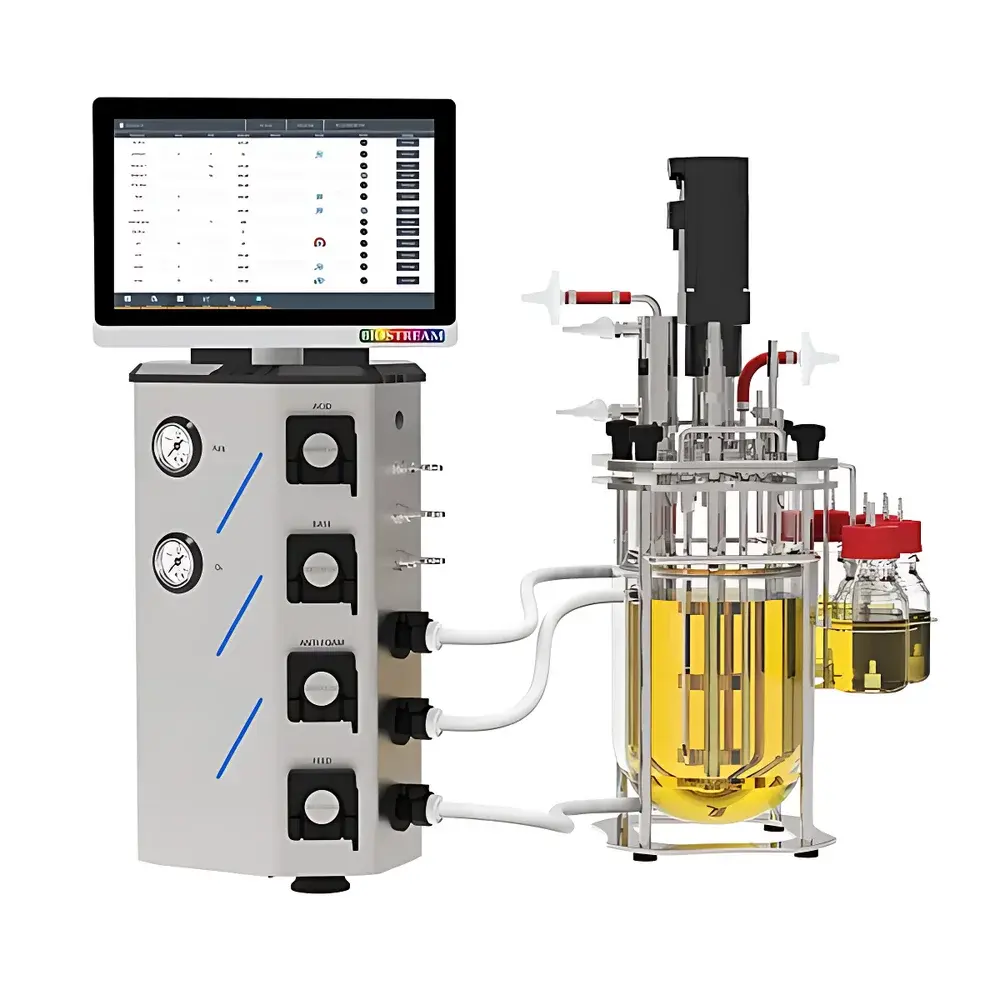
Biostream BioUniv Desktop Bioreactor System
| Brand | Biostream |
|---|---|
| Model | BioUniv |
| Origin | Netherlands |
| Configuration Type | Import |
| Vessel Capacity | 2–13 L |
| Control Interface | 11.6″ Adjustable Touchscreen Display |
| Multi-reactor Support | Up to 6 vessels per controller |
| Drive Options | Mechanical or Magnetic Stirring (optional torque measurement) |
| Pumping | 1–5 integrated peristaltic pumps |
| Gas Control | Mass Flow Controllers (MFCs), rotameters, or manual valves |
| Feeding Modes | Automated batch, fed-batch, and perfusion |
| Electrode Interface | Plug-and-play sensor ports |
| Data Export | Configurable export of setpoints and real-time process values |
| Software | BOS (Biostream Operating System) with embedded training videos and protocol templates |
| Compliance Framework | Designed for GLP/GMP-aligned workflows |
Overview
The Biostream BioUniv Desktop Bioreactor System is an engineered platform for scalable, reproducible microbial and mammalian cell culture under controlled physiological conditions. Based on fundamental principles of bioprocess engineering—including mass transfer optimization, dissolved oxygen (DO) regulation via gas blending, pH control through acid/base titration, and precise nutrient delivery—the BioUniv supports development-stage bioreactor studies from early strain screening to process characterization. Its compact benchtop footprint (designed for standard laboratory fume hoods or biosafety cabinets) integrates modular hardware with a unified software architecture, enabling consistent operation across vessel volumes ranging from 2 L to 13 L working volume. The system adheres to core bioprocessing conventions: DO is maintained via cascaded control between agitation speed, gas flow rate, and O₂/N₂/air mixing ratio; pH is regulated using dual-channel peristaltic dosing with configurable PID tuning; temperature is stabilized via jacketed vessel heating/cooling or internal thermoelectric elements (depending on configuration). All critical process parameters—temperature, pH, DO, agitation, gas flows, feed rates, and off-gas composition (when equipped with optional CO₂/O₂ analyzers)—are synchronized at 1-second resolution and timestamped for traceability.
Key Features
- Adjustable 11.6-inch capacitive touchscreen interface—mechanically pivoted for ergonomic positioning without tooling.
- Single-controller orchestration of up to six independent bioreactors, each with fully decoupled parameter sets and alarm thresholds.
- Modular drive architecture: interchangeable mechanical stirrers (with optional inline torque sensing for rheological monitoring) or magnetic drives for low-shear applications.
- Open-loop and closed-loop feeding: gravimetric feedback control enabled via load-cell integration; programmable feed profiles support exponential, linear, or event-triggered addition strategies.
- Gas distribution flexibility: MFC-based precision blending of O₂, N₂, air, and CO₂; rotameter-based manual calibration mode; or hybrid configurations combining both.
- Plug-and-play electrode connectivity: standardized BNC and mini-DIN ports for pH, DO, conductivity, and redox sensors; automatic sensor ID recognition and calibration logging.
- Controller-integrated storage: motor units dockable on top of the main unit during standby, minimizing bench space and cable clutter.
Sample Compatibility & Compliance
The BioUniv accommodates a broad spectrum of bioprocess applications—including bacterial (E. coli, Pseudomonas), yeast (S. cerevisiae, P. pastoris), insect (Sf9), and mammalian (CHO, HEK293) cultures—across batch, fed-batch, and perfusion modes. Vessels are constructed from borosilicate glass or single-use PETG options (validated for gamma irradiation), with autoclavable or SIP-capable fittings. All wetted materials comply with USP Class VI and FDA 21 CFR 177.2600 standards. The system’s firmware and BOS software are architected to meet ALCOA+ data integrity principles: electronic records include immutable timestamps, user authentication logs, and full audit trails for all parameter changes, calibration events, and method executions—supporting compliance with ISO 13485, EU Annex 11, and FDA 21 CFR Part 11 requirements in regulated environments.
Software & Data Management
The Biostream Operating System (BOS) is a native Windows application developed in-house by Biostream’s software engineering team. It provides real-time visualization of up to 32 process variables per reactor, with configurable dashboards, trend overlays, and comparative analysis tools. Built-in protocol libraries include pre-validated templates for common expression systems (e.g., pET-based E. coli induction, CHO glutamine-free adaptation), each accompanied by annotated instructional videos demonstrating hardware setup, sensor calibration, and run initiation. Data export is configurable in CSV, Excel (.xlsx), or HDF5 formats—with metadata headers containing instrument ID, operator login, environmental context (room temp/humidity), and digital signatures for regulatory submission readiness. Optional cloud synchronization enables remote monitoring and cross-site method sharing under TLS 1.2–encrypted channels.
Applications
- Early-stage bioprocess development: kinetic profiling of growth phases, substrate uptake rates, and metabolite accumulation (e.g., lactate, ammonium).
- Scale-down model validation: correlation of BioUniv performance with pilot-scale (50–200 L) and production-scale (2,000+ L) bioreactors using dimensionless numbers (e.g., P/V, kLa, tip speed).
- Media optimization studies: Design-of-Experiments (DoE)-driven evaluation of carbon/nitrogen sources, trace metals, and feed strategies.
- Cell line comparability assessment: side-by-side evaluation of clone performance under identical environmental setpoints.
- Regulatory filing support: generation of GMP-compliant process documentation packages, including URS, DQ/IQ/OQ protocols, and validation reports.
FAQ
Can the BioUniv be validated for GMP manufacturing use?
Yes—the system supports full qualification (DQ/IQ/OQ/PQ) with documented evidence packages. Its architecture includes role-based access control, electronic signatures, and 21 CFR Part 11–compliant audit trails.
Is remote operation possible?
Yes—via secure RDP or BOS WebConnect (HTTPS-enabled), allowing real-time monitoring and limited intervention from authorized network endpoints.
What sterilization methods are supported?
Glass vessels: autoclaving (121°C, 20 min); single-use vessels: gamma irradiation (25–40 kGy); all sensors and tubing are steam-sterilizable or disposable.
How is torque measurement integrated?
Optional high-resolution torque sensors are mounted inline with mechanical stirrers, providing real-time power input data correlated to broth viscosity and cell density changes.
Can third-party analytical devices be interfaced?
Yes—via Modbus TCP, OPC UA, or analog 4–20 mA inputs; compatible with in-line NIR probes, capacitance-based biomass sensors, and exhaust gas analyzers.



