
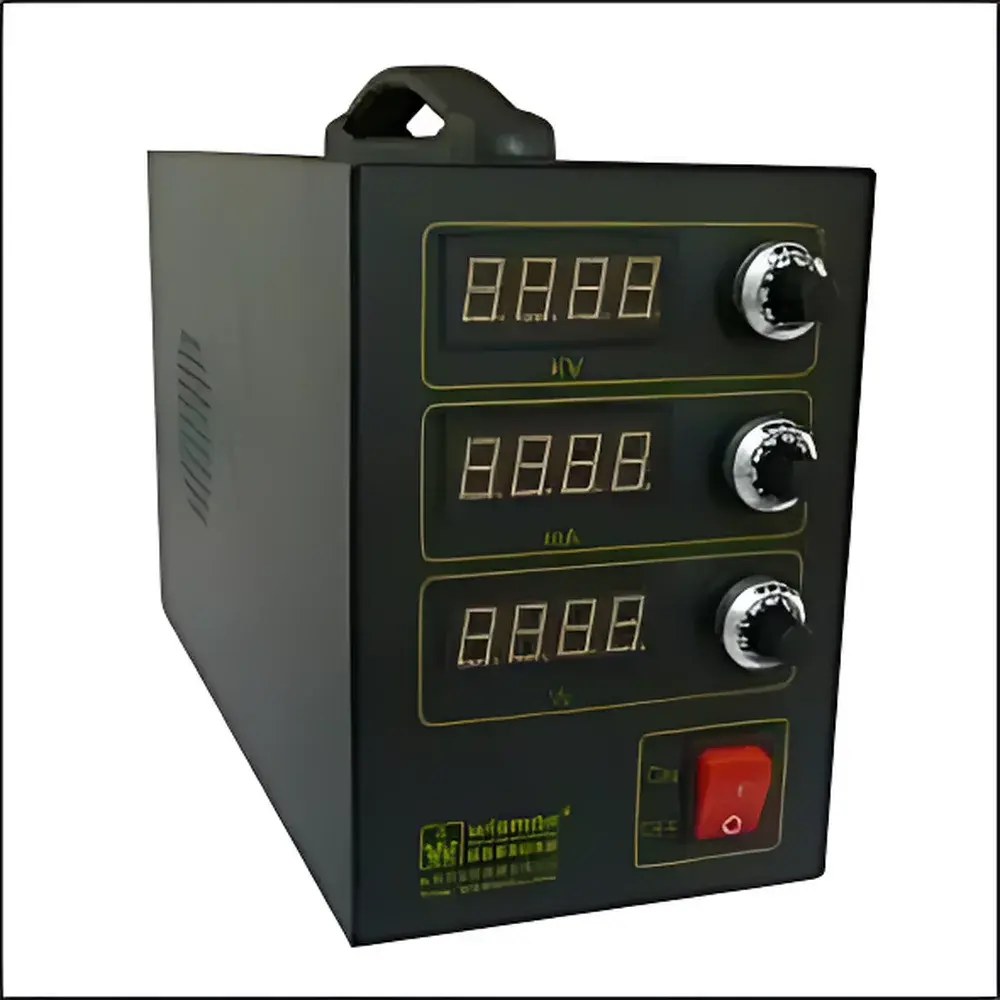
Wiseman DED Series Portable High-Voltage Power Supply – 50 kV / 100 W
| Brand | Wiseman |
|---|---|
| Model | DED |
| Output Voltage Range | 0.5–50 kV (adjustable) |
| Output Current Range | 0–50 mA |
| Maximum Output Power | 100 W |
| Input | AC 86–256 V ±10%, 3 A |
| Ripple | ≤0.1% peak-to-peak of rated output voltage |
| Stability | <25 ppm/h (after 30 min warm-up) |
| Temperature Coefficient | ≤25 ppm/°C |
| Voltage & Current Regulation | Local (multi-turn potentiometer) or Remote (0–10 V analog, USB/RS-232/RS-422 digital) |
| Protection Features | Overvoltage, Short-Circuit, Arc Detection, Interlock Safety |
| Dimensions | 310 × 130 × 185 mm |
| Weight | 2.5–6.2 kg |
| Compliance | Designed for GLP/GMP-aligned lab environments |
Overview
The Wiseman DED Series Portable High-Voltage Power Supply is an engineered precision DC high-voltage source designed for demanding laboratory and industrial applications requiring stable, controllable, and safe operation up to 50 kV. Based on solid-state switching topology with linear regulation stages, the DED series delivers low-noise, high-stability DC output optimized for electrostatic processes, analytical instrumentation, and materials testing. Its compact chassis—measuring only 310 mm in length and weighing as little as 2.5 kg—enables deployment in mobile labs, cleanroom workstations, and field-deployable test setups without compromising electrical integrity. Unlike general-purpose HV supplies, the DED integrates dual-mode control architecture: analog remote interface (0–10 V) for real-time analog feedback loops and digital serial interfaces (USB 2.0, RS-232, RS-422) for programmable automation, data logging, and integration into LIMS or SCADA systems.
Key Features
- Precision-adjustable output: 0.5–50 kV DC, 0–50 mA, with maximum continuous power up to 100 W
- Ultra-low ripple performance: ≤0.1% peak-to-peak of rated output voltage under full load conditions
- High short-term stability: <25 ppm/h drift after thermal stabilization (30-minute warm-up period)
- Low temperature coefficient: ≤25 ppm/°C across operating range (0–50 °C ambient)
- Dual-control flexibility: local multi-turn potentiometers + analog 0–10 V remote input + digital serial command set
- Comprehensive protection suite: overvoltage shutdown (OVP), arc detection with auto-recovery or latch-off (AT), short-circuit current limiting, interlock-enabled safety disable, and optional floating ground (FG) or low-leakage (FGLL) configurations
- Modular connectivity: standardized HV output connectors (SHV or MHV, user-selectable), 1 m shielded HV cable included, and auxiliary I/O for voltage/current monitoring (0–10 V analog outputs, ±1% accuracy)
- Configurable startup behavior: optional no-soft-start (NSS), custom soft-start (SS(X)), or over-power trip (ATP) modes for system-level compatibility
Sample Compatibility & Compliance
The DED series is explicitly qualified for use with electrophoresis systems—including horizontal and vertical gel electrophoresis units—as a dedicated instrument-grade HV source meeting IEC 61010-1 (Safety Requirements for Electrical Equipment for Measurement, Control, and Laboratory Use) Class II insulation standards. Its low leakage design (optional FGLL module) ensures minimal stray current during high-resistance sample measurements, critical for DNA fragment separation fidelity and blotting efficiency. When operated with validated firmware and audit-trail-enabled host software, the DED supports compliance with FDA 21 CFR Part 11 for electronic records and signatures in regulated laboratories. It is routinely deployed in ISO/IEC 17025-accredited testing facilities for dielectric strength evaluation (per ASTM D149), electrostatic coating validation (ISO 15957), and nanoparticle charging characterization.
Software & Data Management
Wiseman provides a Windows-compatible SDK and GUI application supporting USB, RS-232, and RS-422 communication protocols. The software enables real-time parameter readback (voltage, current, status flags), scheduled ramp profiles, event-triggered logging (e.g., arc detection timestamps), and export to CSV or MATLAB-compatible formats. For integration into automated test platforms, the command set follows ASCII-based SCPI-like syntax with full error reporting (e.g., “:STAT:QUES:COND?”). All digital control channels support non-volatile storage of last-set parameters and configurable watchdog timeouts. When used with third-party LabVIEW or Python (PySerial) environments, the DED maintains deterministic response latency (<50 ms for setpoint updates), essential for closed-loop electrostatic deposition or pulsed charging applications.
Applications
- Electrophoresis power supply for SDS-PAGE, native PAGE, and capillary electrophoresis systems
- Electrostatic process control: electrospinning of nanofibers, electrostatic spraying of functional coatings, and electrostatic flocking for textile adhesion
- Insulation resistance and dielectric breakdown testing per ASTM D149 and IEC 60243
- Capacitor conditioning and aging tests in component qualification labs
- Laser tube biasing and photomultiplier tube (PMT) dynode chain powering
- Air purification and particulate removal systems requiring controlled corona discharge
- Research-scale electrohydrodynamic (EHD) flow studies and ion mobility spectrometer calibration
FAQ
What safety certifications does the DED series comply with?
The DED series meets IEC 61010-1 Edition 3 for laboratory equipment safety, including double insulation, creepage/clearance compliance, and enclosure IP20 rating. Optional configurations support UL 61010-1 listing upon request.
Can the DED be used in a grounded versus floating configuration?
Yes—standard models feature earth-referenced outputs, but optional FG (floating ground) and FGLL (floating low-leakage) variants are available for isolation-sensitive applications such as PMT biasing or differential electrostatic sensing.
Is remote programming supported for automated test sequences?
Yes—the DED supports full SCPI-style command sets over USB, RS-232, and RS-422, enabling integration with Python, LabVIEW, MATLAB, or custom C++ test executive frameworks.
How is output stability verified during long-duration experiments?
Stability is characterized per IEEE Std 118-2020: drift is measured continuously for ≥2 hours post-warm-up under constant load and ambient conditions; all published specs reflect mean values across ≥5 units at 25 °C.
What accessories are required for electrophoresis integration?
Standard delivery includes SHV output connector, 1 m shielded HV cable, and mating low-voltage control cable. Electrophoresis-specific mounting brackets and DIN-rail adapters are available as optional accessories.
Related Products



