
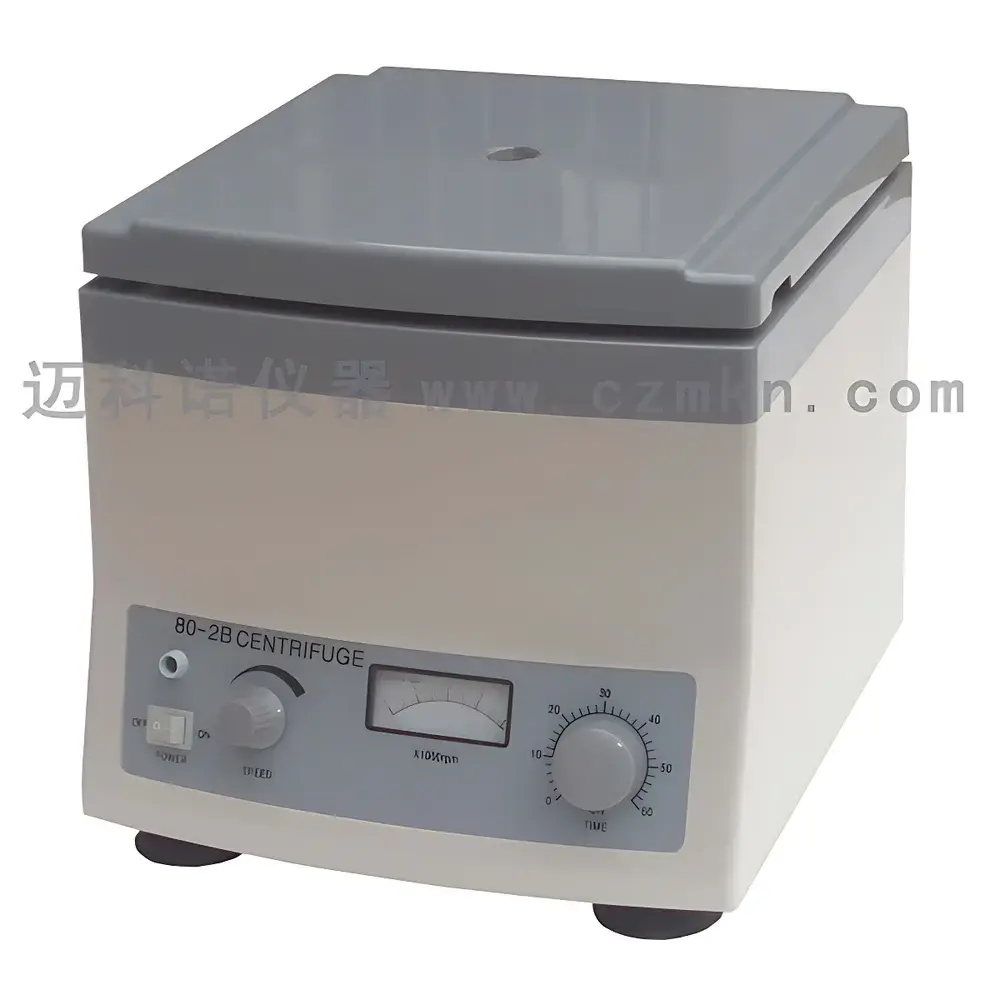
Maykno 80-2B Benchtop Centrifuge
| Origin | Zhejiang, China |
|---|---|
| Manufacturer Type | Distributor |
| Model | 80-2B |
| Max Speed | 4000 rpm |
| Relative Centrifugal Force (RCF) | 2325 × g |
| Capacity | 12 × 20 mL (or 12 × 15 mL) |
| Timer Range | 0–60 min |
| Power | 135 W |
| Noise Level | ≤60 dB(A) |
| Supply Voltage | AC 220 V, 50 Hz, 2 A |
| Rotor Material | Anodized Aluminum |
| Drive System | Dedicated Brushed DC Motor |
| Control Type | Analog Speed & Time Dial |
| Safety Features | Lid Interlock Switch, Dual Fuses, Imbalance Protection |
Overview
The Maykno 80-2B is a compact, analog-controlled benchtop centrifuge engineered for routine separation tasks in academic laboratories, clinical diagnostics, pharmaceutical QC labs, and environmental testing facilities. It operates on the principle of sedimentation under centrifugal force—accelerating particle settling based on density, size, and shape differences in heterogeneous liquid suspensions. Designed for reproducible low-to-medium speed applications, the 80-2B delivers consistent RCF up to 2325 × g at 4000 rpm, making it suitable for pelleting cells, precipitating macromolecules, clarifying serum or plasma samples, and preparing suspensions prior to downstream analysis (e.g., ELISA, HPLC sample prep, or microbial culture processing). Its robust mechanical architecture—featuring a high-torque brushed DC motor, precision-machined aluminum rotor, and vibration-damped housing—ensures stable operation across extended runs without thermal drift or speed fluctuation.
Key Features
- Continuous analog speed control (0–4000 rpm) with calibrated pointer dial for intuitive setting and verification
- Mechanical timer (0–60 minutes) with audible end-of-run signal and automatic rotor deceleration
- Integrated safety interlock system: centrifuge halts immediately upon lid opening during operation
- Dual-fuse overcurrent protection and built-in imbalance detection circuitry prevent motor overload and rotor wobble
- Lightweight yet rigid polypropylene housing with ergonomic footprint (ideal for crowded fume hoods or shared lab benches)
- Low-noise design (<60 dB[A] at maximum speed) compliant with ISO 717-1:2013 ambient noise guidelines for laboratory environments
- Aluminum rotor compatible with standard 15 mL and 20 mL conical tubes; rotor balance verified per ISO 15195:2021 calibration protocols
Sample Compatibility & Compliance
The 80-2B accommodates up to twelve 15 mL or 20 mL conical centrifuge tubes (e.g., Falcon® 15×100 mm or similar), supporting common biological matrices including whole blood, serum, plasma, bacterial lysates, cell culture supernatants, and food homogenates. Tube compatibility assumes use of tubes rated for ≥2500 × g (e.g., polypropylene tubes meeting ASTM D4976 specifications). While not certified for biosafety level 3 (BSL-3) containment, the unit meets general-purpose laboratory safety requirements outlined in IEC 61010-1:2010 (Safety of Electrical Equipment for Measurement, Control, and Laboratory Use). It supports GLP-compliant workflows when operated with documented SOPs, manual log entries, and periodic verification of speed accuracy using an external tachometer traceable to NIST standards.
Software & Data Management
As an analog instrument, the 80-2B does not incorporate digital firmware, USB connectivity, or data logging capabilities. All operational parameters—including speed, time, and run status—are manually set and visually confirmed via front-panel dials and indicators. This architecture eliminates software validation overhead and aligns with FDA 21 CFR Part 11 “exclusion criteria” for non-electronic record systems. Users maintain full auditability through handwritten or LIMS-integrated run logs, noting batch ID, operator initials, date/time, rotor position, tube configuration, and observed performance (e.g., no abnormal vibration or temperature rise). Calibration certificates for speed and timer accuracy may be issued upon request for internal QA documentation.
Applications
- Routine blood fractionation: separation of serum/plasma from erythrocytes in clinical chemistry screening
- Pelleting mammalian or microbial cells prior to lysis buffer addition or RNA extraction
- Clarification of protein solutions and antibody-containing supernatants
- Pre-concentration of environmental water samples for heavy metal or pathogen analysis
- Removal of particulates from food extracts or beverage formulations prior to spectrophotometric assay
- Supporting USP sterility test preparation by centrifuging membrane filtration eluates
FAQ
Is the 80-2B suitable for centrifuging infectious samples?
No. It lacks sealed rotor containment, aerosol-tight lids, or HEPA filtration. For BSL-2+ agents, a Class II biosafety cabinet-compatible centrifuge with certified biocontainment rotors is required.
Can I use glass tubes in this centrifuge?
Not recommended. The rotor is designed for plastic conical tubes rated to ≥2500 × g. Glass tubes pose fracture risk under acceleration and are incompatible with the rotor’s tube pocket geometry.
What maintenance is required for long-term reliability?
Wipe exterior with 70% ethanol after each use; inspect rotor for corrosion or stress cracks every 6 months; verify speed accuracy annually using a calibrated handheld tachometer.
Does the unit support variable acceleration/deceleration rates?
No. It employs fixed-rate ramp-up and coast-down profiles optimized for mechanical stability and tube integrity.
Is rotor balancing mandatory before each run?
Yes. Always load symmetrically opposite positions with equal mass (±0.1 g tolerance) to prevent bearing wear and premature failure per ISO 21501-4:2018 guidance.



