
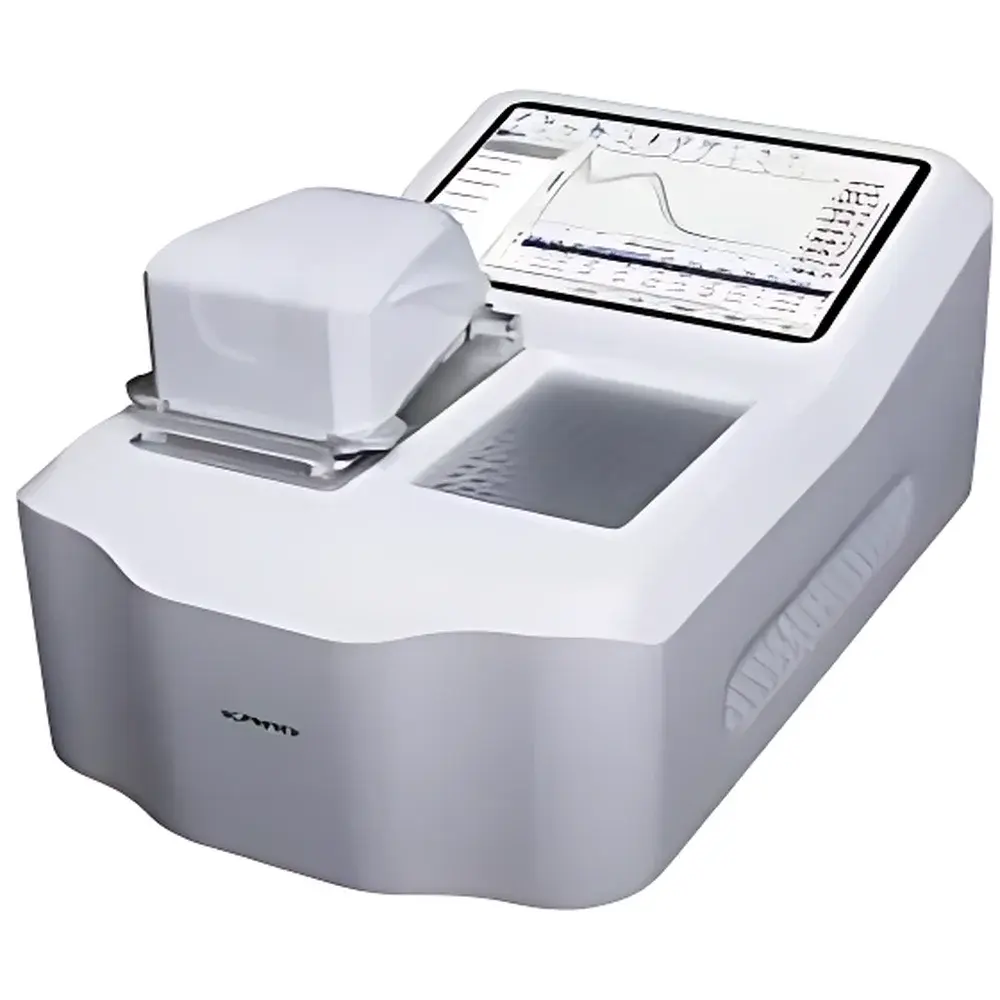
K8000 Eight-Channel Ultra-Microvolume UV-Vis Spectrophotometer
| Brand | Jihepu |
|---|---|
| Origin | Shandong, China |
| Model | K8000 |
| Detector Type | 2048-pixel linear CCD array |
| Wavelength Range | 190–850 nm |
| Wavelength Accuracy | ±1 nm |
| Spectral Bandwidth | 2 nm (FWHM at Hg 546 nm) |
| Wavelength Repeatability | <±0.5 nm |
| Absorbance Range | 0.002–150 AU (equivalent to 10 mm pathlength) |
| Sample Volume | 1–2.5 µL |
| Nucleic Acid Quantitation Range | 2–7500 ng/µL (dsDNA) |
| Protein Quantitation Range | 0.01–100 mg/mL (BSA) |
| Measurement Time | <5 s per 8-sample batch |
| Light Source | Long-life pulsed xenon lamp |
| Optical Platform | Stainless steel base with fused silica fiber-coupled quartz measurement stage |
| Data Interface | USB 2.0 and Ethernet |
| Display | High-resolution capacitive touchscreen |
Overview
The K8000 Eight-Channel Ultra-Microvolume UV-Vis Spectrophotometer is an engineered solution for high-throughput nucleic acid and protein quantification in modern molecular biology, biopharmaceutical QC, and academic research laboratories. Utilizing fixed-pathlength microvolume measurement via fiber-coupled quartz optical geometry—rather than variable-drop compression—it eliminates capillary-based calibration drift and ensures consistent photometric performance across all eight parallel channels. The system operates on the principle of direct absorbance spectroscopy in the ultraviolet and visible range (190–850 nm), employing a pulsed xenon lamp for broad-spectrum excitation and a thermally stabilized 2048-element linear CCD array for simultaneous spectral acquisition. This architecture delivers high photometric linearity (>99.9% R² over full absorbance range), low stray light (<0.01% at 220 nm), and intrinsic resistance to lamp aging effects—critical for longitudinal assay reproducibility under GLP or GMP-aligned workflows.
Key Features
- Parallel eight-channel measurement architecture enables true batch processing of up to eight independent microvolume samples (1–2.5 µL each) without manual repositioning or recalibration.
- Fixed optical path design using fused silica fiber-optic coupling and quartz measurement stage ensures pathlength consistency (equivalent to 10 mm) and eliminates user-induced variability associated with adjustable pedestals.
- Pulsed xenon lamp provides stable, flash-based illumination across 190–850 nm with >10⁹ shot lifetime—eliminating warm-up time and intensity decay during daily operation.
- High-fidelity 2048-pixel linear CCD detector achieves 2 nm spectral resolution (FWHM at Hg 546 nm) and wavelength accuracy of ±1 nm, validated per ISO 8579-1:2021 optical alignment protocols.
- Capacitive touchscreen interface supports gesture-driven navigation, multi-language UI (English, German, Japanese), and on-device data review with zoomable spectral overlays.
- Integrated data management supports timestamped audit trails, user access levels (admin/operator/guest), and export formats compliant with LIMS integration (CSV, XML, PDF with embedded spectra).
Sample Compatibility & Compliance
The K8000 accommodates standard 0.2 mL PCR tubes, 8-well strips, and custom microvolume sample holders compatible with common labware footprints. Its optical design is optimized for aqueous biological matrices—including crude lysates, purified DNA/RNA, antibody solutions, and small-molecule formulations—with no requirement for dilution below 2 ng/µL dsDNA or 0.01 mg/mL BSA. The instrument meets electromagnetic compatibility requirements per IEC 61326-1:2023 and safety standards IEC 61010-1:2010. While not FDA 510(k)-cleared, its firmware architecture supports 21 CFR Part 11-compliant electronic signatures when deployed with validated network authentication and encrypted local storage—making it suitable for regulated environments operating under internal SOPs aligned with ISO/IEC 17025 or USP .
Software & Data Management
The bundled SpectraLink v3.2 software provides real-time spectral visualization, kinetic mode (up to 10 Hz sampling), and built-in quantitation modules for A260/A280 ratio analysis, Nanodrop-style concentration algorithms, and custom extinction coefficient entry. All measurements are automatically tagged with instrument ID, operator credentials, environmental temperature/humidity (via optional external sensor input), and GPS-derived location metadata (when enabled). Raw spectral data (.spc binary format) and processed reports (.pdf/.csv) are stored with SHA-256 hash integrity verification. Audit logs record every parameter change, file export, or user login—retained for ≥180 days unless purged under documented retention policy.
Applications
- Routine QC of plasmid preps, CRISPR gRNA stocks, and NGS library fragments prior to sequencing.
- High-frequency monitoring of monoclonal antibody titer and purity in upstream bioprocess development.
- Verification of oligonucleotide synthesis yield and desalting efficiency in oligo core facilities.
- Quantitative assessment of protein stability under thermal or chemical denaturation gradients (via time-resolved A280 tracking).
- Educational use in undergraduate biochemistry labs for teaching Beer-Lambert law fundamentals with minimal consumables.
FAQ
Does the K8000 require routine wavelength calibration using holmium oxide or didymium filters?
No—its monolithic CCD-based spectrometer is factory-aligned to NIST-traceable standards and maintains wavelength fidelity without user-performed recalibration. Annual verification using supplied reference standards is recommended per ISO/IEC 17025 Clause 6.5.2.
Can the instrument measure turbid or particulate-containing samples such as cell lysates?
Yes—scattering compensation algorithms are applied in real time using baseline correction from 800 nm region; however, centrifugation or filtration is advised for samples exceeding OD320 > 0.3 to minimize Mie scattering artifacts.
Is remote monitoring supported via LabVantage or Thermo Fisher SampleManager LIMS?
Native API support (RESTful JSON over HTTPS) enables bidirectional integration with major LIMS platforms; certified drivers for LabVantage v12.4+ and SampleManager 2023.1 are available upon request from technical support.
What is the minimum detectable absorbance for low-concentration RNA samples?
At 260 nm, the system achieves a signal-to-noise ratio (SNR) of ≥300:1 at 0.002 AU, corresponding to ~0.5 ng/µL dsDNA or ~0.8 ng/µL ssRNA under optimal pipetting conditions.
How is photometric accuracy verified during IQ/OQ/PQ qualification?
Comprehensive qualification kits include NIST-traceable neutral density filters (OD 0.3/1.0/2.0), holmium oxide solution (for wavelength verification), and certified protein/DNA reference materials—validated against ASTM E275-22 Annex A2 protocols.





