
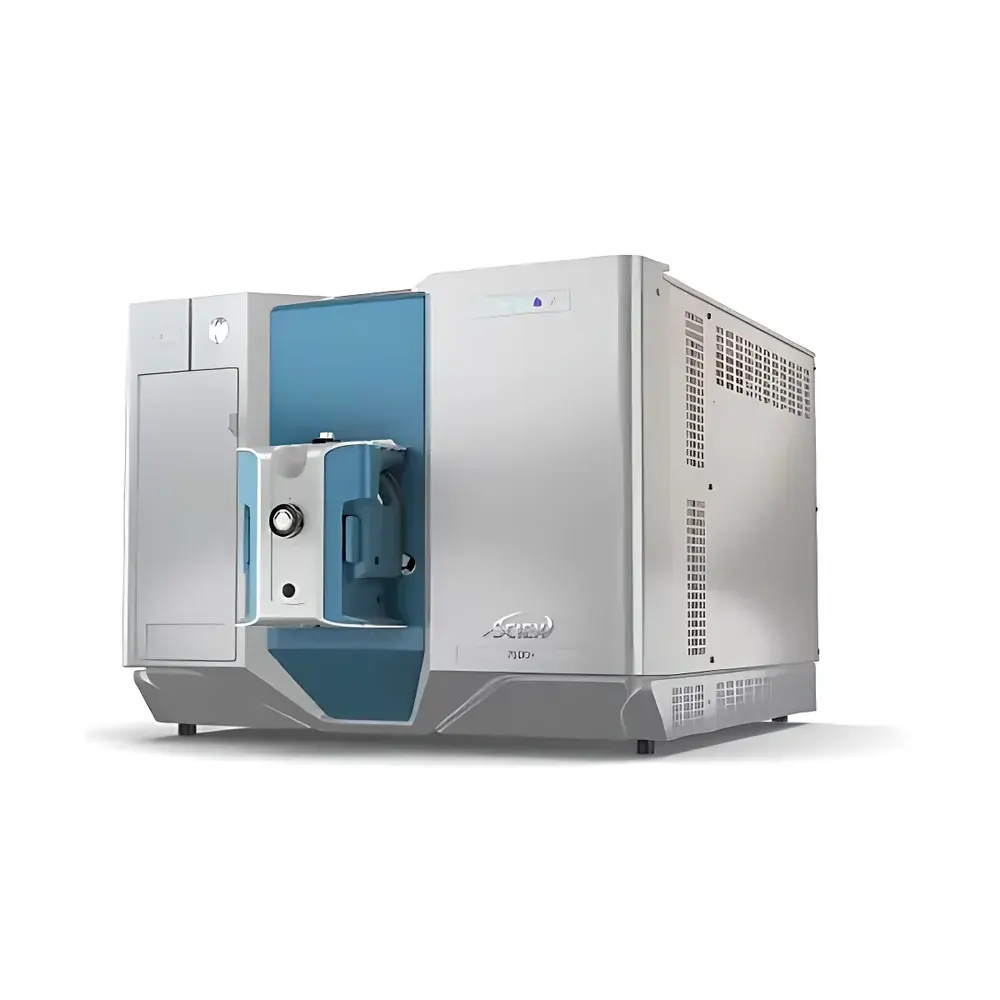
SCIEX 7500+ Triple Quadrupole Mass Spectrometry System
| Brand | SCIEX |
|---|---|
| Origin | USA |
| Manufacturer Type | Authorized Distributor |
| Origin Category | Imported |
| Model | SCIEX 7500+ System |
| Instrument Type | Triple Quadrupole (Tandem Quadrupole, QqQ) |
| Application Scope | Universal LC-MS/MS Analysis |
| MRM Transition Rate | 800 transitions/sec |
| Vacuum System Compatibility | Dry Pump Compatible |
| Regulatory Alignment | Designed for GLP/GMP-compliant laboratories |
| Software Platform | SCIEX OS |
Overview
The SCIEX 7500+ Triple Quadrupole Mass Spectrometry System is a high-performance liquid chromatography–tandem mass spectrometry (LC-MS/MS) platform engineered for precision quantitative analysis across diverse sample matrices and regulatory environments. Built upon a robust QqQ architecture, the system operates on the principle of selective ion transmission through three quadrupole stages: Q1 for precursor ion selection, Q2 as a collision cell for controlled fragmentation (CID), and Q3 for product ion filtering—enabling highly specific detection via Multiple Reaction Monitoring (MRM). This configuration delivers exceptional sensitivity, selectivity, and reproducibility in complex biological, environmental, pharmaceutical, and food safety applications. As a next-generation evolution of SCIEX’s 50-year legacy in triple quadrupole innovation—dating back to the industry’s first commercial QqQ system introduced in 1981—the 7500+ integrates hardware and software advances to address evolving analytical demands, including higher throughput, lower maintenance burden, and long-term performance stability under routine operation.
Key Features
- Mass Guard Technology: An integrated active ion filtering mechanism that selectively suppresses non-target ions prior to the collision cell, significantly reducing source and detector contamination—particularly critical when analyzing high-fat, high-protein, or highly matrix-laden samples such as plasma, tissue homogenates, or wastewater extracts.
- DJet+ Ion Source Assembly: A fully modular, tool-free detachable electrospray ionization (ESI) interface designed for front-end maintenance. Enables rapid cleaning or replacement of critical components—including the spray needle, curtain gas plate, and orifice—without venting the vacuum system, minimizing instrument downtime.
- 800 MRM Transitions per Second: The highest MRM acquisition speed in the SCIEX QqQ portfolio, supporting comprehensive multi-analyte panels (e.g., >200 compounds in a single run) without sacrificing dwell time or quantitation accuracy—ideal for clinical toxicology, pesticide residue screening, and targeted metabolomics workflows.
- Dry Pump Compatibility: Native support for oil-free vacuum pumping systems reduces power consumption by up to 24% versus traditional oil diffusion or turbomolecular pumps, lowers operational costs, eliminates oil backstreaming risks, and simplifies laboratory infrastructure requirements.
- SCIEX OS Software Integration: Provides real-time instrument health monitoring, automated performance verification (e.g., calibration check, tuning report generation), and intelligent decision logic to flag suboptimal acquisitions—reducing manual review burden and reanalysis frequency in regulated environments.
Sample Compatibility & Compliance
The SCIEX 7500+ demonstrates broad compatibility with reversed-phase, HILIC, and ion-pairing LC methods, and supports both positive and negative electrospray ionization (ESI) as well as atmospheric pressure chemical ionization (APCI). It routinely handles biological fluids (serum, urine, CSF), plant and animal tissues, soil extracts, food homogenates, and purified small molecules. From a compliance standpoint, the system is architected to support audit-ready operations: SCIEX OS enables full electronic record retention, user access controls, audit trail logging (per FDA 21 CFR Part 11), and method versioning—facilitating adherence to ISO/IEC 17025, CLIA, GLP, and GMP frameworks. Routine calibration and system suitability testing align with ASTM D7622, USP , and ICH M10 guidelines.
Software & Data Management
SCIEX OS serves as the unified control, acquisition, and processing environment. Its modular architecture separates instrument control (Acquisition), data review (Review), and reporting (Report) functions—each governed by role-based permissions. Raw data files (.wiff) are stored in a structured, timestamped hierarchy compliant with FAIR (Findable, Accessible, Interoperable, Reusable) principles. Batch processing supports automatic peak integration using weighted linear regression, internal standard normalization, and outlier detection based on predefined QC acceptance criteria. All processing parameters—including integration algorithms, baseline correction settings, and calibration curve weighting—are fully traceable and exportable for regulatory submission packages.
Applications
The 7500+ is deployed in core application domains requiring high-confidence quantitation at low ng/L to pg/mL levels: clinical diagnostics (vitamin D, steroid hormones, immunosuppressants); environmental monitoring (PFAS, PCBs, organophosphate pesticides); food safety (mycotoxins, veterinary drug residues, adulterants); and pharmaceutical development (PK/PD studies, bioequivalence, impurity profiling). Its enhanced robustness in dirty matrix analysis also supports emerging areas such as exposome research and single-cell metabolite profiling when coupled with nano-LC or microfluidic separation platforms.
FAQ
What regulatory standards does the SCIEX 7500+ support for validated laboratory use?
The system meets technical and procedural requirements for ISO/IEC 17025 accreditation, FDA 21 CFR Part 11 compliance (via SCIEX OS audit trail and electronic signature modules), and alignment with USP and ICH M10 method validation guidance.
Can the 7500+ be integrated into existing LIMS or ELN environments?
Yes—SCIEX OS provides ODBC-compliant database connectivity and supports HL7, ASTM E1384, and ANSI X12 interfaces for bidirectional data exchange with major LIMS and electronic lab notebook platforms.
Is Mass Guard technology compatible with APCI and other ionization sources?
Mass Guard is optimized for ESI and APCI configurations; performance validation data is available for both modalities under routine operating conditions.
How frequently is preventive maintenance recommended for the DJet+ source?
Under typical high-throughput operation (≥50 samples/day), source inspection is advised every 7–10 days, with full cleaning intervals ranging from 2–4 weeks depending on sample cleanliness—significantly extending maintenance cycles compared to previous-generation SCIEX QqQ platforms.
Does the 7500+ support isotopic dilution mass spectrometry (IDMS)?
Yes—the system’s high mass accuracy stability (<0.1 Da over 24 h), precise dwell time control, and dual-channel analog-to-digital conversion enable reliable IDMS workflows for reference material certification and metrological-grade quantitation.






