
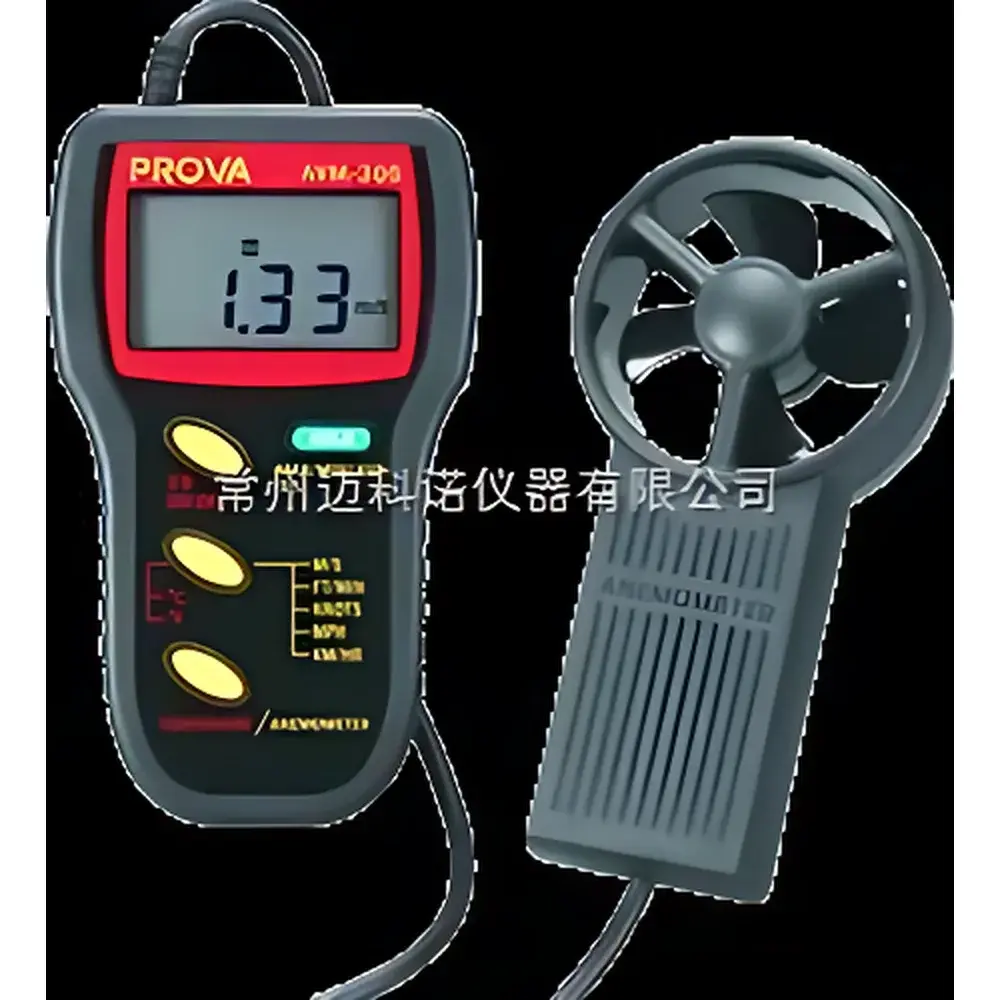
MKN AVM-305 Digital Vane Anemometer
| Brand | MKN |
|---|---|
| Model | AVM-305 |
| Type | Digital Vane Anemometer |
| Wind Speed Range | 0.0–45.0 m/s (0.0–100.0 mph, 0.0–88.0 knots, 0.0–160.0 km/h, 0–8800 ft/min) |
| Resolution | 0.01 m/s (selectable unit-dependent) |
| Accuracy | ±3% ±0.2 m/s (typical) |
| Wind Temperature Range | −5.0–60.0 °C / 32.0–140.0 °F |
| Temp Accuracy | ±1.0 °C / ±1.8 °F |
| Display | 4-digit LCD with hold, max/min/avg functions |
| Power | 2 × 1.5 V AA batteries (200 h typical life) |
| Interface | RS-232C (USB adapter included) |
| Operating Temp | 0–50 °C (instrument), 0–60 °C (probe) |
| Humidity Limit | <80% RH |
| Dimensions (meter) | 78 × 130 × 40 mm |
| Weight | 250 g (with batteries) |
Overview
The MKN AVM-305 Digital Vane Anemometer is a handheld, precision-engineered instrument designed for reliable measurement of air velocity and ambient temperature in HVAC commissioning, indoor air quality (IAQ) assessments, cleanroom validation, industrial ventilation audits, and environmental compliance monitoring. Utilizing a calibrated axial vane sensor with low-inertia rotor design, the AVM-305 operates on the principle of rotational drag—where airflow induces proportional angular velocity in the vane assembly, converted via optical or magnetic sensing into a linear digital output. Its dual-parameter capability (simultaneous wind speed and temperature) supports psychrometric calculations and airflow volume estimation when paired with duct cross-sectional area data. The device complies with fundamental metrological requirements for portable anemometers per ISO 7726:1998 (Ergonomics of the thermal environment — Instruments for measuring physical quantities) and aligns with best practices outlined in ASHRAE Guideline 12-2020 (Managing the Risk of Legionellosis Associated with Building Water Systems) for routine air movement verification.
Key Features
- Four-digit backlit LCD display with intuitive icon-driven interface and real-time unit switching (m/s, ft/min, knots, km/h, mph)
- Multi-function data logging: instantaneous reading, peak hold, minimum/maximum tracking, and time-weighted average calculation
- Auto power-off after 10 minutes of inactivity to conserve battery life; low-battery indicator ensures uninterrupted field operation
- High-sensitivity vane probe (66 × 132 × 29.2 mm) with balanced aerodynamic profile for stable response across turbulent and laminar flow regimes
- Integrated thermistor-based temperature sensor with dual-scale readout (°C/°F) and automatic conversion per ITS-90 reference equations
- Rugged ABS housing rated for professional field use; 1/4″-20 threaded mounting interface compatible with tripods and fixed-position brackets
- RS-232C serial port (with included USB-to-RS232 adapter and Windows-compatible software) enables traceable data export for QA documentation and audit trails
Sample Compatibility & Compliance
The AVM-305 is optimized for gaseous media under standard atmospheric conditions (500 mbar–2 bar pressure, <80% RH). It is not intended for corrosive, explosive, or particulate-laden airstreams without appropriate inlet filtration or probe shielding. While not certified to IECEx or ATEX standards, its electrical design adheres to IEC 61010-1:2010 safety requirements for hand-held measuring equipment. The instrument supports GLP-aligned workflows through timestamped data capture and CSV export—facilitating integration into laboratory information management systems (LIMS) or electronic batch records compliant with FDA 21 CFR Part 11 when used with validated software configurations. Calibration certificates traceable to NIM (National Institute of Metrology, China) are available upon request.
Software & Data Management
Bundled Windows software provides real-time graphing, statistical analysis (mean, SD, min/max), and customizable report generation. Raw datasets include date/time stamps, measurement units, and environmental context tags. Export formats include .CSV (for Excel, MATLAB, or Python post-processing) and .PDF (for audit-ready documentation). The software supports configurable auto-save intervals and user-defined pass/fail thresholds for go/no-go testing in HVAC balancing protocols. All firmware updates and driver packages are distributed via secure HTTPS download—no cloud dependency or mandatory account registration.
Applications
- HVAC system balancing and airflow verification per SMACNA and ACCA Manual D guidelines
- Occupational health & safety assessments of local exhaust ventilation (LEV) performance (OSHA 1910.146, HSE HSG258)
- Validation of laminar flow hoods and biosafety cabinets (NSF/ANSI 49)
- Indoor environmental quality (IEQ) surveys supporting LEED IEQ Credit 2 and WELL Building Standard Air Concept
- Educational laboratories for fluid mechanics and thermodynamics instruction
- Field verification of fan coil unit output and duct leakage testing pre/post sealing
FAQ
What is the recommended calibration interval for the AVM-305?
Annual calibration is advised for applications requiring documented metrological traceability. Field zero-checks using still-air conditions should be performed before each critical measurement session.
Can the AVM-305 measure airflow in round ducts directly?
No—it measures point velocity only. To estimate volumetric flow rate, users must perform multi-point traverses per ISO 10780 or ASME PTC 19.5 and apply appropriate area-weighting algorithms.
Is the RS-232 interface optically isolated?
No. The interface uses standard TTL-level signaling. For electrically noisy industrial environments, use of a galvanically isolated USB-RS232 converter is recommended.
Does the device support custom unit definitions or user-defined scaling?
No. Unit selection is fixed per ISO 80000-4 and NIST SP 811 conventions. Scaling factors cannot be modified to preserve measurement integrity and regulatory defensibility.
How does temperature compensation affect wind speed accuracy?
The internal temperature reading is used only for display and auxiliary calculations; the vane sensor’s speed response is inherently temperature-stable within the specified operating range (0–60 °C), eliminating need for dynamic compensation.
Related Products







