
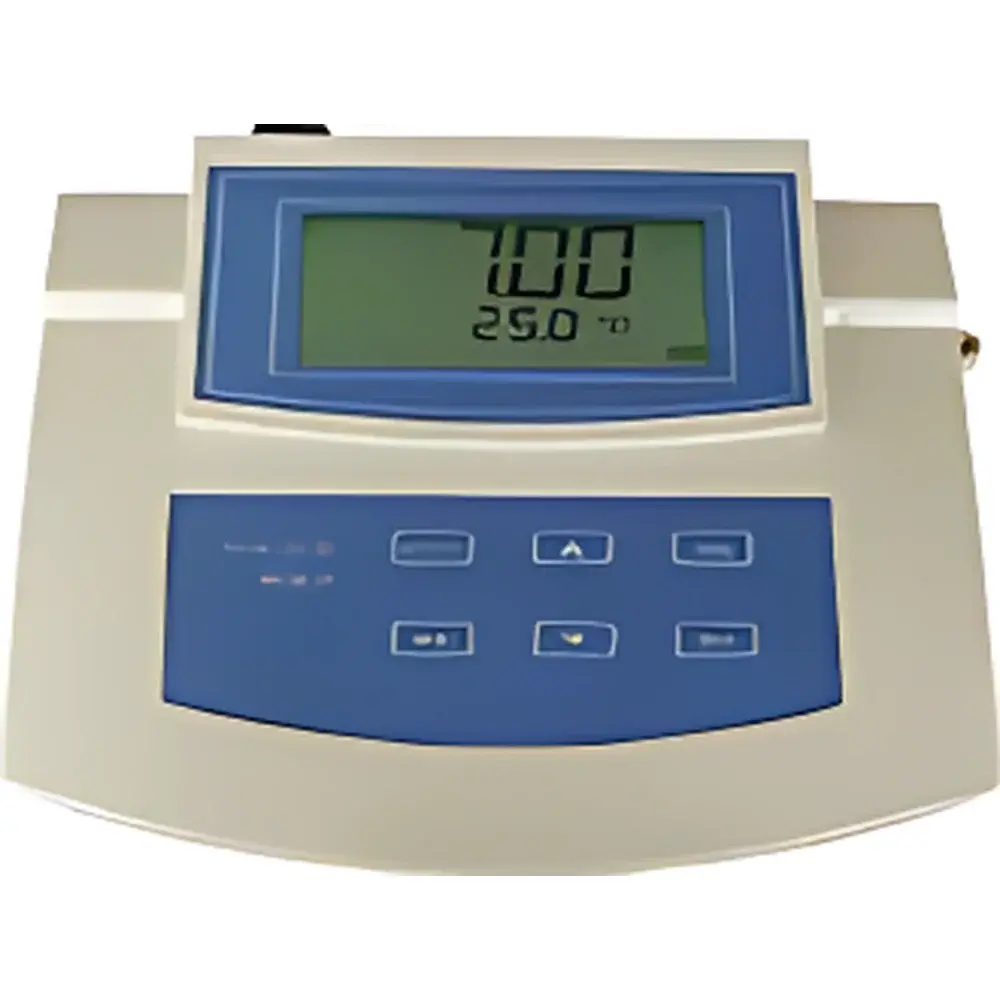
PHS-3C Benchtop pH Meter
| Origin | Jiangsu, China |
|---|---|
| Manufacturer Type | Authorized Distributor |
| Origin Category | Domestic (China) |
| Model | PHS-3C |
| Price | Upon Request |
| Accuracy Class | 0.01 |
| pH Range | 0.00–14.00 pH |
| mV Range | ±1400 mV |
| Resolution | 0.01 pH / 1 mV / 0.1 °C |
| Temperature Compensation | 0–60 °C |
| Basic Error (pH) | ±0.1 pH |
| Input Impedance | ≥3 × 10¹¹ Ω |
| Input Current | ≤1 × 10⁻¹¹ A |
| Repeatability (pH) | ≤0.05 pH |
| Stability | ±0.05 pH ±1 digit / 3 h |
| Dimensions (L×W×H) | 220 × 160 × 65 mm |
| Weight | 0.3 kg |
| Operating Temp. | 5–50 °C |
| RH Limit | ≤85% |
| Power Supply | DC 6 V |
Overview
The PHS-3C Benchtop pH Meter is a precision electrochemical instrument engineered for accurate, stable, and repeatable measurement of hydrogen ion activity in aqueous solutions. Based on the potentiometric principle, it measures the potential difference between a pH-sensitive glass electrode and a reference electrode (typically Ag/AgCl), converting this voltage into a calibrated pH reading via the Nernst equation (−59.16 mV/pH unit at 25 °C). Designed to meet ISO 8655-4 and IUPAC recommended practices for pH metrology, the PHS-3C delivers 0.01-class accuracy—suitable for routine quality control, environmental water testing, educational laboratories, and process validation under GLP-compliant workflows. Its dual-display LCD with blue backlight simultaneously shows pH and temperature or mV and temperature, enabling real-time thermal compensation without manual recalibration.
Key Features
- Dual-parameter digital display: Simultaneous readout of pH/mV and temperature (°C), eliminating sequential measurement steps and reducing operator error.
- High-input-impedance amplifier (≥3 × 10¹¹ Ω) minimizes loading effects on high-resistance electrodes, ensuring signal fidelity across low-conductivity samples such as deionized water or organic-aqueous mixtures.
- Manual or automatic temperature compensation (0–60 °C) using integrated thermistor sensing, supporting both ATC and MTC modes for flexibility in calibration and sample measurement protocols.
- Low input current (≤1 × 10⁻¹¹ A) preserves electrode integrity and extends service life—critical for long-term monitoring applications and sensitive reference junctions.
- Compact benchtop form factor (220 × 160 × 65 mm; 0.3 kg) with robust ABS housing, optimized for space-constrained labs and portable field deployment with external DC 6 V power supply.
- Compliance-ready design: Supports traceable calibration with NIST-traceable buffer standards (e.g., pH 4.01, 7.00, 10.01); compatible with documented calibration logs required under ISO/IEC 17025 and FDA 21 CFR Part 11 when paired with compliant data recording software.
Sample Compatibility & Compliance
The PHS-3C is validated for use with standard combination pH electrodes, ORP (oxidation-reduction potential) electrodes, and single-ion selective electrodes (e.g., fluoride, nitrate, calcium)—enabling versatile electrochemical analysis beyond pH. It accommodates aqueous samples across conductivity ranges from 10 µS/cm to >10 mS/cm, including wastewater, drinking water, fermentation broths, and buffer solutions. The instrument conforms to GB/T 11165–2022 (Chinese national standard for laboratory pH meters), aligning with international performance benchmarks in ISO 3696 (water for analytical use) and ASTM D1293 (pH of water). For regulated environments, its stability (±0.05 pH ±1 digit over 3 hours) and repeatability (≤0.05 pH) support audit-ready documentation per GLP and GMP Annex 11 requirements.
Software & Data Management
While the PHS-3C operates as a standalone analog-digital hybrid meter without embedded connectivity, its analog output capability (via optional interface modules) allows integration with third-party data acquisition systems (e.g., LabVIEW, MATLAB, or LIMS platforms) for automated logging, trend analysis, and electronic signature compliance. When used in conjunction with certified calibration procedures—including documented electrode conditioning, two-point (or three-point) buffer calibration, and daily verification—the device supports full traceability under ISO/IEC 17025 Clause 7.7 (Measurement Uncertainty) and USP pH measurement guidelines. Audit trails may be maintained externally via timestamped calibration records and raw mV readings.
Applications
- Environmental monitoring: Field and lab-based pH and ORP assessment of surface water, groundwater, and effluent streams per EPA Method 150.1 and ISO 10523.
- Academic instruction: Undergraduate and graduate teaching of electrochemical fundamentals, buffer theory, and electrode kinetics in chemistry and environmental science curricula.
- Pharmaceutical QC: Verification of dissolution media pH (USP ) and cleaning validation rinse water compliance (FDA Guidance for Industry).
- Food & beverage processing: Monitoring acidification steps in dairy, brewing, and juice production where pH directly impacts microbial stability and enzyme activity.
- Industrial process control: Inline support for neutralization reactions, electroplating bath management, and boiler water treatment programs.
FAQ
What calibration buffers are recommended for the PHS-3C?
Standard NIST-traceable buffers at pH 4.01, 7.00, and 10.01 are recommended for two- or three-point calibration. Buffer selection must match the expected sample pH range to minimize interpolation error.
Can the PHS-3C measure non-aqueous samples?
It is primarily designed for aqueous solutions. Non-aqueous or low-dielectric media require specialized electrodes and correction factors; direct measurement is not advised without method validation.
Is temperature compensation mandatory during pH measurement?
Yes—temperature affects both electrode slope and sample equilibrium. The PHS-3C’s built-in compensation ensures Nernstian response alignment; omitting it introduces systematic error exceeding ±0.1 pH per 10 °C deviation.
How often should the electrode be cleaned and stored?
Rinse with deionized water after each use; store hydrated in 3 M KCl solution. Clean with mild detergent (for organic fouling) or dilute HCl (for mineral deposits) every 5–10 measurements or daily in high-throughput labs.
Does the PHS-3C comply with FDA 21 CFR Part 11?
The base unit does not include electronic signatures or audit trail functionality. However, when integrated with validated external software and procedural controls (e.g., user access logs, calibration lockouts), it can operate within a Part 11–compliant environment.
Related Products




