
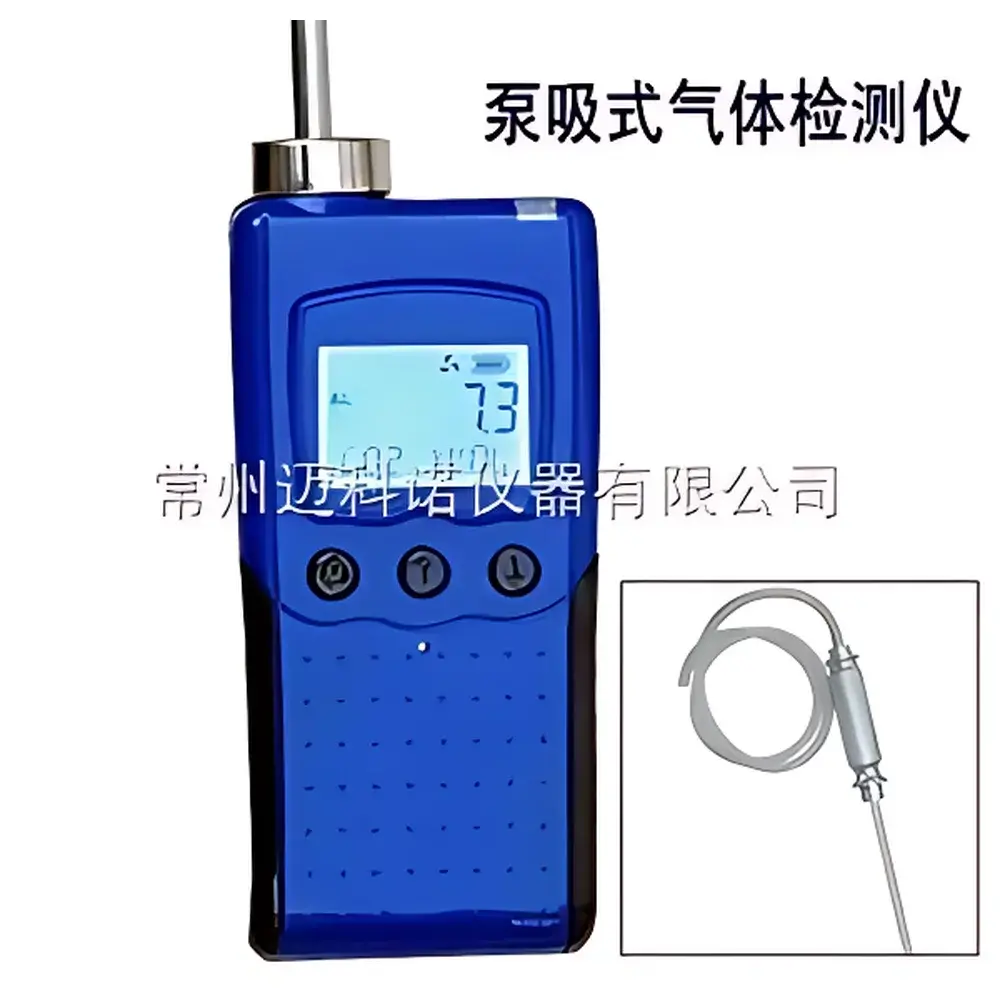
ST-808-SO2 Portable Pump-Aspirated Electrochemical Sulfur Dioxide (SO₂) Gas Detector with Alarm Function
| Key | Sampling Method: Pump-aspirated |
|---|---|
| Measurement Principle | Electrochemical Sensor |
| Detection Range Options | 0–10 ppm to 0–5000 ppm SO₂ |
| Resolution | 0.001–0.1 ppm (model-dependent) |
| Accuracy | ≤±3% FS |
| Response Time | ≤30 s |
| Recovery Time | ≤40 s |
| Operating Temperature | −20 °C to +70 °C |
| Relative Humidity | ≤95% RH (non-condensing) |
| Power Supply | 3.6 V DC, 1800 mAh Rechargeable Li-ion Battery |
| Dimensions | 125 × 52 × 30 mm (L×W×H) |
| Weight | 200 g |
| Intrinsic Safety Rating | Ex ib IIB T4 Gb |
| Sensor Lifetime | ≥2 years (up to 10 years under optimal conditions) |
| Display | Backlit LCD |
| Alarm Modes | Audible (buzzer), Visual (LED), Vibration, Low-Battery |
Overview
The ST-808-SO2 is a portable, pump-aspirated sulfur dioxide (SO₂) gas detector engineered for reliable, real-time ambient air quality monitoring in occupational and environmental settings. Utilizing a high-selectivity electrochemical sensing principle, the instrument measures SO₂ concentration by quantifying the current generated from the oxidation-reduction reaction of SO₂ at the working electrode surface—ensuring linear output, low cross-sensitivity to common interferents (e.g., NO₂, CO, H₂S), and stable baseline performance across variable temperature and humidity conditions. Its integrated micro-diaphragm sampling pump enables active draw-through sampling at a consistent flow rate (~300 mL/min), eliminating reliance on diffusion and significantly improving detection speed and representativeness—especially critical in low-airflow or confined spaces. Designed for field-deployable operation, the ST-808-SO2 complies with international functional safety requirements for portable gas detection equipment and supports continuous logging and alarm-triggered event capture in accordance with OSHA 29 CFR 1910.120 and EU Directive 2014/34/EU (ATEX) for hazardous area use.
Key Features
- Pump-aspirated sampling architecture ensures rapid, representative gas intake—critical for detecting transient SO₂ releases in industrial hygiene and emergency response scenarios.
- Imported electrochemical sensor with built-in temperature compensation (−20 °C to +70 °C operating range) and automatic zero/span calibration capability, minimizing drift and maintaining measurement integrity without frequent manual intervention.
- Backlit LCD display with intuitive icon-based interface provides real-time concentration readout, battery status, alarm indicators, and operational mode feedback—even under low-light or high-glare conditions.
- Triple-alarm system (audible buzzer, red LED strobe, and tactile vibration) with independently configurable upper/lower threshold limits per user-defined exposure criteria (e.g., OSHA PEL, NIOSH REL, or WHO IAQ guidelines).
- Intrinsically safe design certified to Ex ib IIB T4 Gb (IEC 60079-0, -11), enabling safe deployment in Zone 1/2 classified areas including petrochemical facilities, wastewater treatment plants, and sulfuric acid production lines.
- Robust housing constructed from chemical-resistant, abrasion-proof polymer with IP65-rated ingress protection—designed for repeated handling, cleaning with alcohol wipes, and long-term durability in demanding field environments.
Sample Compatibility & Compliance
The ST-808-SO2 is optimized for direct measurement of gaseous SO₂ in ambient air, workplace breathing zones, and process exhaust streams. It exhibits minimal interference from CO, NO₂, Cl₂, and H₂S when operated within specified environmental constraints (≤95% RH, non-condensing). The device meets performance requirements outlined in ISO 16000-25 (indoor air—determination of SO₂), EN 45544-1 (electrochemical gas detectors—performance requirements), and ASTM D5012 (standard practice for evaluating gas detector response). Its intrinsic safety certification permits use in potentially explosive atmospheres per IEC 60079 series standards. While not intended for regulatory stack emission compliance (e.g., EPA Method 6), it serves as a validated screening tool for pre-compliance assessment, leak detection, and worker exposure evaluation aligned with GLP-aligned field data collection practices.
Software & Data Management
Data logging functionality records time-stamped SO₂ concentration values at user-selectable intervals (1 s to 300 s), storing up to 100,000 data points internally. Logged files export via USB-C interface in CSV format for traceable post-processing in Excel, MATLAB, or LIMS-compatible platforms. Firmware supports audit-trail-enabled configuration changes—including alarm thresholds, calibration dates, and user access logs—meeting documentation rigor required under ISO/IEC 17025 and FDA 21 CFR Part 11 for electronic records in regulated laboratories. Optional PC software provides trend visualization, exposure dose calculation (TWA/STEL), and automated report generation compliant with OSHA 300 log requirements.
Applications
- Occupational health & safety: Real-time SO₂ exposure monitoring for workers in pulp & paper mills, metal smelters, coal-fired power plants, and sulfur recovery units.
- Environmental field surveys: Ambient air quality assessment near volcanic zones, industrial corridors, or transportation hubs where sulfurous emissions may impact community health.
- Emergency response: Rapid deployment during chemical spills, railcar leaks, or facility incidents involving liquid SO₂ or sulfite-based compounds.
- Public health & sanitation: Indoor air evaluation in schools, hospitals, and municipal buildings following fumigation or disinfection procedures using sulfur-based agents.
- Preventive maintenance: Routine checks of scrubber efficiency, flue gas desulfurization (FGD) system bypasses, and ventilation duct integrity in HVAC systems.
FAQ
What calibration gases are required for routine bump testing and full calibration?
A certified 5 ppm SO₂/N₂ standard gas (±2% uncertainty) is recommended for daily bump tests; for span calibration, a 50% or 80% of full-scale gas (e.g., 5 ppm for ST-808A, 1000 ppm for ST-808E) traceable to NIST or equivalent national metrology institute is required.
Can the instrument be used in condensing or high-humidity environments?
Standard units are rated for ≤95% RH non-condensing operation. For persistent condensation, optional hydrophobic particulate filter + heated sample line assembly must be specified at time of order.
Is firmware upgrade supported in the field?
Yes—via USB-C connection and manufacturer-provided utility software; all updates include version-controlled release notes and cryptographic signature verification.
How is sensor lifetime defined, and what factors affect longevity?
Sensor lifetime is defined as the period during which zero stability remains within ±10% FS and sensitivity loss does not exceed 20% of initial response; exposure to >100 ppm SO₂, H₂S >5 ppm, or solvent vapors accelerates degradation.
Does the device support multi-gas configurations?
The ST-808 platform is single-gas dedicated; however, the ST-808 series shares mechanical and firmware architecture with multi-gas variants (e.g., ST-808-4G), enabling fleet-level interoperability in mixed-deployment environments.
Related Products







