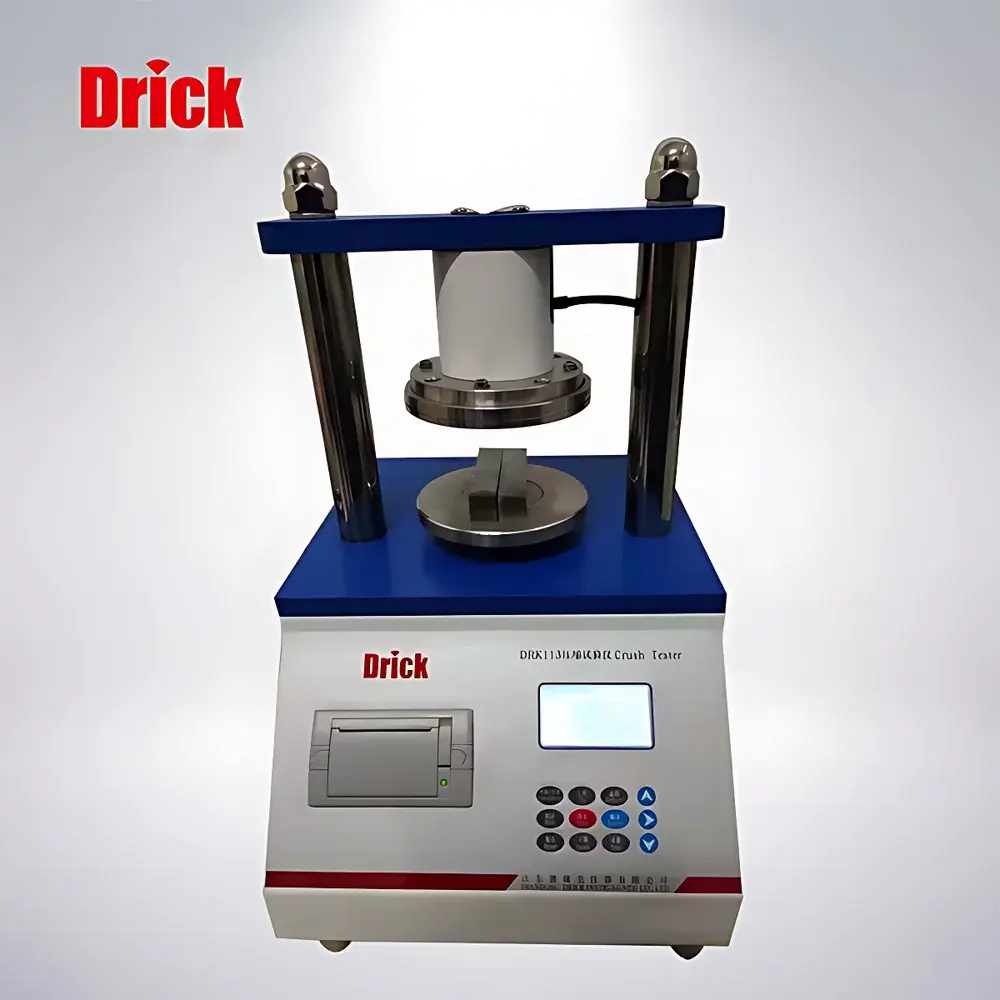
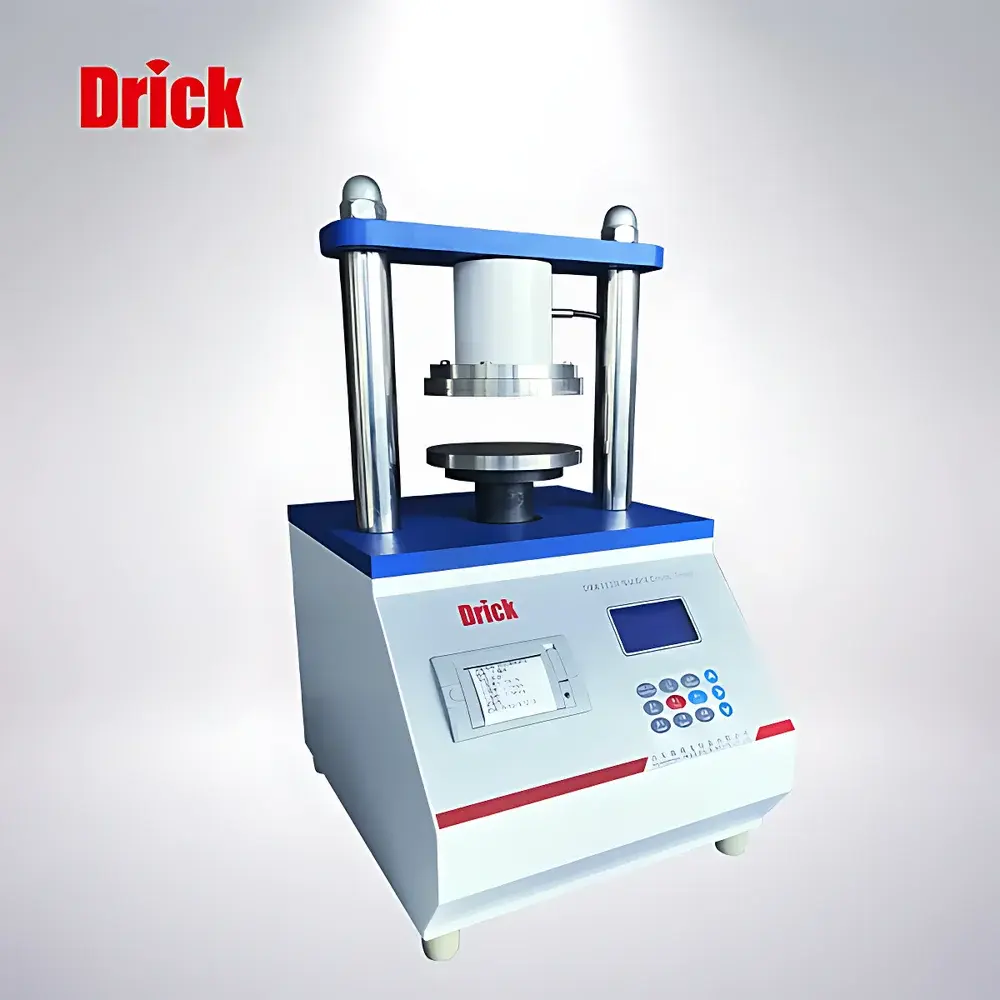
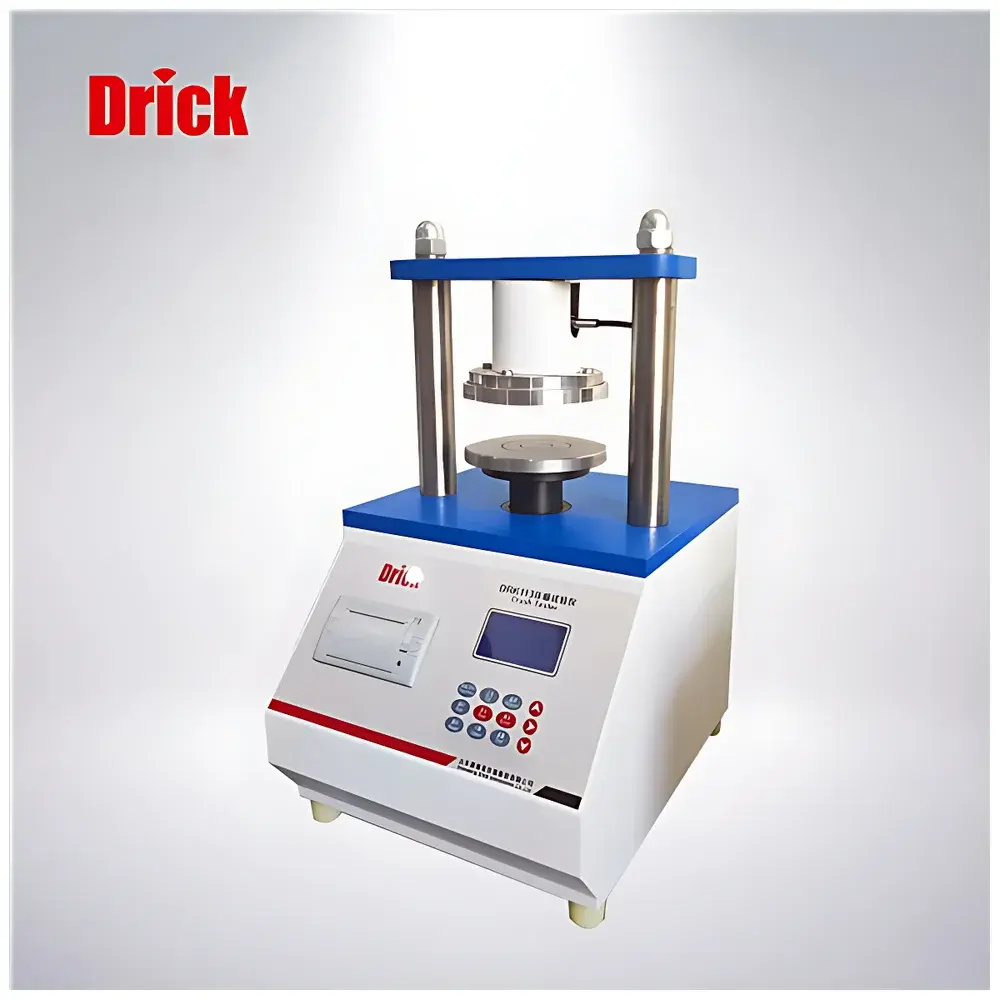
Drick DRK113A Button-Operated Paper & Corrugated Board Compression Tester
| Brand | Drick |
|---|---|
| Origin | Shandong, China |
| Manufacturer Type | Direct Manufacturer |
| Country of Origin | China |
| Model | DRK 113A |
| Power Supply | AC 220 V ±5%, 50 Hz, 2 A |
| Load Range | 5–5000 N |
| Resolution | 0.1 N |
| Accuracy | ±1% FS |
| Repeatability | <1% FS |
| Parallelism of Platen | ≤0.05 mm |
| Test Speed | 12.5 ± 2.5 mm/min |
| Platen Diameter (Ring Crush) | 235 mm |
| Stroke | 1–70 mm |
| Operating Temperature | 20 ± 10 °C |
| Relative Humidity | <85% RH |
| Display | LCD with bilingual Chinese/English interface |
| Data Output | Thermal printer (integrated), PC connectivity via RS232/USB |
Overview
The Drick DRK113A Button-Operated Paper & Corrugated Board Compression Tester is a precision-engineered mechanical testing instrument designed specifically for static compressive strength evaluation of paper, paperboard, and corrugated packaging materials. It operates on the fundamental principle of controlled axial loading between parallel platens under standardized displacement rates, enabling quantitative measurement of force–deformation response in compliance with internationally recognized test methodologies. The system employs a fixed upper platen configuration coupled with a high-accuracy load cell (±1% full-scale accuracy, 0.1 N resolution) and a robust electromechanical drive train regulated by an ARM-based embedded controller. Its architecture supports repeatable, operator-independent execution of standardized compression tests—including Ring Crush Test (RCT), Edge Crush Test (ECT), Flat Crush Test (FCT), Pin Adhesion Test (PAT), and Crush Resistance Test (CMT)—all critical to assessing structural integrity, stacking performance, and material consistency in packaging supply chains.
Key Features
- Fixed upper platen design with precision-machined 235 mm diameter circular anvil ensures uniform stress distribution during RCT and CMT measurements.
- High-stability load cell with <1% repeatability and real-time digital signal conditioning delivers traceable force data across the 5–5000 N range.
- Integrated thermal line printer enables immediate hard-copy output of test results, including peak load, deformation at failure, and test identifier—without external software dependency.
- Bilingual LCD interface (Chinese/English) with intuitive button navigation supports rapid method selection, parameter entry, and live display of compressive force and displacement curves.
- RS232 and USB interfaces allow seamless integration with laboratory PCs for extended data logging, statistical analysis (mean, SD, CV%), and audit-ready report generation.
- Compliance-ready firmware architecture supports GLP-aligned operation: automatic timestamping, user ID tagging, and non-editable raw data storage in internal memory prior to export.
Sample Compatibility & Compliance
The DRK113A accommodates specimens within defined geometric and dimensional constraints: paper thickness 0.15–1.00 mm; corrugated board samples up to 60 mm in width or diameter; small-diameter paper cores (≤60 mm); and rigid containers such as paper cups, bowls, tubes, and miniature folding cartons. It meets the mechanical and procedural requirements of ISO 12192 (ring crush), ISO 3035 (flat crush of single-faced board), ISO 3037 (edge crush of corrugated board), ISO 7263 (fluted core flat crush), GB/T 2679.6 and GB/T 2679.8 (Chinese national standards for corrugated medium and linerboard ring crush), GB/T 6546 (ECT), GB/T 6548 (PAT), and QB/T 1048–1998 (general compression testing of boxes and boards). While not certified to ISO/IEC 17025, its metrological performance aligns with calibration practices referenced in ISO/IEC 17025 Annex A.3 for mechanical testing equipment used in accredited laboratories.
Software & Data Management
The embedded firmware provides real-time graphical display of force vs. displacement during each test cycle, with automatic detection of peak load and corresponding deformation. All raw measurement sequences—including time-stamped force values sampled at ≥100 Hz—are stored internally and exportable via serial or USB link in CSV format. Optional PC-based software (supplied separately) extends functionality to multi-sample batch reporting, trend charting over time, comparative analysis across material lots, and PDF report generation compliant with internal QA documentation protocols. Audit trails include operator ID, test date/time, calibration status flag, and environmental condition metadata (if logged externally), satisfying baseline requirements for FDA 21 CFR Part 11–aligned systems where electronic records are retained for regulatory review.
Applications
This instrument serves quality control laboratories in paper mills, corrugated converting facilities, packaging R&D centers, and third-party testing agencies. Typical use cases include incoming raw material verification (e.g., linerboard RCT acceptance), in-process monitoring of corrugation line performance (ECT stability), finished box qualification (compression resistance under simulated pallet stacking), and adhesion validation of fluting media (PAT pass/fail thresholds). Its versatility extends to niche applications such as crush resistance profiling of molded fiber trays, stiffness assessment of laminated cup stock, and comparative benchmarking of recycled versus virgin fiberboard substrates—all under controlled ambient conditions (20 ± 10 °C, RH <85%).
FAQ
What standards does the DRK113A support out-of-the-box?
It natively implements test routines aligned with ISO 12192, ISO 3035, ISO 3037, ISO 7263, GB/T 2679.6, GB/T 2679.8, GB/T 6546, GB/T 6548, and QB/T 1048–1998.
Can the DRK113A perform both RCT and ECT without hardware modification?
Yes—via interchangeable platens and preconfigured test modes; no tooling or recalibration is required when switching between ring crush and edge crush fixtures.
Is the internal memory capacity sufficient for long-term unattended operation?
Internal storage retains up to 1,000 complete test records with timestamps, force-displacement arrays, and operator tags—sufficient for weekly batch archiving before offloading.
Does the instrument meet requirements for ISO/IEC 17025-accredited testing?
While the DRK113A itself is not accredited, its metrological specifications (±1% accuracy, <1% repeatability) and data traceability features enable labs to validate it per ISO/IEC 17025 Clause 6.4 and Appendix A.3 during equipment qualification.
How frequently must the load cell be calibrated?
Annual calibration against traceable deadweight standards is recommended; the unit includes built-in zero and span verification routines for daily operational checks.