
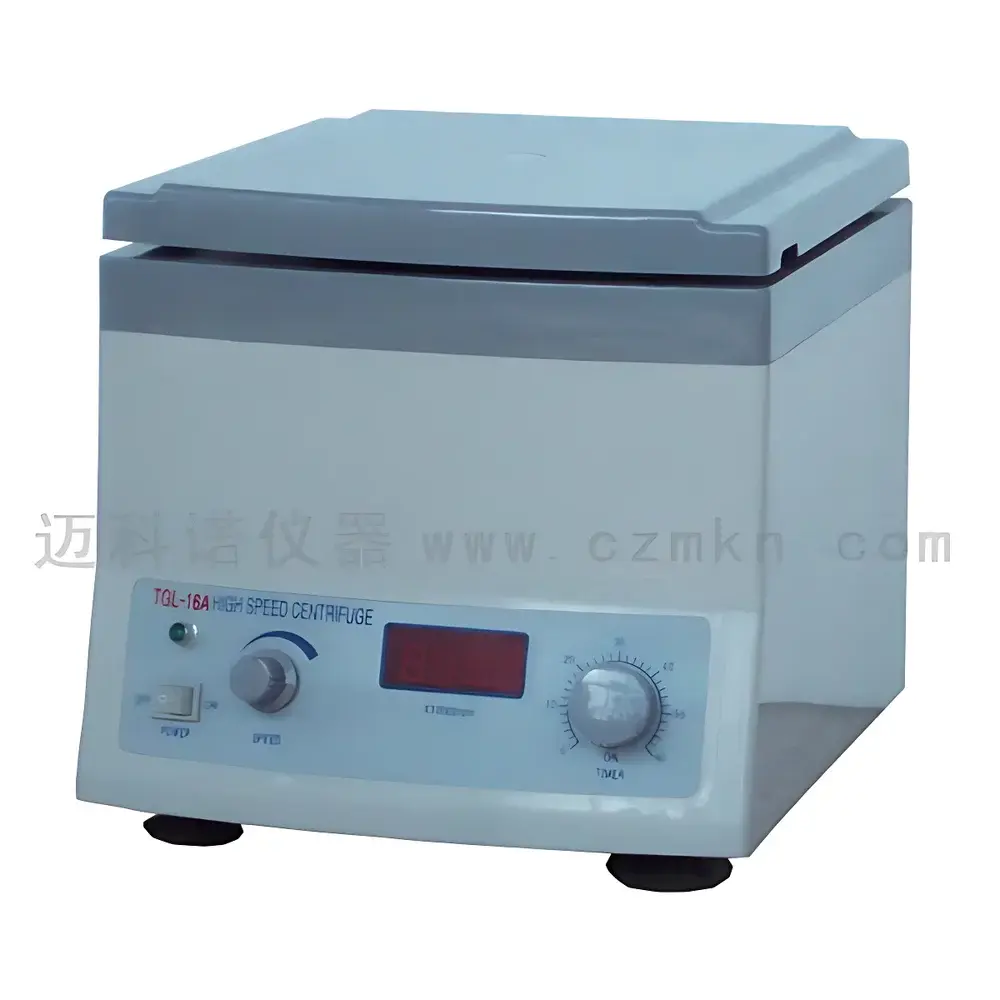
MKN TGL-16A Digital Benchtop High-Speed Centrifuge
| Brand | MKN |
|---|---|
| Model | TGL-16A |
| Max Speed | 16,000 rpm (stepless speed control with digital RPM display) |
| RCF | 17,000 × g |
| Capacity | 12 × 1.5 mL or 12 × 0.5 mL or 8 × 5 mL tubes |
| Timer Range | 0–30 min |
| Noise Level | ≤60 dB(A) |
| Power Supply | AC 220 V, 50 Hz, 5 A |
| Dimensions | Not specified |
| Weight | Not specified |
| Compliance | CE-marked for laboratory use (IEC 61010-1), GLP-compatible operation |
Overview
The MKN TGL-16A Digital Benchtop High-Speed Centrifuge is an engineered solution for rapid, reproducible separation of biological and chemical suspensions in research, clinical, and quality control laboratories. It operates on the principle of sedimentation under controlled centrifugal force—generating up to 17,000 × g at its maximum rotational speed of 16,000 rpm—to separate components based on density, size, and molecular weight. Designed for benchtop deployment, this centrifuge integrates precision digital speed control with real-time RPM monitoring, enabling consistent method execution across repeated runs. Its compact footprint and low thermal signature support continuous operation in temperature-sensitive environments, while the balanced rotor assembly minimizes vibration and ensures long-term mechanical stability.
Key Features
- Digital stepless speed control with LED RPM readout—enabling precise, repeatable setpoint selection from 0 to 16,000 rpm in 100-rpm increments
- Microprocessor-based timer (0–30 minutes) with automatic rotor deceleration and audible end-of-run alert
- Aluminum alloy rotor with optimized aerodynamic geometry—reducing air resistance, minimizing heat generation, and extending bearing life
- Self-balancing rotor chamber with dual-axis suspension system—ensuring stable operation even with minor tube mass asymmetry (±0.1 g tolerance per position)
- Low-noise design (<60 dB[A] at 1 m distance) achieved via vibration-damping housing and precision-machined rotor shaft
- Over-speed, over-temperature, and lid interlock safety circuits compliant with IEC 61010-1 Class II requirements
- Quick-release rotor interface—allowing tool-free rotor installation and removal for routine cleaning and maintenance
Sample Compatibility & Compliance
The TGL-16A accommodates standard microcentrifuge tubes (0.5 mL, 1.5 mL) and conical 5 mL tubes without adapter requirements, supporting common applications in serum/plasma isolation, nucleic acid precipitation, and immunoprecipitation workflows. Rotors are certified for use with polypropylene and polycarbonate tubes rated for ≥17,000 × g. The instrument meets essential safety and electromagnetic compatibility standards for laboratory equipment: IEC 61010-1 (electrical safety), IEC 61326-1 (EMC), and carries CE marking for conformity with EU Directive 2014/30/EU and 2014/35/EU. While not FDA 510(k)-cleared, it is routinely deployed in GLP-aligned environments where documentation of calibration, maintenance, and operational parameters is maintained per internal SOPs.
Software & Data Management
As a standalone benchtop instrument, the TGL-16A does not include embedded data logging or PC connectivity. However, its digital interface supports manual protocol documentation for audit trails—operators may record run parameters (speed, time, date, operator ID) in lab notebooks or LIMS-integrated electronic records. For regulated environments requiring 21 CFR Part 11 compliance, external validation protocols can be developed to verify timer accuracy (±1% tolerance), speed fidelity (±200 rpm at 16,000 rpm), and thermal stability (ΔT < 3°C after 15 min continuous operation). Routine verification using NIST-traceable tachometers and calibrated timers is recommended quarterly.
Applications
- Clinical diagnostics: Rapid separation of whole blood into serum or plasma layers for ELISA, immunoassay, and coagulation testing
- Molecular biology: Pellet recovery of plasmid DNA, PCR products, and RNA following ethanol precipitation
- Cell culture: Harvesting adherent and suspension cells prior to lysis or cryopreservation
- Pharmaceutical QC: Clarification of small-volume formulation samples prior to HPLC or UV-Vis analysis
- Environmental testing: Concentration of suspended particulates from water or soil extracts for heavy metal analysis
- Academic teaching labs: Demonstrating sedimentation kinetics, density gradient principles, and rotor dynamics fundamentals
FAQ
What is the maximum relative centrifugal force (RCF) achievable with the TGL-16A?
The instrument delivers up to 17,000 × g when operating at 16,000 rpm with the standard 12-position rotor.
Is the rotor autoclavable?
No—the aluminum rotor is not designed for autoclaving; cleaning is performed with 70% ethanol or mild detergent and air-drying.
Does the centrifuge support fixed-angle or swing-bucket rotors?
It is configured exclusively with a fixed-angle aluminum rotor optimized for microtubes.
Can the timer be bypassed for continuous operation?
No—this model requires a defined time setting; it will not operate without timer activation as a safety measure.
What maintenance is required for long-term reliability?
Biannual inspection of rotor threads, bearing lubrication status, and lid latch integrity is recommended; full service by authorized technicians every 24 months.



