
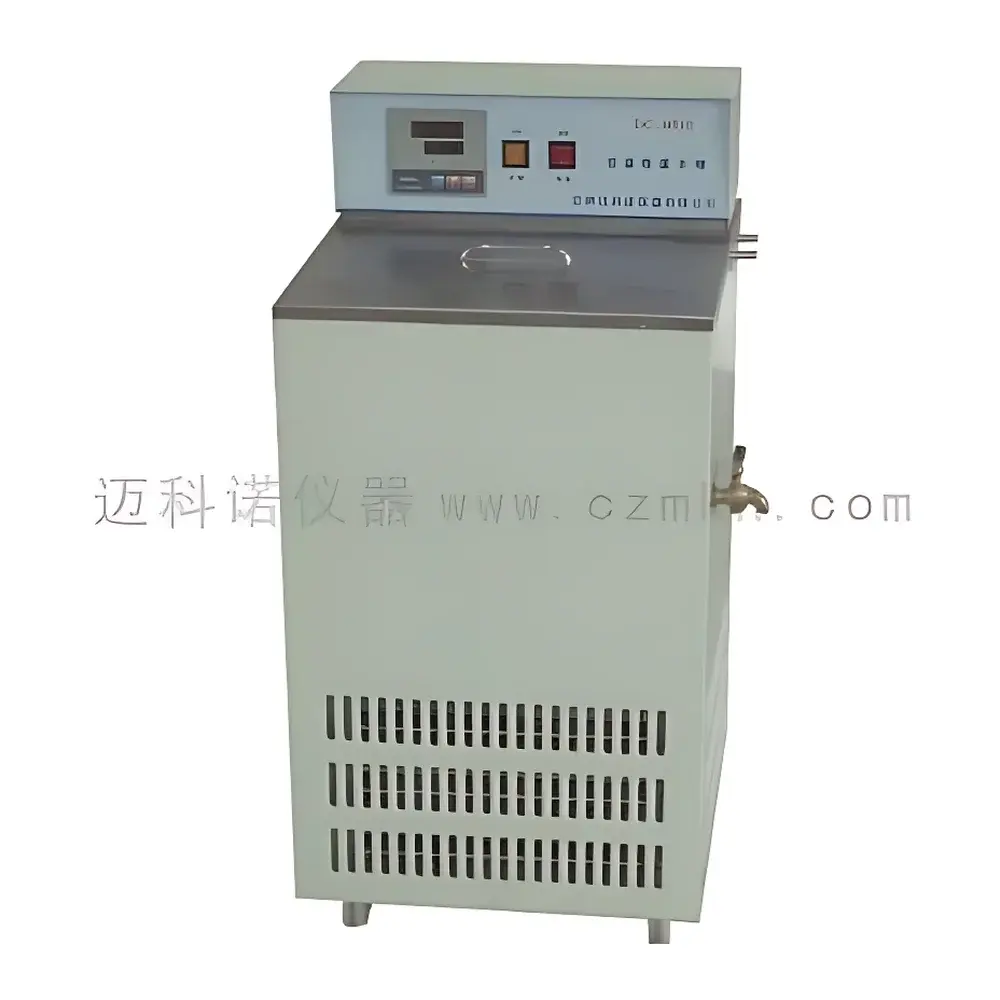
MKN DC Series Low-Temperature Constant-Temperature Water Bath
| Brand | MKN |
|---|---|
| Model | DC Series |
| Temperature Range | -40°C to 100°C (selectable variants: -40, -30, -20, -10, -5 to 100°C) |
| Temperature Stability & Uniformity | ±0.5°C |
| Inner Bath Volume | 20 L |
| Internal Dimensions | 295 mm × 370 mm × 150 mm |
| Power Supply | 220 V ±10%, 50–60 Hz, 10 A |
| Control System | Microprocessor-based PID controller with LED digital display |
| Construction | Stainless steel inner tank and lid, precision-machined |
| Heating Method | Far-infrared heating |
| Sensor Technology | High-stability op-amp circuitry with dual-integration high-precision A/D conversion |
Overview
The MKN DC Series Low-Temperature Constant-Temperature Water Bath is a precision-engineered thermal management instrument designed for laboratory environments requiring stable, reproducible temperature control across an extended range—from cryogenic cooling at –40°C up to 100°C. Unlike standard water baths limited to ambient or mild heating, the DC Series integrates active refrigeration with far-infrared heating and microprocessor-driven PID regulation to maintain tight thermal setpoints under dynamic load conditions. Its operational principle relies on closed-loop feedback between a high-resolution platinum resistance thermometer (PRT) sensor, a dual-integration analog-to-digital converter, and a digitally tuned proportional-integral-derivative (PID) algorithm—ensuring minimal overshoot and rapid thermal equilibration (<15 min typical from ambient to –20°C). The unit serves as a critical ancillary device in applications demanding precise thermal input without direct flame or open-heating elements, including solvent evaporation, enzymatic incubation, viscosity calibration baths, and low-temperature reaction quenching.
Key Features
- Wide operational temperature range: selectable configurations from –40°C to 100°C, enabling both cryogenic stabilization and high-temperature processing within a single platform.
- Stainless steel inner bath (AISI 304 grade) with precision-machined seams and electropolished finish—resistant to corrosion from aqueous buffers, organic solvents, and mild acids commonly used in analytical and biochemical workflows.
- Microprocessor-based PID temperature controller with LED digital display—providing real-time readout with 0.1°C resolution and user-accessible parameter tuning for ramp/soak profiles.
- Far-infrared heating element combined with forced convection circulation ensures uniform thermal distribution (±0.5°C spatial uniformity across full bath volume) and eliminates hot spots common in resistive coil systems.
- Thermal stability of ±0.5°C maintained under steady-state conditions, verified per ASTM E1137/E1137M for laboratory thermal equipment performance testing.
- Compact footprint (W×D×H: 295 × 370 × 150 mm internal) optimized for benchtop integration in ISO 17025-accredited labs and GLP-compliant QC facilities.
Sample Compatibility & Compliance
The DC Series accommodates standard laboratory glassware—including 1000 mL beakers, 500 mL Erlenmeyer flasks, and immersion-cooled condensers—without obstruction. Its 20 L capacity supports multi-vessel parallel processing while maintaining thermal homogeneity. All wetted surfaces comply with USP Class VI biocompatibility requirements for indirect contact with pharmaceutical intermediates. The system meets IEC 61010-1:2010 safety standards for electrical equipment used in laboratory environments and includes over-temperature cut-off, dry-run protection, and ground-fault circuit interruption (GFCI) compliance. Documentation packages support audit readiness for FDA 21 CFR Part 11–aligned environments when paired with optional data logging modules.
Software & Data Management
While the base model operates via standalone microcontroller interface, optional RS-232/USB connectivity enables integration with LabVIEW™, MATLAB®, or custom SCADA systems for remote monitoring and automated protocol execution. Firmware supports timestamped temperature logging at user-defined intervals (1–60 s), with CSV export capability for post-processing in statistical analysis tools (e.g., JMP, Minitab). Audit trail functionality—including operator ID tagging, parameter change logs, and calibration event records—is available through the optional MKN DataTrace Suite, fulfilling ALCOA+ data integrity criteria for regulated laboratories.
Applications
- Controlled-rate evaporation of volatile solvents (e.g., acetone, hexane) during sample preparation for GC-MS or HPLC analysis.
- Low-temperature stabilization of thermolabile reagents (e.g., restriction enzymes, monoclonal antibodies) prior to assay setup.
- Calibration of viscometers, densitometers, and refractometers using NIST-traceable reference fluids at defined temperatures.
- Accelerated stability testing of formulations per ICH Q1A(R2) guidelines, with programmable thermal cycling between –20°C and 40°C.
- Supporting rotary evaporation systems by providing consistent coolant supply to condenser jackets at sub-zero temperatures.
- Pre-conditioning of polymer samples prior to DSC or TMA analysis to eliminate thermal history effects.
FAQ
What refrigerant is used in the DC Series cooling system?
The unit employs R-134a refrigerant in a hermetically sealed cascade refrigeration circuit—non-ozone-depleting and compliant with EU F-Gas Regulation (EU) No 517/2014.
Can the bath operate continuously at –40°C?
Yes—rated for uninterrupted operation at minimum setpoint; ambient temperature must remain ≤25°C with ≥15 cm rear clearance for heat dissipation.
Is the stainless steel bath compatible with chlorinated solvents?
AISI 304 stainless steel resists short-term exposure to dilute sodium hypochlorite and chloroform; prolonged use of concentrated chlorine-based solutions requires optional AISI 316L upgrade.
Does the controller support external temperature probe input?
Standard configuration uses internal PRT sensing; external probe input (PT100) is available via optional Input Expansion Module (Order Code: DC-EXT-PROBE).
What maintenance is required for long-term reliability?
Annual inspection of refrigerant charge, condenser coil cleaning, and verification of PID tuning coefficients against factory calibration certificate—service logs are retained in onboard non-volatile memory.



