
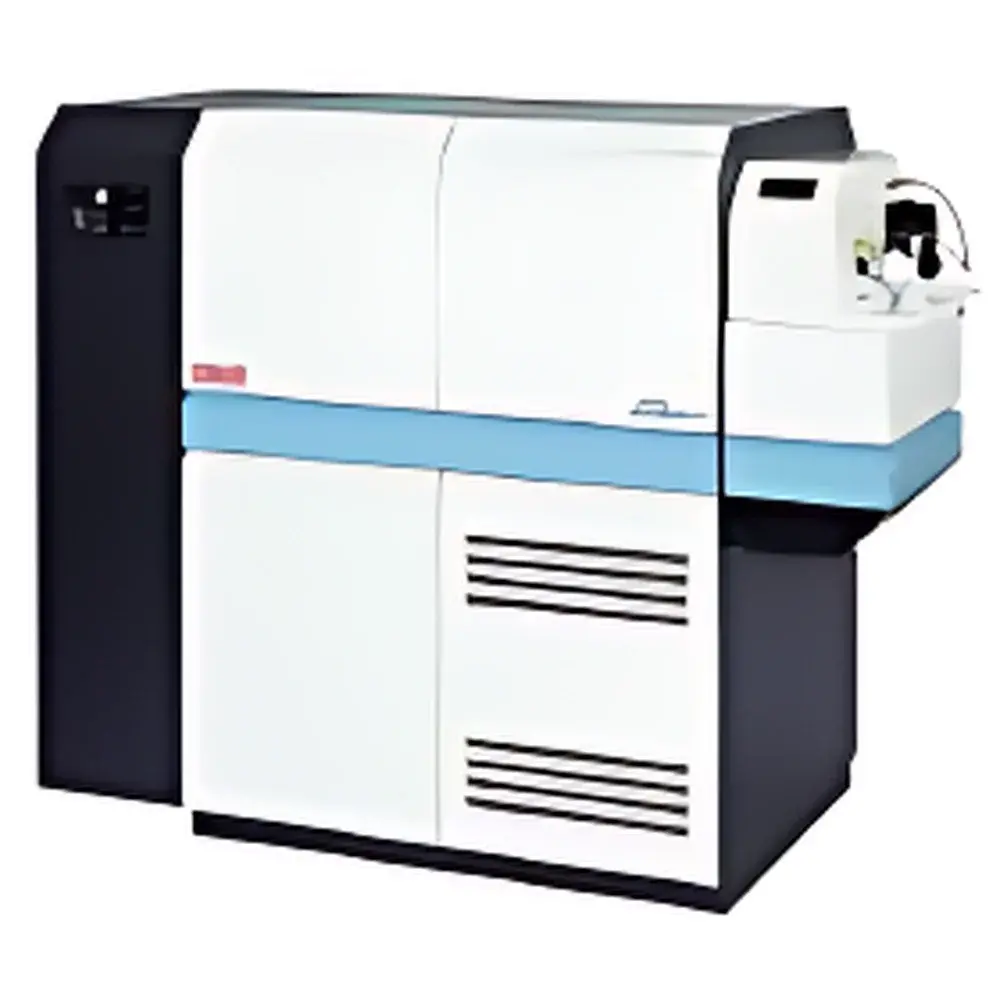
Thermo Fisher Scientific ELEMENT2 High-Resolution Inductively Coupled Plasma Mass Spectrometer
| Brand | Thermo Fisher Scientific |
|---|---|
| Origin | Germany |
| Manufacturer | Yes |
| Origin Category | Imported |
| Model | ELEMENT 2 |
| Instrument Type | Magnetic Sector ICP-MS (not quadrupole) |
| Sensitivity | >10⁹ cps/ppm for In |
| Resolution | 300, 4,000, and 10,000 (10% valley definition) |
| Dynamic Range | >10⁹ (linear) |
| Background Equivalent Concentration (BEC) | <0.2 cps |
| Detection Mode | Simultaneous multi-element detection for transient signals |
Overview
The Thermo Fisher Scientific ELEMENT2 is a double-focusing magnetic sector field inductively coupled plasma mass spectrometer (ICP-MS), engineered for ultra-trace elemental analysis and high-precision isotope ratio measurements. Unlike quadrupole-based ICP-MS systems, the ELEMENT2 employs a Mattauch-Herzog geometry with electrostatic and magnetic sectors to achieve true high mass resolution—enabling separation of analyte isotopes from polyatomic and isobaric interferences at the physical level. This architecture supports routine operation at mass resolutions up to 10,000 (10% valley definition), making it suitable for demanding applications in geochemistry, nuclear safeguards, environmental forensics, clinical trace metal analysis, and semiconductor materials characterization. The instrument couples robust plasma ionization (ICP source) with high-transmission ion optics and low-noise Faraday and electron multiplier detection, delivering sub-part-per-quadrillion (sub-fg/g) detection limits across the periodic table—from Li to U—while maintaining exceptional mass accuracy and long-term stability.
Key Features
- Double-focusing magnetic sector mass analyzer with variable resolution modes (R = 300, 4,000, 10,000) for interference-free isotope analysis
- High sensitivity (>1 × 10⁹ cps/ppm for indium at m/z 115) and ultra-low background (<0.2 cps typical BEC)
- Dynamic linear range exceeding 10⁹, supporting quantification from mg/L down to sub-pg/L without dilution or re-injection
- Simultaneous multi-element acquisition capability for transient signals (e.g., laser ablation, HPLC-ICP-MS, CE-ICP-MS)
- Automated tuning, calibration, and interference correction routines integrated into Thermo’s Qtegra Intelligent Scientific Data Solution™ software
- Modular design compatible with multiple sample introduction systems: ultrasonic nebulizers, desolvating systems, laser ablation (e.g., UP213, NWR213), GC, HPLC, FFF, and capillary electrophoresis
- Robust mechanical and thermal architecture rated for continuous 24/7 operation in regulated laboratory environments
Sample Compatibility & Compliance
The ELEMENT2 accommodates liquid samples (aqueous and organic matrices), digested solids, and direct solid sampling via laser ablation. Its high-resolution capability allows unambiguous identification of isotopic signatures even in complex matrices—such as seawater, biological tissues, geological silicates, and high-purity electronic-grade chemicals—where polyatomic overlaps (e.g., 40Ar16O+ on 56Fe+, 40Ar35Cl+ on 75As+) would compromise quadrupole ICP-MS data integrity. The system meets requirements for ISO/IEC 17025:2017 method validation, supports GLP/GMP-compliant workflows through audit-trail-enabled software, and facilitates compliance with EPA Method 6020B, ASTM D5673, USP , and IAEA Nuclear Safeguards protocols. All firmware and software modules are designed in accordance with FDA 21 CFR Part 11 for electronic records and signatures.
Software & Data Management
Controlled exclusively by Thermo’s Qtegra ISDS software, the ELEMENT2 provides a unified platform for instrument setup, method development, real-time data acquisition, offline processing, and reporting. Qtegra includes built-in isotope dilution mass spectrometry (IDMS) calculators, interference correction algorithms (e.g., mathematical correction, peak-stripping, and interference-free element selection), and customizable QC dashboards. Raw data files (.raw) are stored in vendor-neutral formats compliant with ASTM E1994 and support third-party integration via OPC UA or ASCII export. Full audit trail functionality logs all user actions—including parameter changes, calibration events, and report generation—with time-stamped, non-erasable entries required for regulatory submissions.
Applications
- High-precision isotope ratio analysis for geochronology (e.g., U–Pb, Lu–Hf, Sr–Nd systems)
- Ultra-trace metal impurity profiling in pharmaceutical excipients and biologics (ICH Q3D)
- Nuclear fuel cycle monitoring and isotopic fingerprinting (e.g., 235U/238U, 240Pu/239Pu)
- Multi-element speciation analysis using hyphenated techniques (HPLC-ICP-MS, LA-ICP-MS imaging)
- Reference material certification (e.g., NIST SRMs, IRMM CRMs) and inter-laboratory comparison studies
- Environmental monitoring of heavy metals and radionuclides in soil, water, and airborne particulates
FAQ
Is the ELEMENT2 a quadrupole ICP-MS?
No—the ELEMENT2 is a magnetic sector ICP-MS. It uses double-focusing mass spectrometry, not quadrupole filtering. Its resolution and mass accuracy exceed those achievable with quadrupole instruments.
Can it perform isotope ratio measurements with certified uncertainty?
Yes. With appropriate calibration standards (e.g., NIST SRM 3100 series), internal standardization, and replicate analysis, the ELEMENT2 achieves long-term external precision better than 0.01% RSD for major isotope ratios under optimized conditions.
Does it support laser ablation analysis?
Yes. The ELEMENT2 is routinely coupled with 193 nm and 213 nm Nd:YAG laser ablation systems for spatially resolved elemental and isotopic mapping of solids.
What regulatory standards does its software support?
Qtegra ISDS complies with 21 CFR Part 11, EU Annex 11, and ISO/IEC 17025 requirements for electronic records, user access control, and audit trail integrity.
How many units are deployed globally?
Over 500 ELEMENT2 systems are installed worldwide, primarily in national metrology institutes, reference laboratories, and academic core facilities engaged in trace element metrology.







