
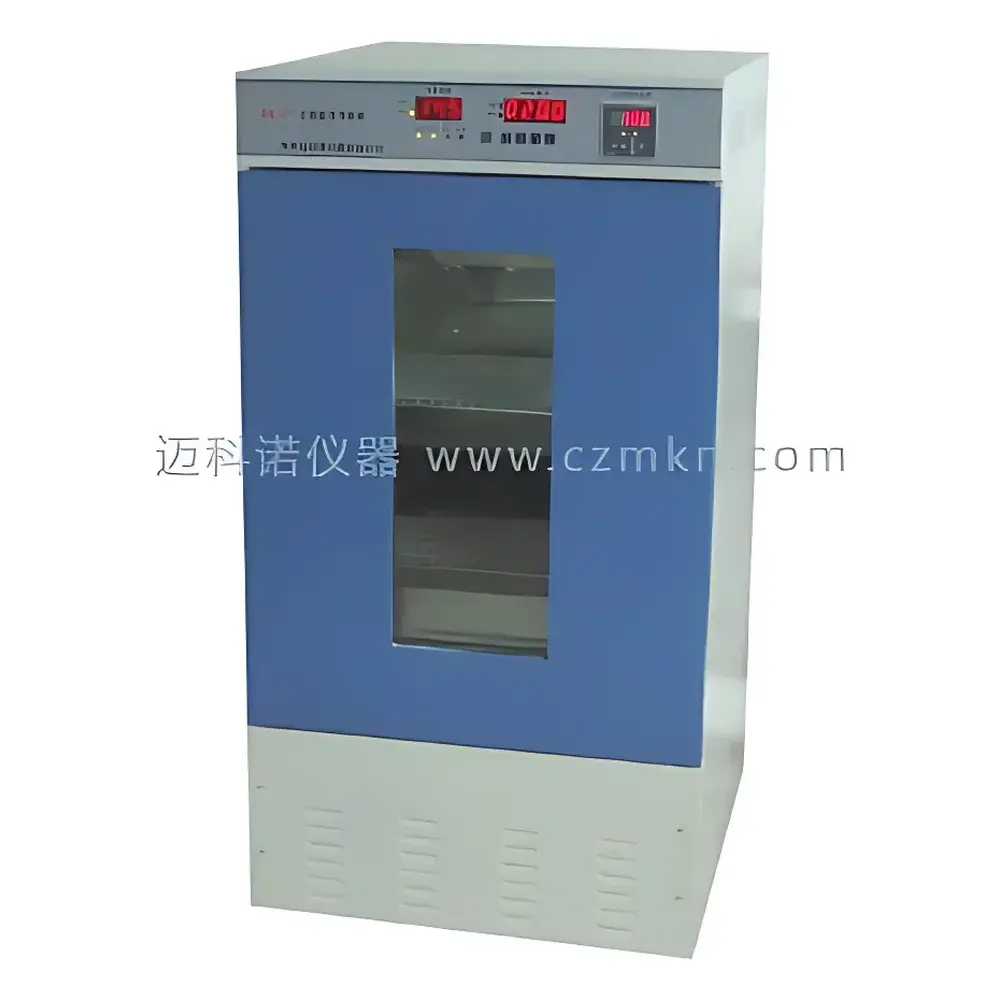
MKN BS-1E Digital Shaking Incubator
| Brand | MKN |
|---|---|
| Model | BS-1E |
| Type | Orbital Shaking Incubator |
| Chamber Material | Stainless Steel Interior |
| Insulation | Polyurethane Foam |
| Viewing Window | Double-Layer Hollow Glass |
| Air Circulation | DC Fan–Forced Convection |
| Control System | Microprocessor-Based Digital Controller |
| Illumination | Integrated LED Light (Optional) |
| Oscillation Mode | Orbital (Reciprocating Option Available) |
| Stroke Amplitude | 20 mm |
| Max Load Capacity | 20 kg |
| Speed Range | 40–260 rpm |
| Temperature Range | 5–50 °C |
| Temperature Uniformity | ±0.5 °C |
| Heating Power | 600 W |
| Tray Dimensions | 470 × 370 mm |
| Timer Range | 1–999 min |
Overview
The MKN BS-1E Digital Shaking Incubator is a precision-engineered laboratory instrument designed for simultaneous temperature-controlled incubation and orbital shaking—critical for aerobic microbial growth, cell suspension culture, enzyme assays, solubility studies, and biochemical reaction kinetics. Built upon the principles of controlled convective heat transfer and uniform mechanical agitation, the BS-1E integrates a microprocessor-based PID temperature regulation system with a brushless DC motor-driven oscillation mechanism. Its stainless steel chamber ensures corrosion resistance and ease of decontamination, while polyurethane foam insulation provides thermal stability and energy efficiency. The double-layer hollow glass door enables real-time visual monitoring without compromising internal environmental integrity. Engineered for reproducibility in regulated environments, the unit maintains ±0.5 °C temperature uniformity across the working chamber under dynamic load conditions—meeting baseline requirements for GLP-compliant microbiological and cell culture workflows.
Key Features
- Orbital shaking platform with adjustable speed (40–260 rpm) and fixed 20 mm stroke amplitude—optimized for suspension cultures requiring gentle yet consistent mixing.
- Microprocessor-controlled digital interface with intuitive keypad navigation, real-time display of setpoint/actual temperature and speed, and non-volatile memory for parameter retention after power interruption.
- Forced-air convection system driven by a low-noise, maintenance-free DC fan—ensuring rapid thermal equilibration and <±0.5 °C spatial uniformity at any point within the 470 × 370 mm tray area.
- Robust construction: 304 stainless steel interior chamber, powder-coated cold-rolled steel exterior, and reinforced door seal to minimize thermal leakage and cross-contamination risk.
- Programmable timer (1–999 minutes) with auto-shutdown functionality—supporting unattended operation for overnight or extended incubation protocols.
- Optional integrated LED illumination module enables observation of culture turbidity, pellet formation, or colorimetric endpoints without opening the chamber.
Sample Compatibility & Compliance
The BS-1E accommodates standard laboratory vessels including Erlenmeyer flasks (up to 2 L), test tubes, deep-well plates, and custom-sized shaker bottles secured on its universal platform. Its 20 kg load capacity supports multi-vessel configurations common in fermentation optimization, antibiotic susceptibility testing, and recombinant protein expression screening. The unit complies with IEC 61010-1:2010 safety standards for electrical equipment used in laboratory environments. While not certified for ISO Class 5 cleanroom integration, its sealed chamber design and smooth interior surfaces facilitate routine cleaning validation per institutional SOPs. For applications involving human-derived samples or regulated bioprocessing, users are advised to implement additional environmental monitoring (e.g., continuous temperature logging) to satisfy internal QA/QC or FDA 21 CFR Part 11 data integrity expectations.
Software & Data Management
The BS-1E operates as a standalone instrument with no embedded PC connectivity or proprietary software suite. All operational parameters—including temperature setpoint, speed, and timer—are configured and monitored locally via the front-panel LCD. However, the device supports external data acquisition through optional analog output (0–5 V or 4–20 mA) for temperature and speed signals, enabling integration into centralized lab monitoring systems (e.g., LabVIEW, SCADA, or building management platforms). Users performing audit-trail–required procedures should pair the unit with validated third-party data loggers compliant with 21 CFR Part 11 electronic record requirements.
Applications
- Microbial cultivation (E. coli, yeast, Bacillus spp.) under aerobic conditions with scalable agitation intensity.
- Suspension-based mammalian or insect cell culture during early-stage process development.
- Biochemical assays requiring simultaneous thermal stabilization and mixing—such as ELISA plate coating, antigen-antibody binding kinetics, or chromogenic substrate hydrolysis.
- Environmental microbiology: water quality analysis (BOD, coliform enumeration), soil extract enrichment, and phage propagation.
- Pharmaceutical R&D: dissolution profile testing, excipient compatibility screening, and stability-indicating method development.
- Academic teaching labs: hands-on instruction in aseptic technique, growth curve analysis, and experimental design fundamentals.
FAQ
Can the BS-1E operate at temperatures below ambient?
No—the unit is equipped with resistive heating only and lacks refrigeration capability. Its operational range is limited to 5–50 °C, making it suitable for mesophilic culture but not cryogenic or psychrophilic applications.
Is the oscillation mode field-upgradable from orbital to reciprocating?
Yes—reciprocating motion is available as a factory-configured option; retrofitting requires replacement of the drive assembly and firmware calibration, which must be performed by authorized MKN service personnel.
What is the recommended maintenance schedule?
Inspect fan intake filters quarterly; lubricate drive bearings annually using synthetic grease rated for 80 °C continuous operation; verify temperature sensor calibration semiannually using a NIST-traceable reference thermometer.
Does the unit support RS-232 or USB communication?
No—serial or USB interfaces are not included. External data capture requires analog signal routing or third-party hardware adapters.
Can multiple BS-1E units be synchronized for parallel experiments?
Not natively. Synchronization of start time, speed, and temperature across units requires external master clock triggering or manual coordination; no inter-unit communication protocol is implemented.
Related Products





