
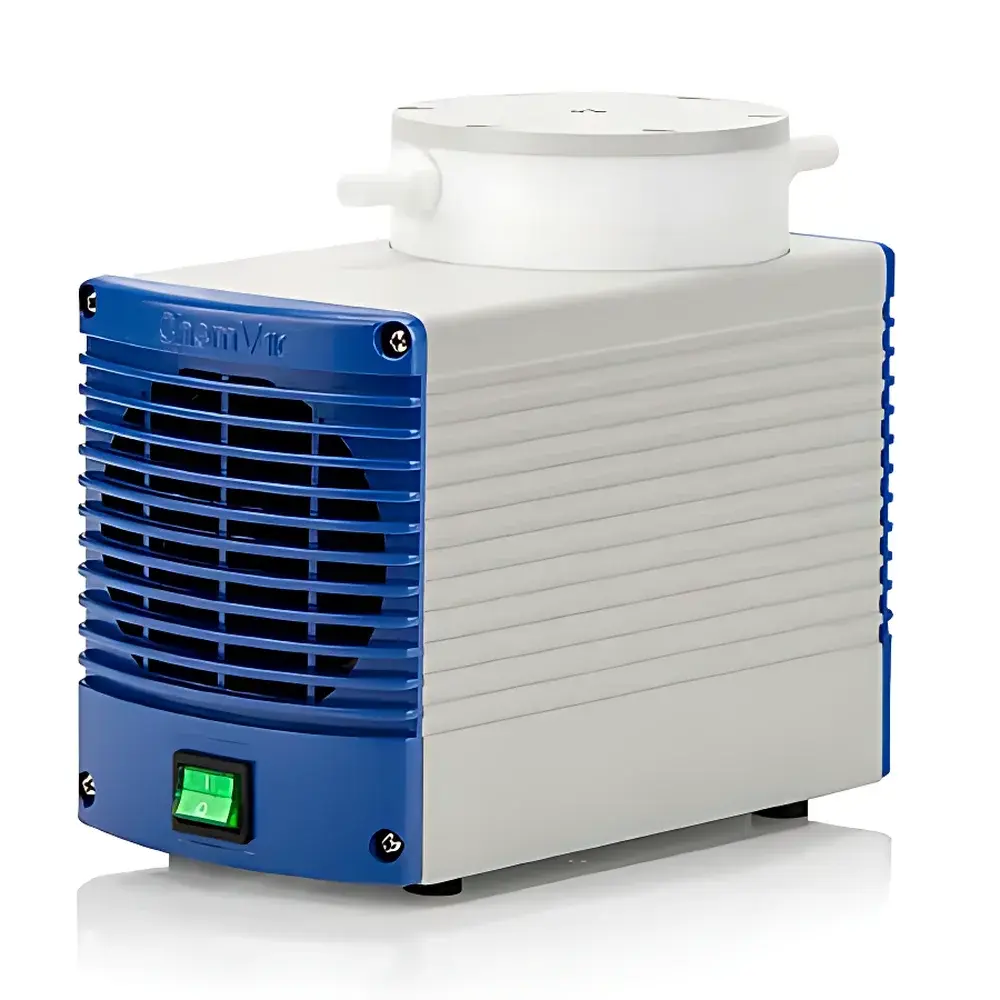
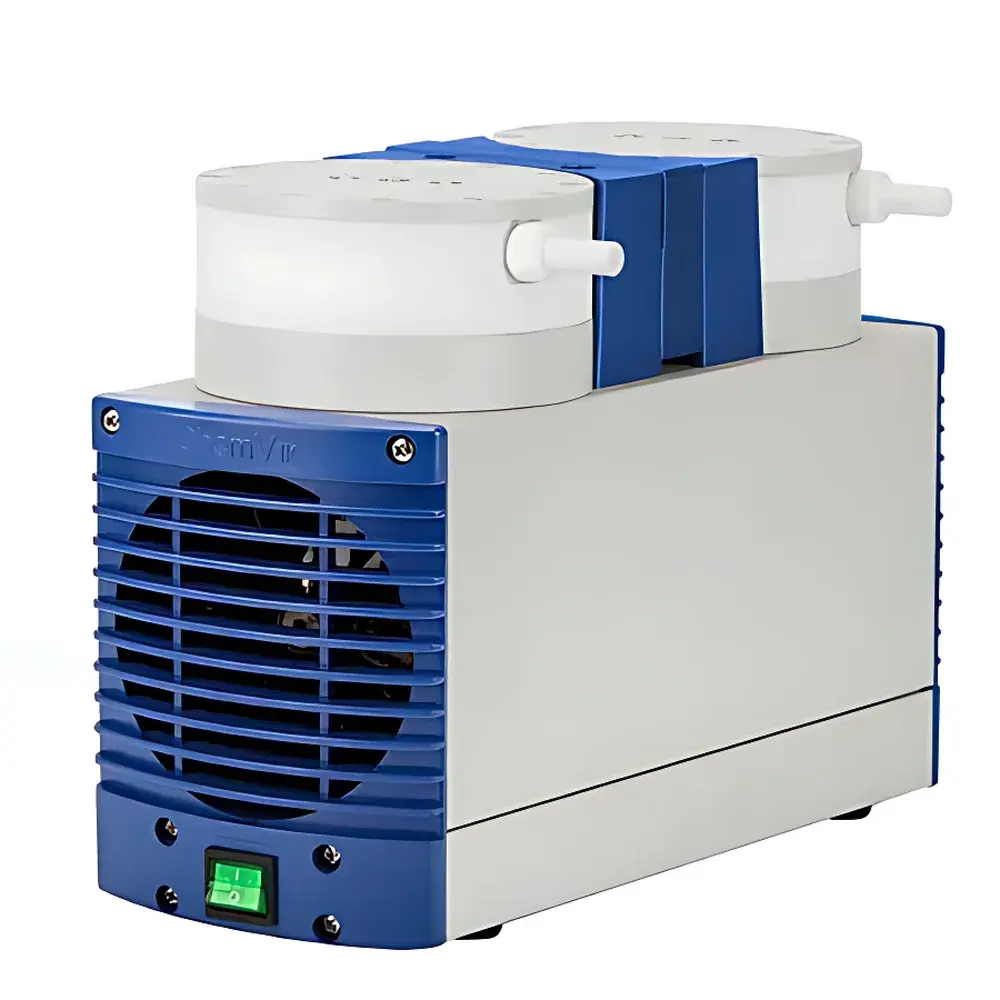
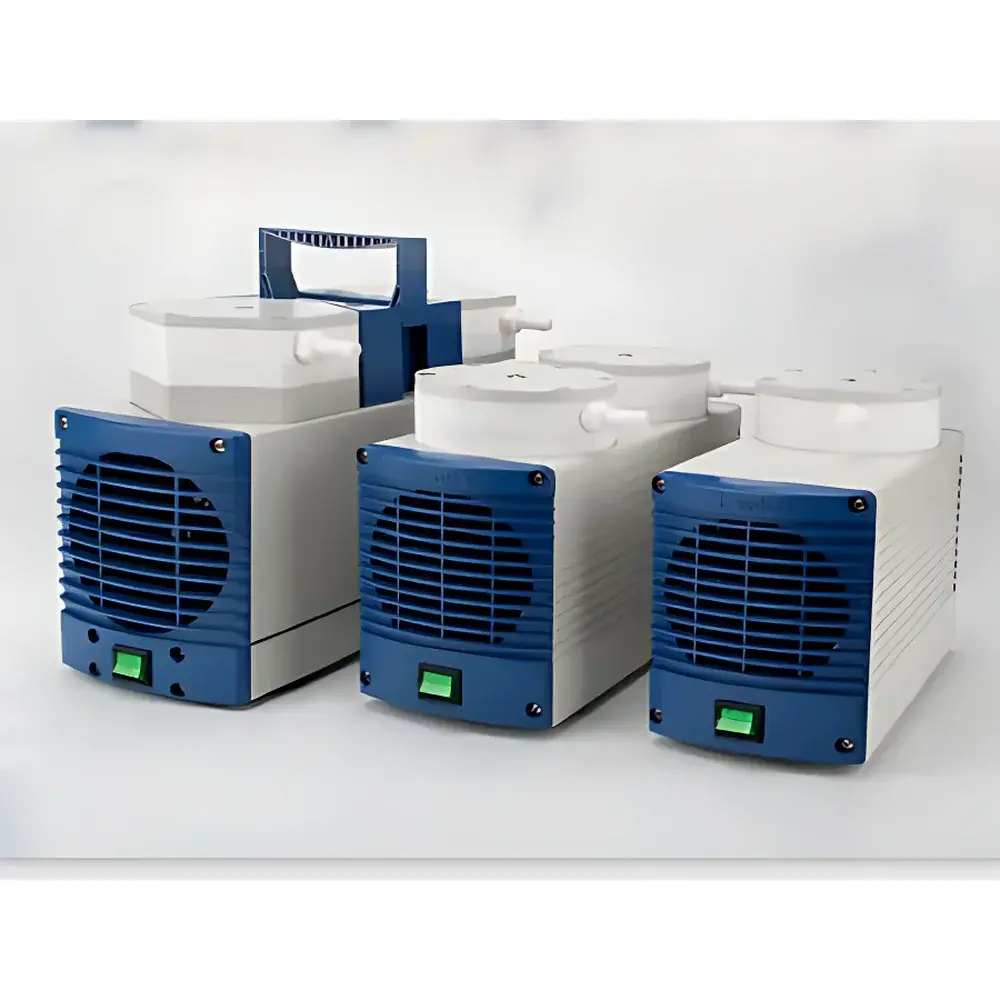
WIGGENS C-Series Corrosion-Resistant Diaphragm Vacuum Pump
| Brand | WIGGENS |
|---|---|
| Origin | Germany |
| Pump Type | Diaphragm Vacuum Pump |
| Gas-Wetted Materials | PTFE (entire flow path) |
| Max Vacuum Level | 2 mbar |
| Noise Level | <50 dB(A) |
| IP Rating | IP20 |
| Compliance | CE, RoHS |
| Enclosure | Chemically resistant polymer housing |
| Motor | Brushless DC motor |
| Duty Cycle | Continuous operation |
| Accessories Optional | Corrosion-resistant vacuum regulator & particulate filter |
Overview
The WIGGENS C-Series Corrosion-Resistant Diaphragm Vacuum Pump is an engineered solution for laboratories and pilot-scale facilities requiring reliable, oil-free vacuum generation in aggressive chemical environments. Based on positive displacement principle using elastomeric diaphragms actuated by a brushless DC motor, the pump achieves stable vacuum down to 2 mbar without lubricating oil or mechanical contact between moving parts and process gas. Its fully PTFE-wetted path—from inlet port through diaphragm chamber to exhaust—ensures compatibility with halogenated solvents, strong acids (e.g., HCl, HNO₃), alkalis (e.g., NaOH), organic vapors, and condensable vapors generated during rotary evaporation, vacuum distillation, or lyophilization. The physical separation between the gas-handling chamber and drive mechanism prevents cross-contamination and extends service life under sustained exposure to corrosive condensates.
Key Features
- PTFE-isolated gas path: All wetted components—including inlet/outlet valves, diaphragm, valve seats, and chamber housing—are constructed from virgin PTFE, providing broad chemical resistance per ASTM D543 and ISO 178 standards.
- Oil-free operation: Eliminates hydrocarbon backstreaming, avoids spent oil disposal, and complies with ISO 8573-1 Class 0 air purity requirements for vacuum lines serving analytical instrumentation.
- Thermal safety architecture: Integrated temperature sensor triggers automatic shutdown at ≥70 °C; restart occurs only after internal thermistor confirms safe ambient equilibrium—enabling unattended overnight operation.
- Low-noise design: Acoustic enclosure and vibration-damped mounting reduce operational noise to <50 dB(A) at 1 m distance, meeting EU Directive 2000/14/EC noise emission limits for laboratory equipment.
- Modular accessory interface: Standard 1/4″ NPT female ports support optional corrosion-resistant vacuum regulators (with PTFE diaphragm and borosilicate glass gauge) and sintered PTFE particulate filters (pore size: 5 µm).
- Continuous-duty rated motor: Brushless DC drive delivers consistent torque across voltage fluctuations (100–240 VAC, 50/60 Hz), minimizing thermal drift during extended vacuum hold applications.
Sample Compatibility & Compliance
The C-Series is validated for use with vapors and gases classified under GHS Category 1–3 corrosivity (e.g., chlorine, sulfur dioxide, acetic anhydride, trifluoroacetic acid). It meets EN 61000-6-3 (EMC emissions) and EN 61000-6-2 (immunity) for electromagnetic compatibility in shared lab infrastructure. While not certified for ATEX Zone 1/21 use, its non-sparking motor and static-dissipative housing (surface resistivity <10⁹ Ω/sq) support deployment in non-classified areas handling flammable solvents. The pump conforms to GLP documentation requirements when paired with optional digital vacuum loggers (not included), supporting audit-ready records per FDA 21 CFR Part 11 when used in pharmaceutical QC workflows.
Software & Data Management
The C-Series operates as a standalone analog device with no embedded firmware or USB/Ethernet connectivity. However, it integrates seamlessly with third-party vacuum controllers (e.g., Vacuubrand VACUU·SELECT, KNF Laboport software suites) via 0–10 V analog input/output signals for remote setpoint modulation and status monitoring. Optional vacuum sensors (capacitance manometer or piezoresistive transducer) can be plumbed inline to feed real-time pressure data into LIMS or ELN systems via 4–20 mA loop interfaces. All electrical components comply with IEC 61010-1 for laboratory safety, including double insulation and reinforced creepage/clearance distances.
Applications
- Vacuum filtration of acidic or basic aqueous/organic suspensions (e.g., catalyst recovery, API crystallization slurries)
- Rotary evaporation of chlorinated solvents (CH₂Cl₂, CHCl₃) and hygroscopic reagents (SOCl₂, POCl₃)
- Reduced-pressure drying of pH-sensitive biomaterials (e.g., enzyme powders, oligonucleotides)
- SPME and solid-phase extraction (SPE) manifolds exposed to aggressive eluents (HFIP, TFA)
- Lyophilizer primary drying stages where condensate temperature falls below −40 °C, generating aggressive ice-vapor mixtures
- Replacement of water aspirators in teaching labs—eliminating municipal water consumption (~12 L/min per unit) and wastewater discharge reporting obligations
FAQ
Can the C-Series handle saturated solvent vapors at elevated temperatures?
Yes—the PTFE diaphragm and valve assembly maintain structural integrity up to 120 °C transient exposure, enabling safe operation with hot acetone, ethanol, or ethyl acetate vapors generated during rapid rotary evaporation.
Is maintenance required beyond filter replacement?
No scheduled maintenance is needed; the brushless motor has >20,000-hour MTBF. Only the optional particulate filter requires replacement every 6–12 months depending on particulate load.
What vacuum level stability can be expected during continuous operation?
Pressure fluctuation remains within ±0.3 mbar over 8-hour periods at 2 mbar setpoint, verified per ISO 21809-2 Annex B test protocol using calibrated capacitance manometers.
Does the pump meet environmental regulations for solvent recovery systems?
Its oil-free design eliminates VOC-laden waste oil streams; exhaust may be ducted to a central scrubber or cold trap without risk of hydrocarbon carryover.
Can multiple C-Series units be manifolded for higher throughput?
Yes—parallel configuration is supported via stainless steel distribution manifolds with individual isolation valves and check valves to prevent cross-flow during single-pump servicing.



