
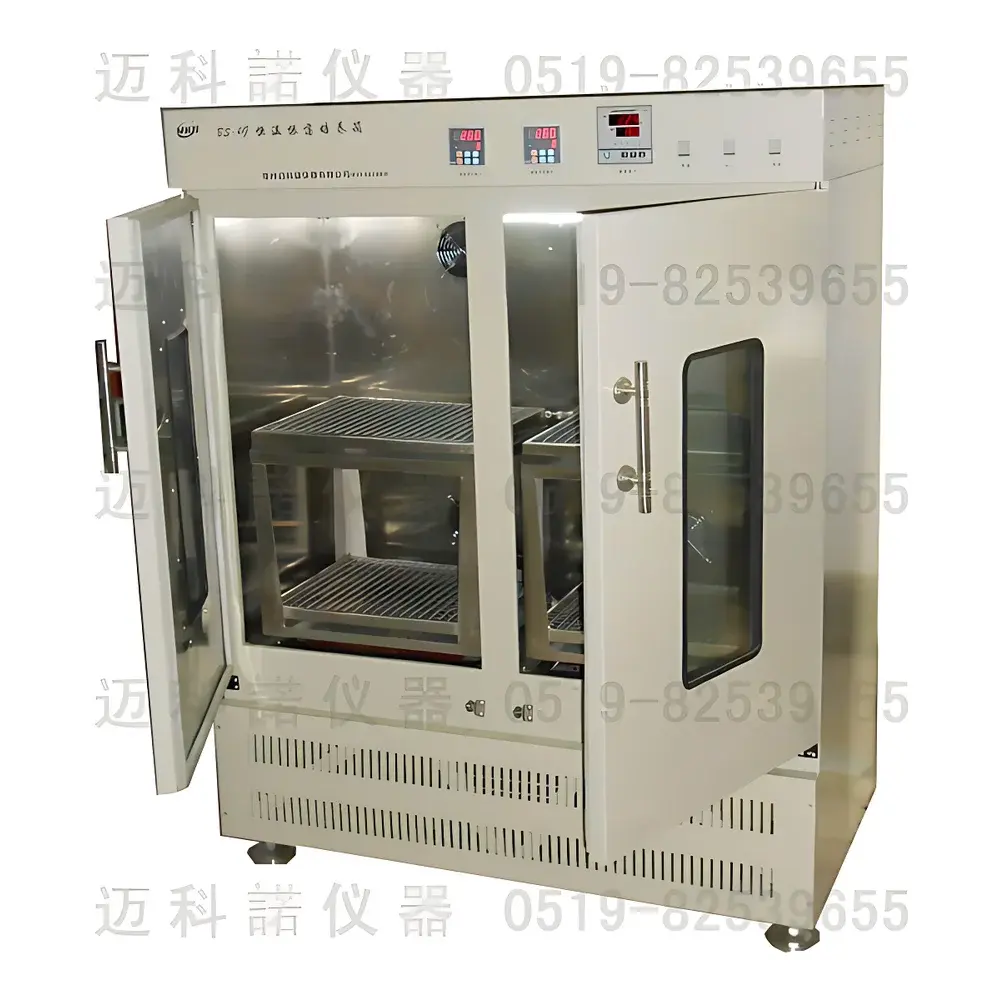
MKN BS-4G Digital Display Orbital Shaking Incubator (Quad-Section Configuration)
| Brand | MKN |
|---|---|
| Model | BS-4G |
| Capacity | 480 L (4 independent shaking sections) |
| Temperature Range | 5–50 °C |
| Temperature Uniformity | ±1 °C |
| Oscillation Speed | 0–300 rpm (infinitely variable) |
| Orbit Diameter | 20 mm |
| Flask Compatibility | Ø16×200 mm test tubes ×4 banks |
| Heating Power | 800 W |
| Compressor Cooling Power | 180 W |
| External Dimensions | 1440 × 770 × 1700 mm (W×D×H) |
| Power Supply | AC 220 V, 50 Hz |
Overview
The MKN BS-4G Digital Display Orbital Shaking Incubator is an integrated life science instrument engineered for simultaneous temperature-controlled incubation and orbital agitation across four independently operated chambers. It operates on the principle of forced-air convection combined with precision-engineered eccentric drive mechanisms to deliver uniform thermal distribution and consistent orbital motion—critical for aerobic microbial growth, suspension cell culture, enzyme kinetics studies, and biochemical assay development. Unlike static incubators, the BS-4G enables dynamic culture conditions essential for oxygen transfer enhancement, homogenous nutrient dispersion, and reproducible biomass accumulation. Its dual-mode thermoregulation system—comprising PTC heating elements and a sealed refrigeration circuit—ensures stable setpoint maintenance from 5 °C to 50 °C under ambient conditions ranging from –5 °C to +32 °C, meeting operational requirements for both mesophilic and psychrotolerant organism cultivation.
Key Features
- Quad-section modular architecture: Four physically isolated shaking decks allow parallel experiments under distinct temperature and agitation parameters—ideal for comparative strain screening, dose-response profiling, or media optimization studies.
- Polyurethane foam-in-place insulation: High-density rigid foam (≥35 kg/m³) applied directly to inner and outer panels minimizes thermal bridging and reduces external environmental influence by >70% compared to conventional fiberglass-insulated enclosures.
- Stainless steel 304 interior chamber: Corrosion-resistant construction withstands repeated exposure to sterilants (e.g., 70% ethanol, hydrogen peroxide vapor), acidic/basic media, and high-humidity environments without surface degradation.
- Microprocessor-based PID temperature control: LED digital display with real-time feedback loop ensures ±1 °C setpoint accuracy and <0.5 °C short-term fluctuation (measured at center position per ISO 15189 Annex A.3).
- Brushless DC motor drive: Enables smooth, low-vibration oscillation across 0–300 rpm with electronic speed ramping—eliminating mechanical wear and enabling precise shear stress modulation for sensitive cell lines.
- Ergonomic spring-loaded universal bottle rack system: Adjustable clamping force accommodates heterogeneous vessel geometries (test tubes, Erlenmeyer flasks, culture bottles) while maintaining secure retention during extended operation (>72 h continuous duty cycle).
Sample Compatibility & Compliance
The BS-4G supports standard laboratory vessels used in microbiology, molecular biology, and bioprocess development—including borosilicate glass and polypropylene containers up to 200 mL volume per position. Its 20 mm orbit diameter generates moderate shear rates suitable for bacterial cultures (e.g., E. coli, Bacillus subtilis), yeast fermentations (Saccharomyces cerevisiae), and suspension-adapted mammalian cells (e.g., CHO-K1, HEK293). The unit complies with IEC 61010-1:2010 safety standards for laboratory equipment and meets electromagnetic compatibility (EMC) requirements per EN 61326-1:2013. While not certified for GMP manufacturing environments, its design facilitates GLP-aligned documentation practices—including manual logbook integration and audit-ready parameter traceability when paired with external data acquisition systems.
Software & Data Management
The BS-4G operates via embedded firmware without proprietary software dependencies. All operational parameters—including setpoints, actual chamber temperatures, and real-time RPM—are displayed locally on the front-panel LED interface. For laboratories requiring electronic recordkeeping, analog voltage outputs (0–5 V DC) are provided for temperature and speed signals, compatible with third-party data loggers (e.g., Omega OM-DAQPRO, Campbell Scientific CR1000X) supporting ASTM E2500-13 compliant validation protocols. Optional RS-485 Modbus RTU communication port enables integration into centralized building management systems (BMS) or LIMS platforms for remote monitoring and alarm notification—supporting 21 CFR Part 11 readiness when deployed with validated access controls and electronic signature workflows.
Applications
- Aerobic microbial propagation for antibiotic susceptibility testing (AST) and minimum inhibitory concentration (MIC) determination per CLSI M07-A11 guidelines.
- Recombinant protein expression in E. coli BL21(DE3) using autoinduction media under controlled thermal ramping protocols.
- Pre-culture preparation for bioreactor inoculation, ensuring consistent OD600 and metabolic activity prior to scale-up.
- Environmental microbiology: Enumeration of heterotrophic plate count (HPC) bacteria in water samples per ISO 6222:2021.
- Enzyme stability assays requiring constant agitation to prevent sedimentation-induced activity loss during thermal challenge experiments.
- Phytochemical extraction optimization using solvent-based shaker-incubation cycles for plant tissue homogenates.
FAQ
What is the maximum load capacity per shaking section?
Each of the four sections supports up to 480 mL total volume—configurable as 4 × 100 mL flasks, 4 × 200 mL flasks, or equivalent combinations of test tubes and vials.
Can the BS-4G operate continuously for 7 days without interruption?
Yes—the system is rated for uninterrupted operation at 25 °C and 150 rpm for ≥168 hours, provided ambient ventilation meets minimum clearance requirements (≥10 cm rear/side spacing).
Is humidity control available on this model?
No—humidity regulation is not integrated; users requiring humidified environments must employ external saturated salt solutions or supplemental steam generators within the chamber.
Does the unit include validation documentation for IQ/OQ protocols?
Factory-supplied calibration certificates for temperature and speed sensors are included; full qualification support materials (e.g., URS, FAT reports) are available upon request for regulated environments.
How is condensation managed during low-temperature operation?
A dedicated condensate evaporation tray beneath the compressor compartment collects and passively evaporates moisture generated during sub-ambient cooling cycles.





