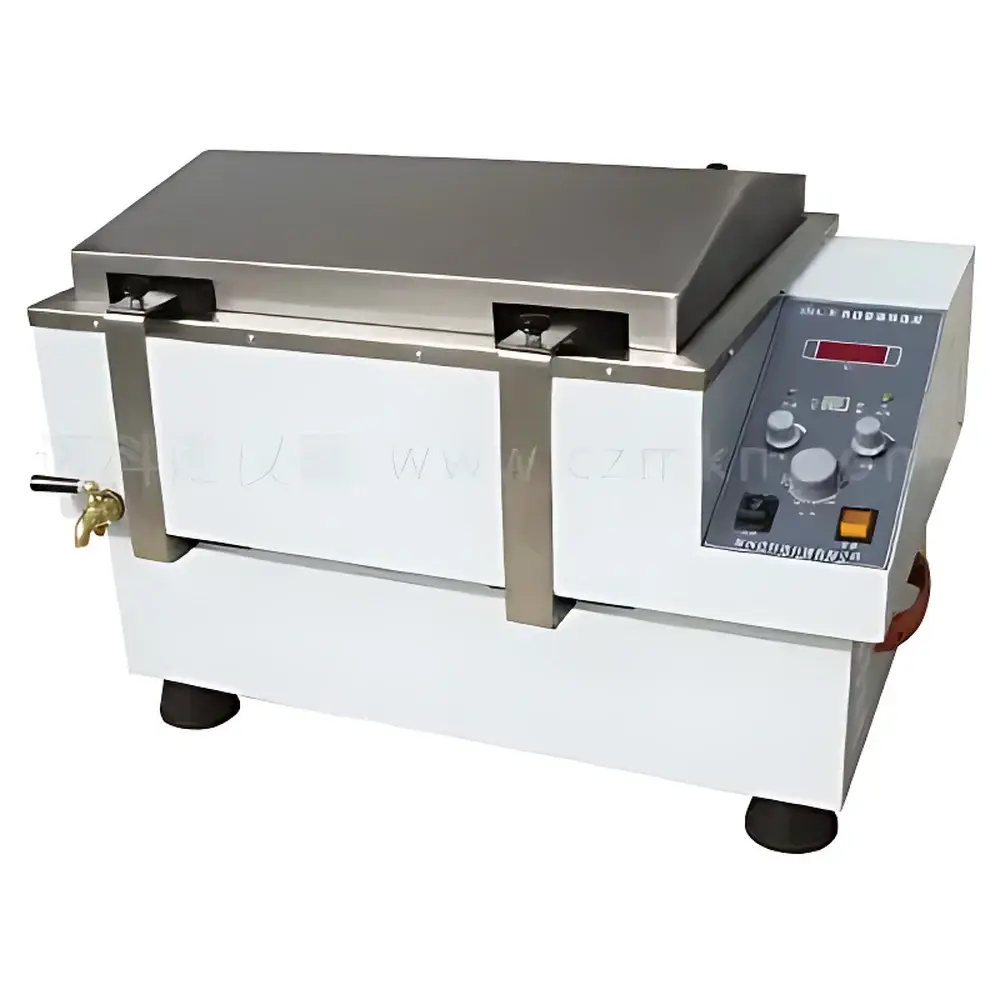
MKN SHA-B Dual-Mode Water Bath Shaker
| Brand | MKN |
|---|---|
| Origin | Jiangsu, China |
| Manufacturer Type | Authorized Distributor |
| Country of Origin | China |
| Model | SHA-B |
| Price | USD 850 (FOB) |
| Power Supply | 220 V AC, 50 Hz |
| Temperature Range | Ambient to 100 °C (±1 °C accuracy, LED digital display) |
| Speed Range | 0–300 rpm |
| Timer | 0–120 min |
| Oscillation Amplitude | 20 mm |
| Chamber Dimensions (L×W×H) | ≥490 × 390 × 170 mm |
| Overall Dimensions (L×W×H) | 720 × 480 × 520 mm |
| Heating Power | 2000 W |
| Oscillation Modes | Orbital and Reciprocating |
| Construction | Stainless Steel 304 Bath Chamber & Frame |
| Universal Clamp System | Spring-loaded stainless steel multi-position fixture |
Overview
The MKN SHA-B Dual-Mode Water Bath Shaker is an integrated laboratory platform engineered for precise temperature-controlled agitation of liquid samples in biological and biochemical applications. It operates on the principle of combined thermal regulation and mechanical oscillation—utilizing a high-efficiency resistive heating system immersed in a stainless steel water bath, coupled with a dual-mode drive mechanism capable of both orbital (circular) and reciprocating (linear back-and-forth) motion. This design ensures uniform heat transfer across sample vessels while maintaining consistent mixing dynamics—critical for cell suspension, enzymatic reactions, solubility studies, and microbial growth kinetics. The unit complies with general safety and electromagnetic compatibility requirements per GB 4793.1–2007 (equivalent to IEC 61010-1), and its temperature control architecture meets ISO/IEC 17025 traceability guidelines for routine calibration verification.
Key Features
- Stainless steel 304 water bath chamber and structural frame—resistant to corrosion, thermal shock, and long-term immersion in aqueous media
- Dual oscillation mode selection (orbital and reciprocating) via front-panel toggle switch—enabling method-specific optimization without hardware modification
- High-resolution LED digital display with ±1 °C temperature accuracy across 0–100 °C range, calibrated against NIST-traceable reference thermometers
- Adjustable speed control (0–300 rpm) with soft-start motor drive to minimize sample splashing and vessel displacement
- Programmable mechanical timer (0–120 minutes) with audible end-of-cycle alert and auto-shutdown functionality
- Universal spring-clamp fixture system accommodating tubes (10–50 mL), flasks (up to 1 L), and multi-well plates—no tool required for reconfiguration
- 2000 W heating element with PID-based thermal regulation, achieving ≤15 min ramp time from ambient to 100 °C under standard load conditions
Sample Compatibility & Compliance
The SHA-B accommodates standard laboratory glassware and plastic containers—including Erlenmeyer flasks, centrifuge tubes, serum bottles, and culture vessels—within its internal chamber (≥490 × 390 × 170 mm). Its open-bath configuration allows direct visual monitoring and easy access during operation. The device is suitable for use in GLP-compliant environments where documentation of temperature setpoint, duration, and agitation parameters is maintained manually or via external logging. While not certified for FDA 21 CFR Part 11 compliance out-of-the-box, it supports audit-ready operation when paired with validated external data loggers meeting ASTM E2874–22 standards for environmental monitoring systems. It is routinely deployed in applications aligned with ISO 8573-1 (compressed air quality), USP (compounding), and EN ISO 15189 (medical laboratory accreditation) auxiliary workflows.
Software & Data Management
The SHA-B operates as a standalone analog-digital hybrid instrument with no embedded microprocessor or network interface. All operational parameters—temperature setpoint, speed, and timer—are configured via tactile rotary dials and push-button controls. Data recording is performed externally using calibrated thermocouple probes (e.g., Type K) connected to USB-based data loggers (e.g., Omega OM-DAQPRO-5300 series) or industrial PLCs. For laboratories implementing electronic lab notebooks (ELNs) such as LabArchives or Benchling, experimental metadata—including batch ID, operator initials, start/end timestamps, and observed stability indicators—is entered manually post-run. The absence of firmware or cloud connectivity eliminates cybersecurity vulnerabilities and simplifies IQ/OQ validation protocols under GMP Annex 11 guidance.
Applications
- Microbial culture expansion in nutrient broths and agar-based media under controlled thermal and aeration conditions
- Protein solubilization and buffer equilibration prior to chromatographic separation or electrophoresis
- Extraction efficiency optimization for plant metabolites, soil contaminants, and pharmaceutical actives
- Enzyme kinetic assays requiring simultaneous temperature stabilization and homogeneous substrate dispersion
- Hybridization and washing steps in molecular biology workflows (e.g., Southern/Northern blotting)
- Quality control testing of food emulsions, dairy homogenates, and cosmetic suspensions
- Environmental water analysis—BOD incubation, nutrient dissolution, and heavy metal leaching studies
FAQ
Is the SHA-B suitable for continuous 24/7 operation?
Yes—when operated within specified ambient conditions (15–30 °C, relative humidity ≤80%, non-condensing), the unit supports uninterrupted duty cycles up to 168 hours, provided cooling airflow around the chassis remains unobstructed.
Can I use organic solvents in the water bath?
No—the bath is designed exclusively for aqueous solutions. Use of alcohols, acetone, or chlorinated solvents may degrade seals, corrode heating elements, and invalidate warranty coverage.
Does the device support external temperature probe input?
Not natively. Temperature feedback is derived solely from the built-in PT100 sensor located at the bath’s geometric center. For vessel-specific monitoring, third-party immersion probes must be interfaced externally.
What maintenance is required for long-term reliability?
Monthly descaling using 5% citric acid solution (at 60 °C, 30 min soak), biannual inspection of clamp spring tension, and annual verification of thermal drift using a calibrated reference thermometer.
Is custom firmware or OEM integration available?
No—this model is delivered as a fixed-function instrument. Non-standard configurations (e.g., RS-485 Modbus output, Ethernet relay control) require engineering consultation and are subject to minimum order quantities and extended lead times.