
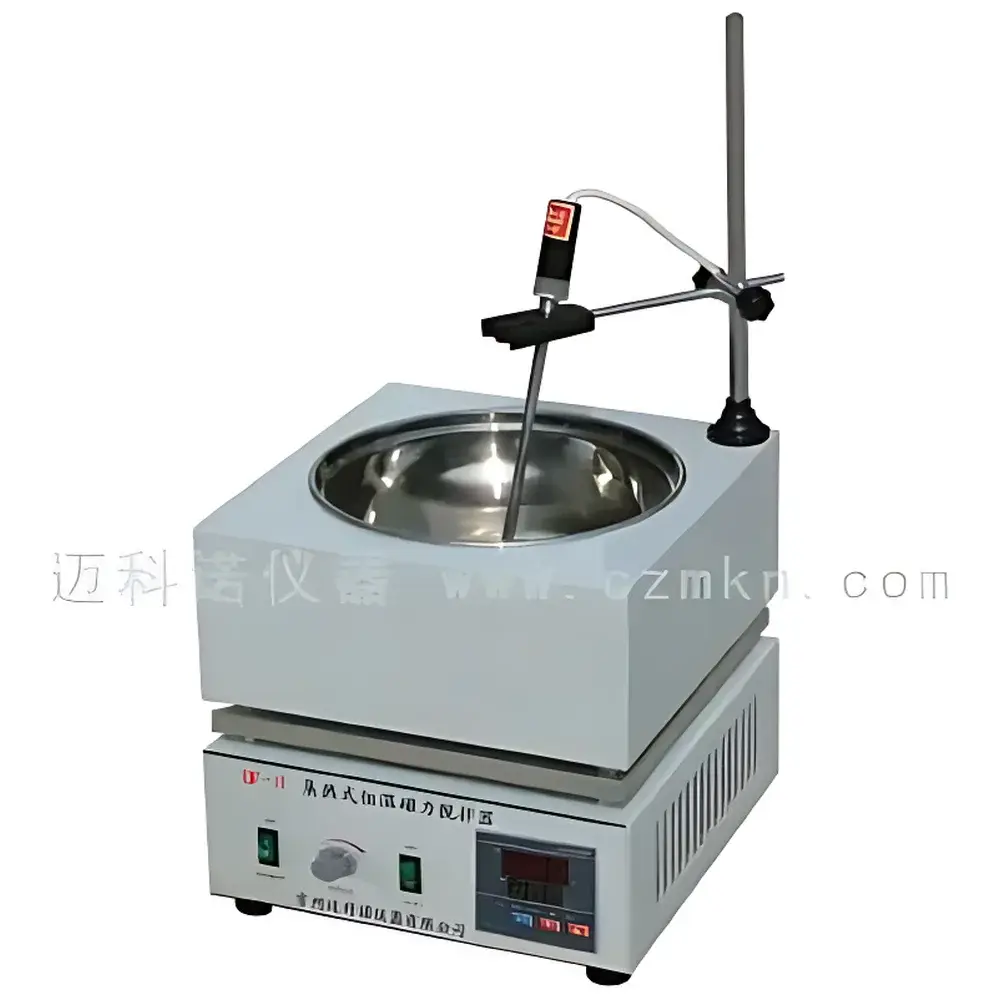
MKN DF-2 Integrated Heating Magnetic Stirrer
| Power Supply | 220 V, 50 Hz |
|---|---|
| Stirring Speed | 0–2400 rpm (infinitely variable) |
| Heating Power | ≤800 W |
| Temperature Range | Ambient to 300 °C (compatible with water bath, oil bath, or dry heating) |
| Temperature Control Accuracy | ±1 °C |
| Heating Rate | 700 mL medium heated from ambient to 100 °C in ≤13 min |
| Motor Type | Brushless DC motor |
| Stir Bar Material | PTFE-coated magnet core |
| Compliance | Designed for general laboratory use under standard GLP conditions |
Overview
The MKN DF-2 Integrated Heating Magnetic Stirrer is an engineered solution for precise, reproducible temperature-controlled mixing in academic, industrial, and quality control laboratories. Unlike conventional hotplate stirrers that rely on surface conduction, the DF-2 employs an integrated far-infrared heating system coupled with a high-efficiency brushless DC motor — enabling uniform thermal distribution across reaction vessels while maintaining mechanical stability during extended operation. Its design supports simultaneous heating and stirring of spherical flasks under vacuum or pressurized conditions, making it suitable for synthetic chemistry, polymerization studies, dissolution testing, and sample preparation workflows where thermal homogeneity and rotational consistency are critical. The instrument operates without external cooling requirements and is rated for continuous duty at temperatures up to 300 °C, accommodating both aqueous and organic solvent systems.
Key Features
- Integrated far-infrared heating element ensures rapid thermal response and >25% higher energy efficiency compared to resistive coil-based alternatives.
- Brushless DC motor delivers quiet operation (<45 dB(A)), zero carbon dust generation, and service life exceeding 10,000 hours — ideal for unattended overnight experiments.
- Infinitely variable speed control (0–2400 rpm) with soft-start functionality minimizes vortex formation and splashing during low-viscosity or volatile liquid handling.
- Dual-mode thermal regulation: compatible with water baths (up to 100 °C), silicone oil baths (up to 250 °C), and direct dry-heating of glassware (up to 300 °C) without thermal runaway risk.
- PTFE-coated magnetic stir bars provide chemical inertness across pH 0–14 and resistance to halogenated solvents, strong acids, and oxidizing reagents.
- Robust aluminum alloy housing with reinforced ceramic top plate resists thermal deformation and offers long-term dimensional stability under cyclic heating loads.
Sample Compatibility & Compliance
The DF-2 accommodates round-bottom flasks from 50 mL to 2000 mL volume, including those fitted with reflux condensers or gas inlet/outlet adapters. It maintains stable rotation under vacuum (down to 10 mbar) and positive pressure (up to 0.3 MPa) when used with appropriate flask clamping systems. While not certified for hazardous area (ATEX/IECEx) applications, the unit complies with IEC 61010-1:2010 safety standards for laboratory electrical equipment. Its temperature control architecture supports basic audit trail requirements per GLP guidelines; however, full 21 CFR Part 11 compliance requires integration with validated third-party data acquisition software.
Software & Data Management
The DF-2 operates as a standalone analog-controlled instrument with no embedded microprocessor or digital interface. Temperature setpoint and stirring speed are adjusted via front-panel rotary dials with tactile feedback and calibrated scales. Real-time monitoring relies on external thermometers (e.g., Pt100 probes or IR pyrometers). For automated data logging, users may connect optional RS-485 or 0–10 V analog output modules (sold separately) to programmable logic controllers or PC-based SCADA systems. All firmware-independent operation ensures deterministic behavior in regulated environments where software validation burden must be minimized.
Applications
- Synthesis of metal-organic frameworks (MOFs) requiring precise thermal ramping and homogeneous nucleation.
- Dissolution testing of pharmaceutical tablets per USP , particularly for sink condition maintenance in multi-vessel setups.
- Preparation of nanomaterial dispersions (e.g., graphene oxide, quantum dots) where shear-induced aggregation must be avoided.
- Enzymatic reaction kinetics studies under controlled thermal profiles, including Arrhenius analysis over 25–70 °C ranges.
- Standardization of calibration standards for viscometers and density meters using thermostatically stabilized reference fluids.
- Environmental sample digestion protocols (EPA Method 3050B) involving HNO₃/HF mixtures at elevated temperatures.
FAQ
Can the DF-2 be used with Teflon-coated stir bars only, or are other materials supported?
The instrument is optimized for PTFE-encapsulated stir bars due to their dielectric properties and thermal stability. Ceramic or glass-coated stir bars may be used but reduce magnetic coupling efficiency above 200 °C.
Is the temperature sensor internally mounted or external?
The DF-2 uses a built-in NTC thermistor embedded in the heating plate. For process-critical applications, users should verify vessel temperature independently using a calibrated immersion probe.
Does the unit support PID temperature control?
No — it implements proportional-only (P-mode) regulation with manual offset adjustment. This simplifies maintenance and avoids overshoot in low-thermal-mass systems.
What is the maximum flask diameter supported on the heating surface?
The ceramic plate accommodates flasks up to 120 mm in base diameter; larger vessels require custom support stands to ensure centering and thermal contact uniformity.
How often does the unit require calibration verification?
Annual verification against NIST-traceable references is recommended for ISO/IEC 17025-accredited labs. No field recalibration is possible — drift exceeding ±2 °C warrants factory service.



