
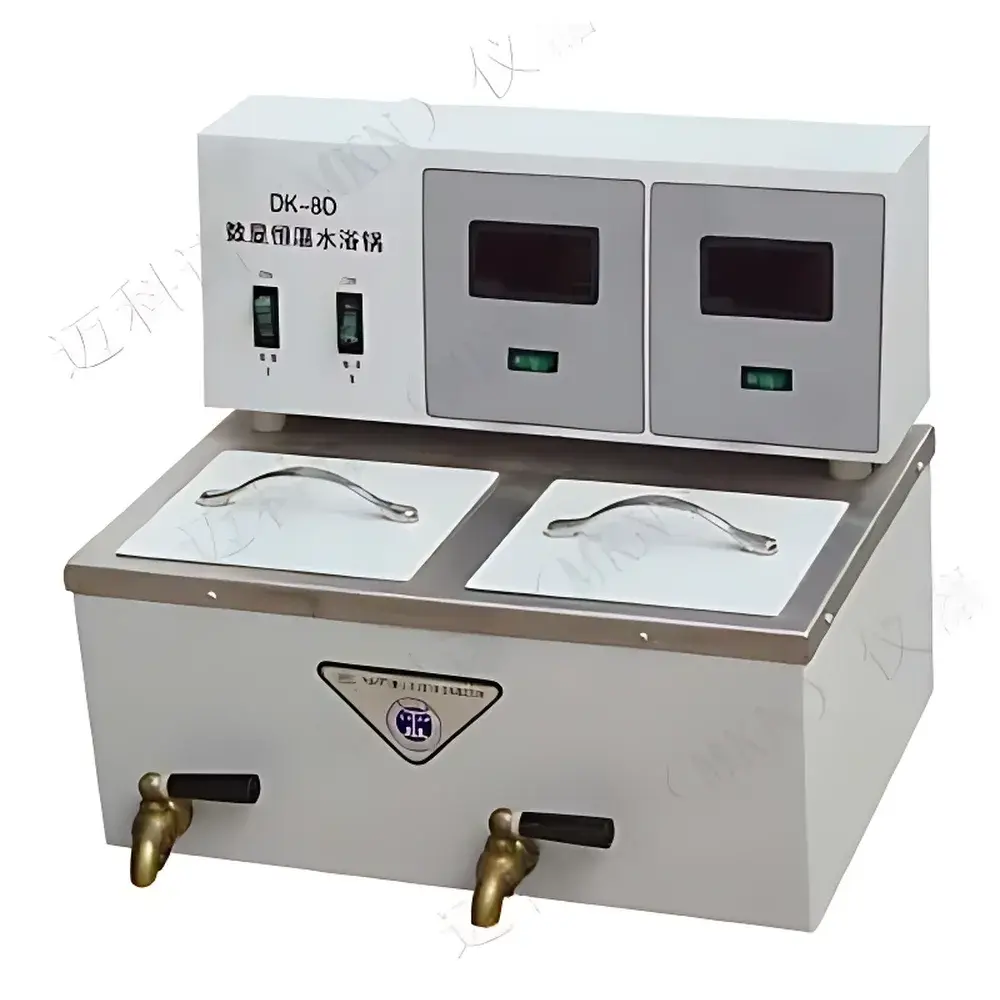
MKN DK-8D-2 Digital Constant-Temperature Water Bath
| Brand | MKN |
|---|---|
| Model | DK-8D-2 |
| Type | Dual-Well Water Bath |
| Power Supply | 220 V, 50 Hz |
| Heating Power | 600 W |
| Temperature Range | Ambient to 100 °C |
| Temperature Stability | ≤ ±0.5 °C |
| Temperature Accuracy | ≤ ±1.0 °C |
| Chamber Volume per Well | 14 × 12 × 12 cm³ (2016 cm³ total) |
| Construction | Imported Stainless Steel 304 |
| Heating Method | Far-Infrared Heating Element |
| Control System | Dual-Integration High-Precision A/D Converter with Operational Amplifier Circuitry |
| Display | LED Digital Display |
| Stirring | Built-in Magnetic Stirrer per Well |
| Certifications | Compliant with GB/T 28001 (OHSAS 18001 equivalent), RoHS Directive 2011/65/EU |
Overview
The MKN DK-8D-2 Digital Constant-Temperature Water Bath is a precision-engineered laboratory thermal platform designed for stable, uniform, and reproducible temperature control across two independent wells. It operates on the principle of convective heat transfer via water as a thermally conductive medium, enabling gentle, non-contact heating ideal for temperature-sensitive samples such as enzyme solutions, cell cultures, reagent pre-warming, and solvent-based chemical reactions. Unlike dry-block heaters or oil baths, water baths provide superior thermal homogeneity and reduced risk of localized overheating—critical for applications requiring compliance with pharmacopeial methods (e.g., USP <797>, EP 2.2.43) and GLP-aligned sample preparation workflows. The unit features far-infrared heating elements integrated into the stainless steel bath base, minimizing thermal lag and ensuring rapid thermal equilibrium (<15 min from ambient to 60 °C under standard load conditions). Its dual-well architecture allows parallel processing of dissimilar samples at identical or independently monitored temperatures.
Key Features
- Dual independent digital temperature control channels—one per well—with LED display for real-time monitoring and adjustment
- High-grade 304 stainless steel tank construction, electropolished for corrosion resistance and ease of decontamination
- Far-infrared heating system engineered for low thermal inertia and high energy efficiency, reducing power consumption by up to 22% versus conventional resistive coil designs
- Integrated magnetic stirrer in each well (adjustable speed range: 0–1200 rpm), enabling homogeneous temperature distribution and enhanced mass transfer during incubation or dissolution
- Advanced temperature regulation circuitry incorporating dual-integration A/D conversion and operational amplifier feedback loops, delivering long-term stability (≤ ±0.5 °C over 8 h) and repeatability (±0.3 °C inter-run CV)
- Over-temperature cut-off protection and dry-run safety shutdown to prevent heater damage during low-water conditions
Sample Compatibility & Compliance
The DK-8D-2 accommodates standard laboratory glassware including 10–500 mL beakers, test tubes (up to 25 mm OD), Erlenmeyer flasks, and volumetric cylinders. Its open-bath configuration supports immersion depth up to 100 mm and permits easy access for pipetting, sampling, or probe insertion. The unit meets ISO 13485 design control requirements for medical device ancillary equipment and conforms to IEC 61010-1:2010 for electrical safety in laboratory environments. It supports audit-ready documentation protocols when used within FDA 21 CFR Part 11–compliant quality systems—particularly where electronic temperature logs are generated via optional RS-232 output (available on firmware v2.1+). All materials in contact with water are USP Class VI certified, ensuring compatibility with pharmaceutical-grade water-for-injection (WFI) systems.
Software & Data Management
While the DK-8D-2 operates as a standalone analog-digital hybrid instrument, its optional RS-232 serial interface enables integration with third-party data acquisition platforms (e.g., LabVIEW, MATLAB, or custom LIMS modules). Temperature setpoints, real-time readings, and alarm status can be logged at user-defined intervals (1–60 s resolution). Firmware supports timestamped event logging—including power-on, setpoint changes, and over-temperature triggers—for traceability in regulated environments. No proprietary software is required; ASCII-formatted output is compatible with CSV import workflows and statistical process control (SPC) dashboards. Audit trail functionality satisfies GLP Annex 11 and EU GMP Chapter 4 documentation expectations when paired with validated PC-based logging software.
Applications
- Pre-incubation of culture media and enzymatic reagents prior to microbiological assays (ASTM D5766, ISO 11133)
- Controlled hydrolysis and esterification reactions requiring precise thermal input below 100 °C
- Calibration of liquid-in-glass thermometers and RTDs using fixed-point reference baths
- Accelerated stability testing of topical formulations per ICH Q1A(R3) guidelines
- Sample equilibration for HPLC mobile phase preparation and buffer degassing
- Thermal denaturation studies of nucleic acids and proteins (e.g., Tm determination via UV-Vis spectroscopy coupling)
FAQ
What is the maximum recommended operating temperature for continuous use?
The DK-8D-2 is rated for sustained operation up to 95 °C; prolonged use at 100 °C may accelerate evaporation and require more frequent water top-up and calibration verification.
Can the magnetic stirrers operate independently of the heating function?
Yes—each well’s stirrer is controlled separately via dedicated front-panel knobs and remains functional even when temperature control is disabled.
Is the unit suitable for use with organic solvents?
Not recommended. The bath is designed exclusively for aqueous media; use of flammable or corrosive solvents voids warranty and violates IEC 61010-1 safety classification.
How often should temperature calibration be performed?
We recommend quarterly verification using a NIST-traceable platinum resistance thermometer (PRT) and daily operational checks against a calibrated reference sensor.
Does the DK-8D-2 support external temperature probes for sample-specific monitoring?
No—the unit does not include probe input ports; temperature sensing is internal only, located at the bath bottom center. For sample-core measurement, users must employ external thermocouples connected to independent dataloggers.



