
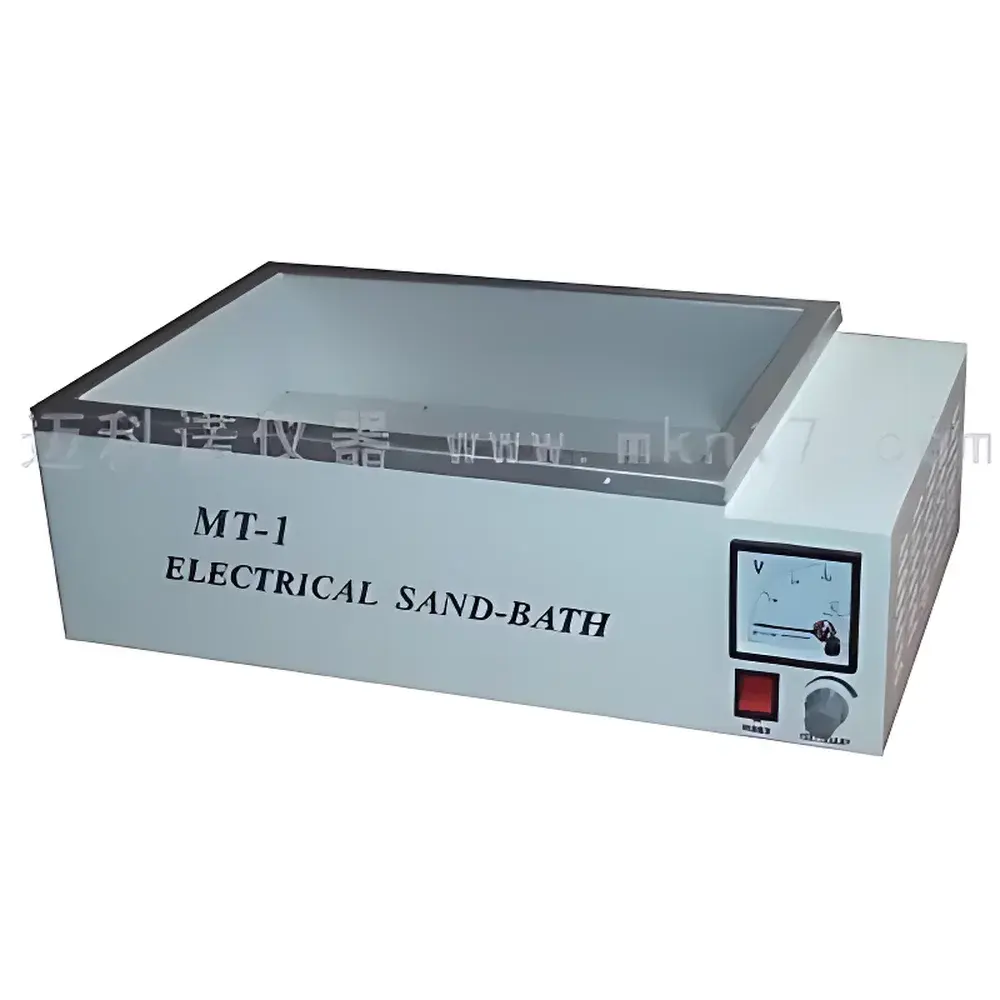
MKN MT-1 Temperature-Controlled Sand Bath
| Brand | MKN |
|---|---|
| Model | MT-1 |
| Type | Temperature-Controlled Sand Bath |
| Heating Principle | Resistive Sand-Mediated Conduction Heating |
| Sand Bath Capacity (mm) | 400 × 300 × 100 |
| Rated Power | 1.8 kW |
| Input Voltage | 220 V AC |
| Adjustable Output Voltage Range | 50–210 V AC |
| Overall Dimensions (mm) | 440 × 340 × 280 |
| Net Weight | 17 kg |
| Construction | Cold-Rolled Steel Housing + Cast Iron Base Plate with Anti-Corrosion Coating |
| Control Method | Stepless Power Regulation via Rotary Potentiometer |
Overview
The MKN MT-1 Temperature-Controlled Sand Bath is a robust, analog-controlled laboratory heating device engineered for uniform, low-risk thermal treatment of glassware and reaction vessels during sample preparation, digestion, distillation, and evaporation procedures. Unlike direct-contact electric hot plates or oil baths, the MT-1 employs granular silica sand as an inert, high-thermal-mass heat-transfer medium—enabling gentle, homogeneous temperature distribution across the entire heating surface while minimizing thermal shock, localized overheating, and fire hazards associated with volatile or flammable solvents. Its design adheres to fundamental principles of conductive heat transfer through particulate media, where sand’s high specific heat capacity (≈0.8 J/g·K) and low thermal conductivity (~0.3 W/m·K) provide inherent thermal buffering and stable setpoint maintenance. The unit is particularly suited for applications requiring sustained heating between ambient and ~350 °C (dependent on sand depth and ambient conditions), without open flames or pressurized systems.
Key Features
- Cast iron base plate and sand reservoir—precision-cast for dimensional stability and long-term resistance to thermal cycling-induced warping
- Cold-rolled steel housing with corrosion-resistant surface treatment—ensures mechanical integrity in humid or chemically exposed lab environments
- Stepless power regulation via front-panel rotary potentiometer—enables fine-tuned control of heating rate and steady-state temperature without discrete steps or digital overshoot
- Adjustable output voltage range (50–210 V AC)—allows user-defined thermal input modulation to match vessel size, sand load, and target temperature profile
- Non-illuminated analog interface—designed for reliability, electromagnetic compatibility (EMC), and compliance with GLP-aligned operational simplicity
- Integrated grounding terminal—meets IEC 61010-1 safety requirements for Class I electrical laboratory equipment
Sample Compatibility & Compliance
The MT-1 accommodates standard laboratory glassware including Erlenmeyer flasks (up to 2 L), round-bottom flasks (up to 1 L), beakers, and digestion tubes placed directly into the sand bed. Its open-sand configuration permits unobstructed visual monitoring and manual vessel repositioning. While not certified to ISO/IEC 17025 calibration standards, the unit conforms to general-purpose laboratory equipment safety norms under GB/T 29588–2013 (Chinese national standard for electric heating apparatus) and aligns with ASTM D129–18 guidelines for controlled-temperature sample conditioning. It is suitable for use in environments operating under basic GLP practices where traceable temperature documentation is maintained externally (e.g., via calibrated external thermocouple loggers). Note: No built-in temperature sensor or feedback loop is included; users must employ external thermometry for process validation.
Software & Data Management
The MT-1 operates as a standalone analog instrument with no embedded microcontroller, firmware, or digital connectivity. Consequently, it does not support data logging, remote control, USB/RS-232 interfaces, or compliance with FDA 21 CFR Part 11 electronic record requirements. This architecture prioritizes operational transparency, serviceability, and immunity to software obsolescence—making it appropriate for regulated laboratories where instrument qualification focuses on physical installation and operational checks (IQ/OQ) rather than computerized system validation (CSV). Users are advised to document operating parameters (e.g., knob position, input voltage, observed sand surface temperature) manually or via external recording devices compliant with their internal SOPs.
Applications
- Controlled-temperature digestion of organic matrices prior to heavy metal analysis (e.g., EPA Method 3050B)
- Gentle solvent evaporation from aqueous extracts to avoid analyte degradation or bumping
- Pre-heating and temperature equilibration of reaction mixtures before catalytic or enzymatic initiation
- Wax melting and viscosity conditioning in polymer or petrochemical sample prep
- Stabilization of reference standards during gravimetric or volumetric calibration workflows
- Backup heating source in multi-instrument labs where redundancy and electromagnetic isolation are critical
FAQ
Does the MT-1 include a built-in temperature sensor or digital display?
No. The MT-1 is an analog, manually regulated device. Temperature monitoring requires external instrumentation such as a calibrated immersion thermometer or thermocouple probe.
What is the maximum recommended operating temperature of the sand bath?
While sand remains stable up to ~1200 °C, practical upper limits are governed by housing integrity and user safety. For continuous operation, we recommend maintaining sand surface temperatures below 350 °C to preserve cast iron structural stability and minimize oxidation.
Can the MT-1 be used with corrosive reagents such as concentrated HNO₃ or HF?
The sand bath itself is chemically inert; however, direct spillage of aggressive acids onto the cast iron base may cause pitting. Always use secondary containment (e.g., ceramic trays) when handling corrosive digestants.
Is the unit compatible with 110 V AC power supplies?
No. The MT-1 is configured exclusively for 220 V AC ±10%, 50 Hz input. Use with voltage converters is not recommended due to potential instability in power regulation and thermal response.
What maintenance is required for long-term reliability?
Periodic inspection of the power cord, grounding connection, and sand cleanliness is advised. Replace sand if contaminated with salts or organics to prevent uneven heating or odor generation. Store in low-humidity conditions when idle.



