
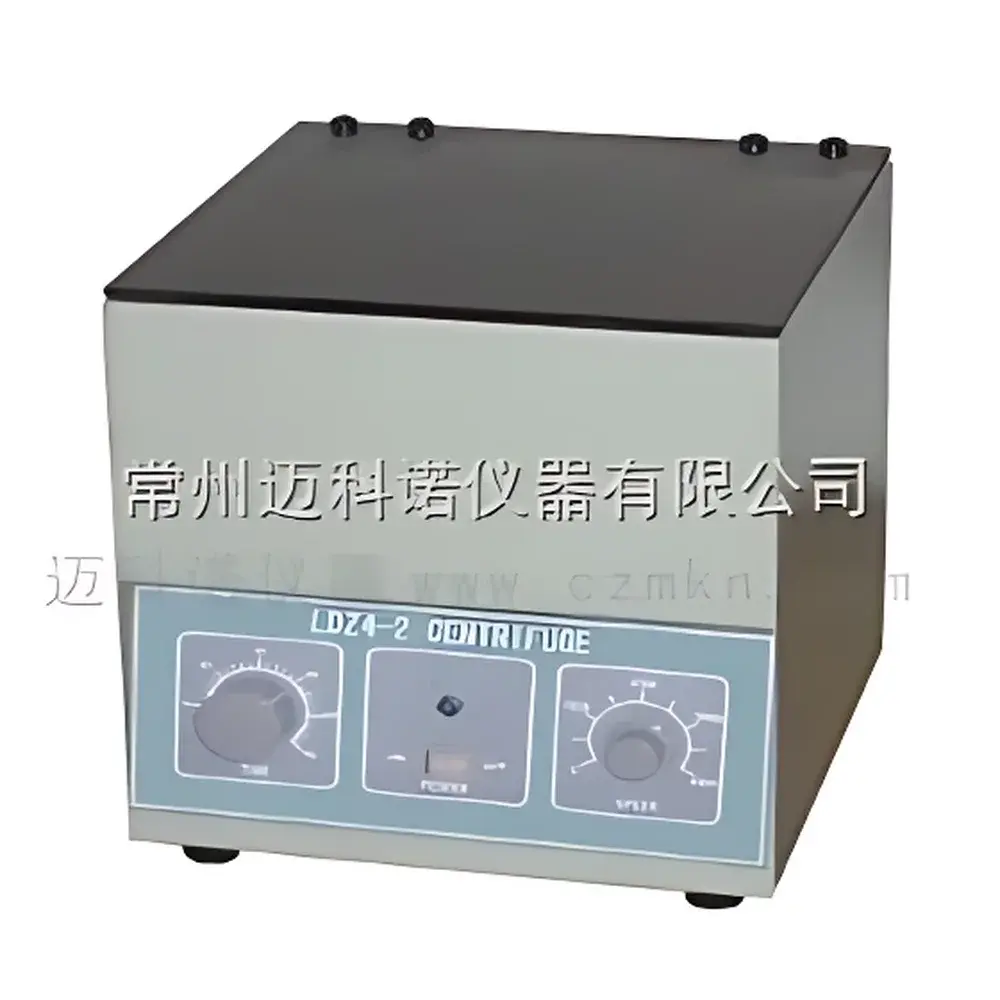
MKN LDZ4-2 Automatic Balancing Centrifuge
| Brand | MKN |
|---|---|
| Origin | Zhejiang, China |
| Model | LDZ4-2 |
| Maximum Speed | 4000 rpm (infinitely variable) |
| Relative Centrifugal Force (RCF) | 2325 × g |
| Capacity | 8 × 20 mL or 8 × 15 mL |
| Timer Range | 0–60 min |
| Noise Level | ≤60 dB(A) |
| Power Supply | AC 220 V, 50 Hz, 2 A |
| Construction | Die-cast aluminum rotor assembly |
| Compliance | Designed for routine clinical and research centrifugation per ISO 13485-aligned manufacturing practices |
Overview
The MKN LDZ4-2 Automatic Balancing Centrifuge is a benchtop, low-speed centrifuge engineered for reproducible, operator-safe separation of biological and clinical samples via sedimentation under controlled rotational force. It operates on the principle of differential sedimentation—where particles of varying density, size, and shape separate radially outward in response to centrifugal acceleration. Unlike fixed-angle or swing-bucket centrifuges requiring manual tube balancing prior to operation, the LDZ4-2 integrates a mechanical auto-balancing mechanism that dynamically compensates for minor mass asymmetries across the rotor during acceleration and deceleration. This design minimizes vibration transmission, extends bearing life, and eliminates the need for pre-run weight matching—a critical advantage in high-throughput clinical labs where rapid sample turnover and operator variability are common constraints.
Key Features
- Infinitely variable speed control (0–4000 rpm), enabling precise optimization for diverse sample viscosities and sedimentation coefficients.
- Integrated mechanical auto-balancing system with dual-axis compensation, reducing operational vibration and audible noise to ≤60 dB(A) at 1 m distance.
- Die-cast aluminum rotor assembly with precision-machined tube pockets; resistant to corrosion and thermal deformation, ensuring long-term dimensional stability and tube integrity.
- Digital timer with 1-minute resolution (0–60 min), supporting both timed runs and continuous operation modes.
- Thermally insulated housing and optimized airflow path limit motor and chamber temperature rise to <12 °C above ambient after 30 min at maximum speed.
- Locking lid with dual safety interlock: centrifuge halts immediately upon lid opening and prevents start-up unless fully latched.
Sample Compatibility & Compliance
The LDZ4-2 accommodates standard conical-bottom polypropylene or glass centrifuge tubes (15 mL and 20 mL formats), including common diagnostic formats used in serum separation, plasma harvesting, and immunoprecipitation workflows. Its RCF output of 2325 × g is suitable for pelleting erythrocytes, leukocytes, platelets, and moderate-density cellular organelles without inducing excessive shear stress. The unit complies with IEC 61010-1:2010 for laboratory electrical equipment safety and meets electromagnetic compatibility (EMC) requirements per EN 61326-1. While not certified for GMP production environments, its construction and documentation support GLP-aligned validation protocols—including IQ/OQ documentation templates provided by MKN upon request.
Software & Data Management
As a standalone electromechanical instrument, the LDZ4-2 does not incorporate embedded software or network connectivity. All operational parameters are set via front-panel rotary encoder and push-button interface. However, it supports full traceability through manual logbook integration: run records—including date/time, speed, duration, rotor load configuration, and operator ID—can be documented in accordance with ISO/IEC 17025 clause 7.9 (result reporting) and FDA 21 CFR Part 11 Annex A guidance for non-electronic record systems. Optional calibration certificates (traceable to NIM, China) and annual performance verification checklists are available for audit readiness.
Applications
- Routine serum/plasma separation from whole blood specimens in hospital core labs and point-of-care testing centers.
- Preparative isolation of immune complexes, antigen-antibody precipitates, and latex-agglutination reaction products.
- Clarification of bacterial culture supernatants prior to ELISA or Western blot analysis.
- Concentration of low-abundance analytes in urine or cerebrospinal fluid for downstream immunoassay or mass spectrometry workflows.
- Stabilization and recovery of exosomes and microvesicles in early-stage biomarker discovery studies (when paired with appropriate density gradient media).
FAQ
Does the LDZ4-2 require regular rotor balancing calibration?
No—its passive auto-balancing mechanism contains no user-serviceable components and requires no recalibration. Routine visual inspection of rotor symmetry and tube seating is sufficient.
Can the centrifuge accommodate 10 mL tubes?
Yes, using optional adapter sleeves (sold separately); the rotor’s pocket geometry supports 10 mL, 15 mL, and 20 mL conical tubes without modification.
Is the unit compatible with refrigerated operation?
No—it is a non-refrigerated model. Ambient temperature operation is recommended between 10 °C and 32 °C with ≤80% non-condensing relative humidity.
What maintenance is required beyond routine cleaning?
Biannual lubrication of the main drive shaft bearing (using ISO VG 32 mineral oil) and annual verification of lid interlock function constitute the full preventive maintenance schedule.
How is compliance with clinical laboratory standards demonstrated?
MKN provides a Declaration of Conformity referencing IEC 61010-1, test reports from SGS Shanghai, and a factory-issued performance verification report covering speed accuracy (±20 rpm), timer deviation (<±1%), and noise emission (≤60 dB(A)).



