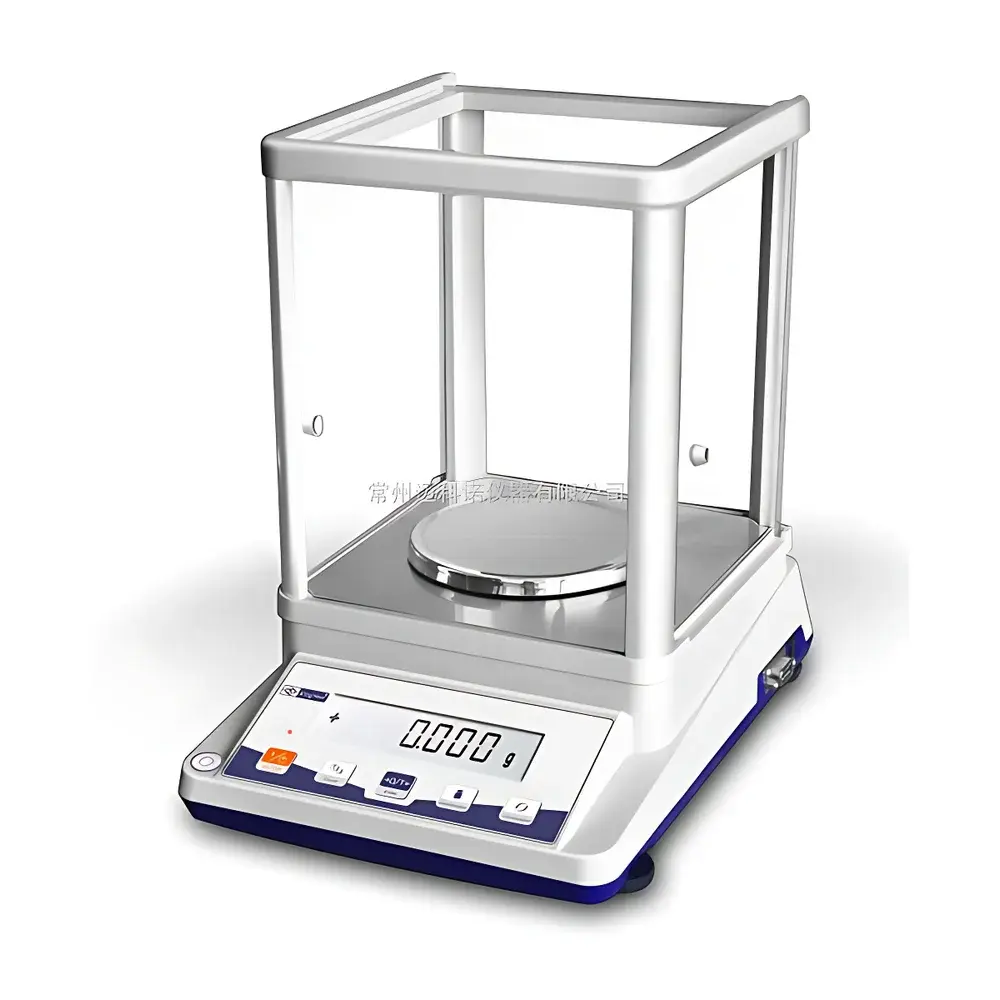
JA103P Analytical Balance by Jinhua Precision Instruments
| Key | Capacity: 100 g |
|---|---|
| Readability | 0.001 g |
| Repeatability | ≤ ±0.002 g (typical) |
| Linearity Error | ±0.003 g |
| Stabilization Time | ≤ 2 s |
| Minimum Weight | 0.003 g |
| Weighing Pan Diameter | Φ110 mm |
| Draft Shield | Triple-door sliding glass enclosure (170 × 190 × 170 mm) |
| Operating Temperature Range | 17.0–25.5 °C |
| Display | Backlit LCD (refresh rate: 0.3 s) |
| Power Supply | AC 220 V ±12 V, 50 Hz, 600 mA |
| Dimensions (W×D×H) | 210 × 270 × 210 mm |
| Net Weight | 4 kg |
| Compliance | ISO 9001-manufactured, GLP/GMP-ready design |
| Interface Options | RS232 serial port (optional) |
Overview
The JA103P Analytical Balance is a high-precision electromagnetic force compensation balance engineered for routine and regulated laboratory weighing tasks requiring 0.001 g readability and consistent repeatability. Designed and manufactured in Zhejiang, China, under ISO 9001 quality management systems, the JA103P employs a strain-gauge-based load cell architecture with internal auto-calibration logic and dynamic drift compensation. Its measurement principle relies on electromagnetic force restoration—where sample-induced displacement of the weighing pan triggers a proportional counter-force generated by a precision coil within a permanent magnetic field; the current required to restore equilibrium is linearly converted into mass output. This architecture delivers superior long-term stability and resistance to mechanical hysteresis compared to basic electromagnetic balance variants. The instrument operates optimally within a controlled ambient range of 17.0–25.5 °C and is intended for use in analytical chemistry labs, QC/QA environments, pharmaceutical formulation units, and academic research settings where trace-level mass quantification supports gravimetric analysis, standard solution preparation, and solid dosage form verification.
Key Features
- Electromagnetic force compensation sensor with integrated strain-gauge transduction for enhanced linearity and thermal drift resilience
- Triple-door sliding glass draft shield (170 × 190 × 170 mm) enabling unobstructed visual access while minimizing air-current interference
- Backlit LCD display with 0.3-second refresh rate and intuitive five-key interface (ON/OFF, PRINT, CAL, →, ←, and ZERO)
- Auto-zero tracking and real-time overload detection with audible/visual alert to prevent sensor overloading
- Internal calibration routine supported by external 100 g Class M2 reference weights (ISO 9001-traceable)
- Multi-unit display capability: grams (g), ounces (oz), carats (ct), and milligrams (mg)
- GLP/GMP-compliant operational log structure—time-stamped calibration events, zero checks, and user-initiated weight records are retained in non-volatile memory
- RS232 serial interface (optional) for bidirectional data transfer to LIMS or ELN platforms, supporting ASCII protocol with configurable baud rates (9600–115200 bps)
Sample Compatibility & Compliance
The JA103P accommodates samples up to 100 g placed on its Φ110 mm stainless-steel weighing pan. Its minimum weighable quantity (MWQ) is 0.003 g at k = 2 (based on typical repeatability of ±0.002 g), meeting USP requirements for analytical balance qualification when operated under validated environmental conditions. The triple-door draft shield conforms to ISO 17025:2017 Annex A.3 guidelines for reducing convective error during low-mass measurements. While not certified to OIML R76 or NIST Handbook 44 out-of-the-box, the unit’s metrological performance aligns with Class II precision balance specifications per ASTM E898–21 and supports audit-ready documentation for FDA 21 CFR Part 11 compliance when paired with compliant software and access controls.
Software & Data Management
Data export is enabled via RS232 connection using standard ASCII framing (STX/ETX delimiters, CR/LF termination). Each transmitted record includes timestamp (YYYY-MM-DD HH:MM:SS), net weight value, unit identifier, and operator ID if configured. The balance stores up to 100 calibration logs and 200 weighing events locally with tamper-resistant timestamps. No proprietary software is bundled; however, the device integrates natively with common laboratory informatics systems—including Thermo Fisher SampleManager, LabVantage, and custom Python/Node.js scripts using pySerial or similar libraries. Audit trail functionality satisfies GLP requirements for traceability of calibration history and critical weighing actions.
Applications
- Preparation of reference standards and volumetric solutions (e.g., 0.1 M NaCl, 100 ppm stock dilutions)
- Weighing of active pharmaceutical ingredients (APIs) and excipients in tablet/capsule development
- Gravimetric moisture content determination per ASTM D2231 and ISO 787-2
- Residue-on-ignition (ROI) and ash content analysis in food, polymer, and mineral testing
- Counting small components (e.g., screws, microbeads) via built-in piece-count mode with statistical averaging
- Calibration verification of pipettes and burettes using water density-based mass-to-volume conversion
FAQ
What is the minimum weight I can reliably measure on the JA103P?
The minimum weighable quantity is 0.003 g under standard operating conditions (k = 2, repeatability ≤ ±0.002 g). This value must be verified during installation qualification (IQ) per USP .
Does the JA103P support internal calibration?
No—it requires external calibration using a certified 100 g Class M2 weight. Internal calibration routines are not implemented; all calibrations are manual or semi-automated via the CAL key sequence.
Can the balance be used in a fume hood?
Not recommended. Draft shields are designed for still-air environments. Operation inside a fume hood introduces turbulent airflow that degrades repeatability and extends stabilization time beyond specification.
Is the RS232 interface optically isolated?
No—the RS232 port uses standard TTL-level signaling without galvanic isolation. For electrically noisy lab environments, a USB-to-RS232 converter with isolation (e.g., ADUM1201-based) is advised.
How often should recalibration be performed?
Per ISO/IEC 17025, recalibration frequency depends on usage intensity, risk assessment, and stability history. A baseline interval of every 24 hours is recommended for GxP-regulated workflows, with additional checks before each critical weighing session.