
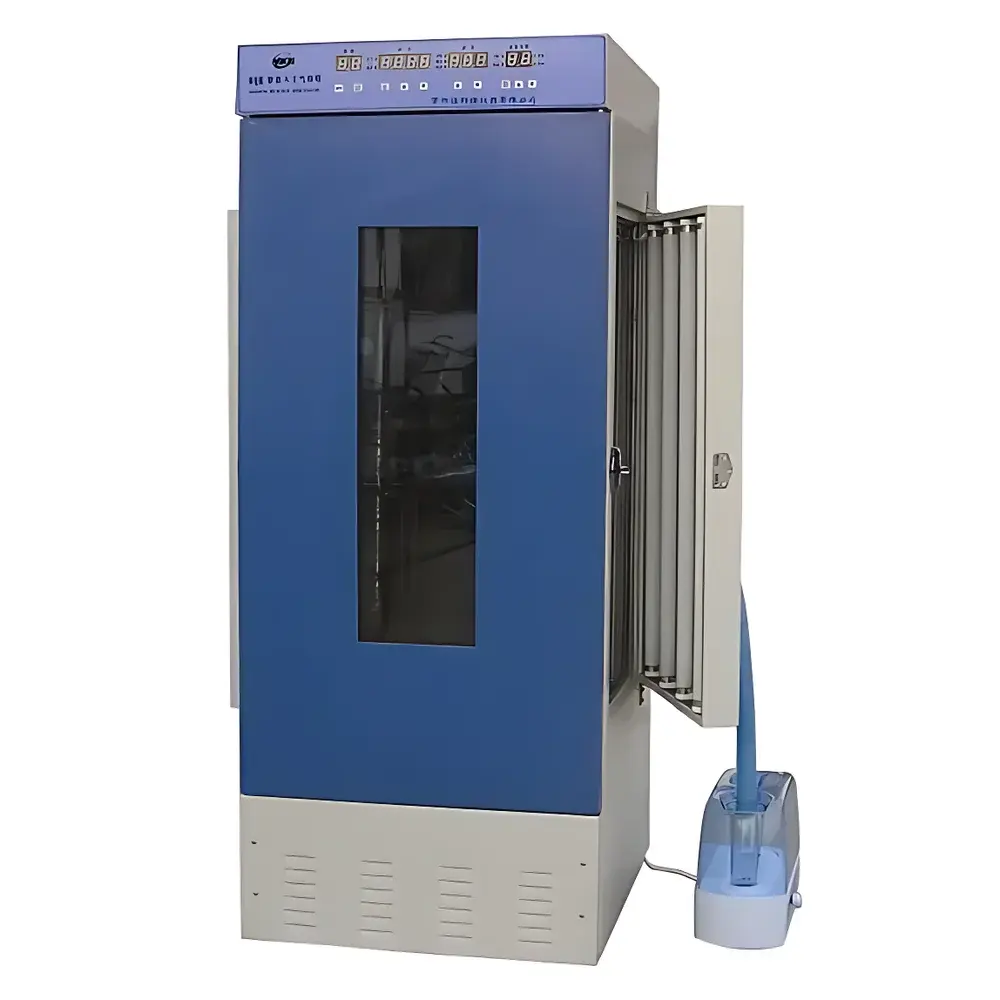
MKN RQX-260 Intelligent Plant Growth Chamber
| Brand | MKN |
|---|---|
| Model | RQX-260 |
| Capacity | 260 L |
| Power Supply | AC 220 V ±10%, 50 Hz ±2% |
| Temperature Range | 5–50 °C (dark), 10–50 °C (full illumination) |
| Temperature Control Accuracy | ±1 °C |
| Temperature Uniformity | ±1 °C |
| Humidity Range | 50–90 %RH |
| Humidity Control Accuracy | ±5 %RH |
| Illumination Intensity | ≥5000 lx (adjustable) |
| Operating Ambient Temperature | 0–40 °C |
| Operating Ambient Relative Humidity | ≤85 %RH |
| Construction | Powder-coated steel exterior, stainless steel interior chamber |
| Insulation | Polyurethane foam |
| Lighting | Internal LED or fluorescent lamp system (standard configuration) |
| Air Circulation | Optimized forced-air convection with multi-directional airflow distribution |
Overview
The MKN RQX-260 Intelligent Plant Growth Chamber is a precision-engineered environmental simulation system designed for controlled plant physiology studies, photobiology research, seed germination assays, and long-term microbial or tissue culture experiments requiring stable, programmable light–temperature–humidity coupling. It operates on a dual-mode thermoelectric and compressor-based cooling/heating architecture, enabling precise thermal regulation across a broad operational range. The chamber integrates a microprocessor-controlled feedback loop that continuously monitors and adjusts chamber conditions using high-stability Pt100 temperature sensors, capacitive humidity transducers, and calibrated photosynthetic photon flux density (PPFD)-referenced illumination control. Unlike basic incubators, the RQX-260 implements dynamic load compensation algorithms to maintain setpoint fidelity during door openings, diurnal cycling, or ambient temperature fluctuations—critical for reproducible experimental outcomes in GLP-compliant botanical and agrobiotech laboratories.
Key Features
- Triple-parameter independent control: Simultaneous, non-interfering regulation of temperature (±1 °C accuracy), relative humidity (50–90 %RH, ±5 %RH tolerance), and illumination intensity (≥5000 lx, stepless dimming via digital interface)
- Forced-air convection system with asymmetric duct geometry and low-turbulence diffusers ensures spatial uniformity of temperature (±1 °C across working volume) and light distribution (CV < 8 % at 30 cm from lamp plane)
- Double-layer insulated chamber with high-density polyurethane foam (thermal conductivity λ = 0.022 W/m·K) and hermetically sealed double-glazed observation door minimizes thermal bridging and condensation risk
- Corrosion-resistant 304 stainless steel inner chamber (electropolished finish) and powder-coated cold-rolled steel exterior meet ISO 14644-1 Class 7 cleanroom compatibility requirements for sterile workflow integration
- Compressor protection circuitry includes phase-loss detection, thermal cut-off relays, and 3-minute anti-short-cycle delay to extend refrigeration system service life under repeated start-stop protocols
- LED-based digital display with intuitive menu navigation supports up to 8-stage programmable cycles (e.g., 16 h light / 8 h dark + ramped temperature profiles), with real-time data logging to internal memory (10,000-point buffer)
Sample Compatibility & Compliance
The RQX-260 accommodates standard-sized plant trays (up to 45 × 45 × 15 cm), multi-well microplates, Petri dishes, and suspension culture flasks without obstructing airflow or light penetration. Its chamber geometry permits unobstructed access to all sample positions during operation. The unit complies with IEC 61000-4 electromagnetic immunity standards and meets CE marking requirements for laboratory equipment (2014/30/EU EMC Directive and 2014/35/EU Low Voltage Directive). While not certified to FDA 21 CFR Part 11 out-of-the-box, its data logging architecture supports audit-trail-ready configurations when integrated with validated third-party software platforms compliant with ISO/IEC 17025 and OECD GLP principles.
Software & Data Management
The embedded controller provides local parameter configuration and real-time monitoring via front-panel interface. Optional RS-485 Modbus RTU or USB-to-serial connectivity enables integration with LabVIEW™, MATLAB®, or custom SCADA systems for centralized environmental monitoring across multi-chamber networks. Logged datasets (timestamped temperature, humidity, illumination, and alarm events) export as CSV files compatible with statistical analysis packages (e.g., R, Python pandas). Firmware updates are performed via secure USB flash drive—no internet connection required—ensuring air-gapped deployment in regulated environments.
Applications
- Controlled-environment phenotyping of crop genotypes under defined photoperiods and stress gradients (drought, heat, chilling)
- Standardized seed viability testing per ISTA Rules and AOAC Official Methods
- Cultivation of phototrophic microalgae (e.g., Chlorella vulgaris, Dunaliella salina) under tunable PAR spectra
- Pre-clinical evaluation of phytochemical biosynthesis kinetics in medicinal plant callus cultures
- Long-term stability studies of biologics stored under accelerated humidity–temperature conditions (ICH Q1A)
- Microbial growth modeling for food safety challenge testing (ISO 21527-1, ISO 21527-2)
FAQ
What is the maximum sustained illumination intensity achievable inside the chamber?
The RQX-260 delivers ≥5000 lux at the center of the shelf plane under full-power operation; actual values vary by lamp type (fluorescent vs. LED array) and distance from source.
Does the unit support continuous 24/7 operation under full-load conditions?
Yes—the refrigeration system and fan motors are rated for uninterrupted duty cycle at nominal ambient temperatures (≤30 °C) and humidity (<60 %RH).
Can humidity be maintained independently of temperature settings?
Yes. Humidity control operates via integrated ultrasonic humidifier and desiccant-assisted dehumidification, decoupled from thermal regulation logic.
Is remote monitoring possible without purchasing additional hardware?
Basic remote status readout requires optional communication module (MKN-COM485); full telemetry and control necessitate integration with external SCADA infrastructure.
What validation documentation is supplied with the instrument?
Each unit ships with Factory Calibration Certificate (traceable to NIST standards), Electrical Safety Test Report, and IQ/OQ protocol templates aligned with ISO 9001:2015 and GxP expectations.



