
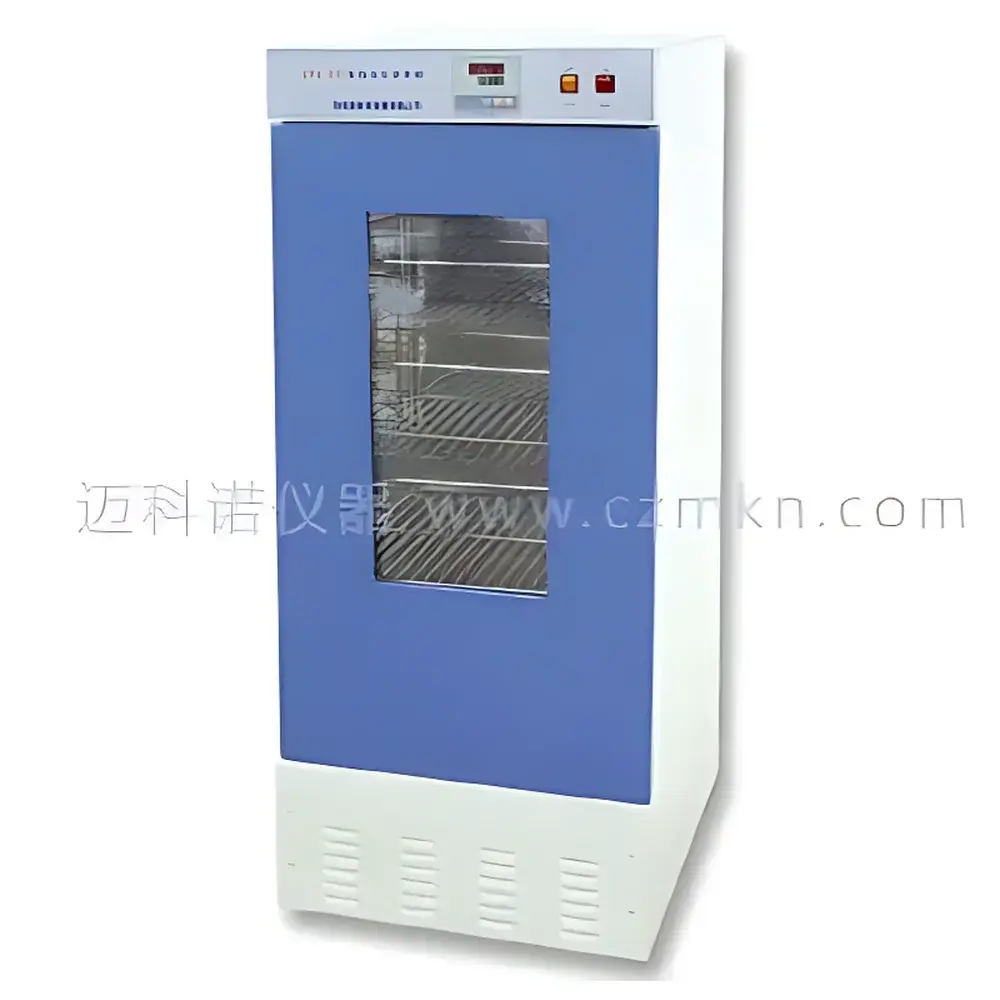
MKN SPX-250 Intelligent Biochemical Incubator
| Brand | MKN |
|---|---|
| Model | SPX-250 |
| Capacity | 250 L |
| Temperature Range | 5–50 °C |
| Temperature Control Accuracy | ±0.5 °C |
| Temperature Uniformity | ±0.5 °C |
| Power Supply | AC 220 V ±10 %, 50 Hz ±2 % |
| Rated Power | ≤500 W |
| Operating Ambient Temperature | 0–40 °C |
| Max. Relative Humidity | <85 % RH |
| Construction | Powder-coated carbon steel exterior, stainless steel interior chamber |
| Insulation | Polyurethane foam |
| Display | LED digital display (optional LCD upgrade) |
| Cooling & Heating | Dual-mode thermostatic control with compressor-based refrigeration and PTC heating |
| Air Circulation | Optimized forced-air convection system with rear-mounted fan and baffle-guided airflow |
| Safety Features | Compressor delay protection, over-temperature alarm, power failure recovery logic |
Overview
The MKN SPX-250 Intelligent Biochemical Incubator is a precision-engineered environmental control system designed for stable, reproducible temperature regulation in life science laboratories. Built upon a dual-mode thermoregulation architecture—integrating a hermetically sealed refrigeration compressor with solid-state PTC heating elements—the unit delivers precise, energy-efficient thermal management across a biologically relevant range of 5 to 50 °C. Its microprocessor-based PID controller continuously monitors chamber temperature via high-stability platinum resistance sensors (PT100), enabling real-time correction and maintaining setpoint accuracy within ±0.5 °C under steady-state conditions. The incubator’s structural integrity supports continuous operation in ISO 17025-compliant QA/QC environments and meets core functional requirements for GLP-aligned biological experiments, including microbial growth assays, enzyme activity profiling, cell line maintenance, and environmental stress testing. Unlike basic benchtop incubators, the SPX-250 incorporates an engineered air distribution system that minimizes vertical and horizontal thermal gradients—critical for uniform culture development across multi-tier shelving configurations.
Key Features
- Microprocessor-controlled PID temperature regulation with LED digital display (upgradable to backlit LCD interface for enhanced readability and menu navigation)
- Dual-mode thermal actuation: Refrigeration-grade compressor + PTC ceramic heater ensures rapid ramping, fine-grained stabilization, and low-noise operation
- Forced-air convection system with rear-mounted centrifugal blower and internal airflow baffles—validated to achieve ≤±0.5 °C uniformity across full 250 L working volume
- Robust chamber construction: 304 stainless steel interior (electropolished finish) for corrosion resistance and ease of decontamination; powder-coated carbon steel exterior with polyurethane insulation (≥50 mm thickness)
- Integrated safety architecture: Compressor delay circuit (3-min restart lockout), over-temperature cut-off (independent mechanical backup thermostat), and auto-recovery after power interruption
- Ergonomic design: Double-layer tempered glass door with anti-fog coating, internal LED illumination (switchable), and removable adjustable shelves (3 standard positions)
Sample Compatibility & Compliance
The SPX-250 accommodates standard laboratory vessels—including Petri dishes, culture flasks (T25–T225), multiwell plates, and serum bottles—within its uniformly heated workspace. Its temperature stability profile complies with ASTM E2876–22 (Standard Practice for Performance Verification of Environmental Chambers) and aligns with key clauses of ISO 13408-1 (Aseptic Processing of Health Care Products). While not humidity-controlled, the unit operates reliably under ambient RH <85 % and ambient temperatures from 0–40 °C—making it suitable for installation in non-climate-controlled lab spaces. All electrical components meet IEC 61010-1 safety standards for laboratory equipment. The absence of internal humidification eliminates condensation-related contamination risks, supporting applications requiring dry, particle-controlled environments per ISO 14644 Class 8 cleanroom protocols.
Software & Data Management
The SPX-250 operates as a standalone instrument with local parameter configuration via front-panel keypad. While no proprietary software or USB/RS-232 connectivity is included in base configuration, the embedded controller logs timestamped temperature data internally (cyclic buffer, 72-hour retention) and supports optional analog output (0–5 V or 4–20 mA) for integration into centralized building management systems (BMS) or SCADA platforms. For regulated environments, users may deploy third-party validated data loggers (e.g., compliant with FDA 21 CFR Part 11) to capture audit-trail-capable records. Firmware supports user-defined setpoint recall and power-loss memory retention—ensuring continuity of experimental conditions without manual reconfiguration.
Applications
- Bacterial and fungal cultivation (E. coli, S. cerevisiae, Aspergillus spp.) under defined thermal regimes
- Enzyme kinetics studies requiring strict thermal consistency between replicate runs
- Stability testing of biologics and diagnostic reagents per ICH Q5C guidelines
- Environmental simulation for ecotoxicology assays (e.g., OECD 201, algae growth inhibition)
- Pre-incubation of samples prior to PCR, ELISA, or flow cytometry workflows
- Long-term storage of temperature-sensitive reference standards and calibration materials
FAQ
What is the maximum load capacity for shelf loading?
Each adjustable shelf supports up to 15 kg evenly distributed; total chamber load must remain below 45 kg to maintain thermal uniformity.
Is the incubator suitable for CO₂-dependent cell cultures?
No—this model lacks gas-tight sealing, CO₂ injection ports, and pH-buffered humidity control; it is intended for ambient-air applications only.
Can temperature data be exported externally?
Direct export is not supported natively, but analog output signals enable connection to external chart recorders or validated data acquisition systems meeting GxP requirements.
Does the unit include validation documentation?
Factory-installed IQ/OQ documentation is available upon request (additional fee applies); users are responsible for site-specific PQ execution per their internal SOPs.
What maintenance intervals are recommended?
Compressor oil level and condenser coil cleaning should be performed every 12 months; door gasket integrity and sensor calibration verification are advised every 6 months in high-use settings.




