
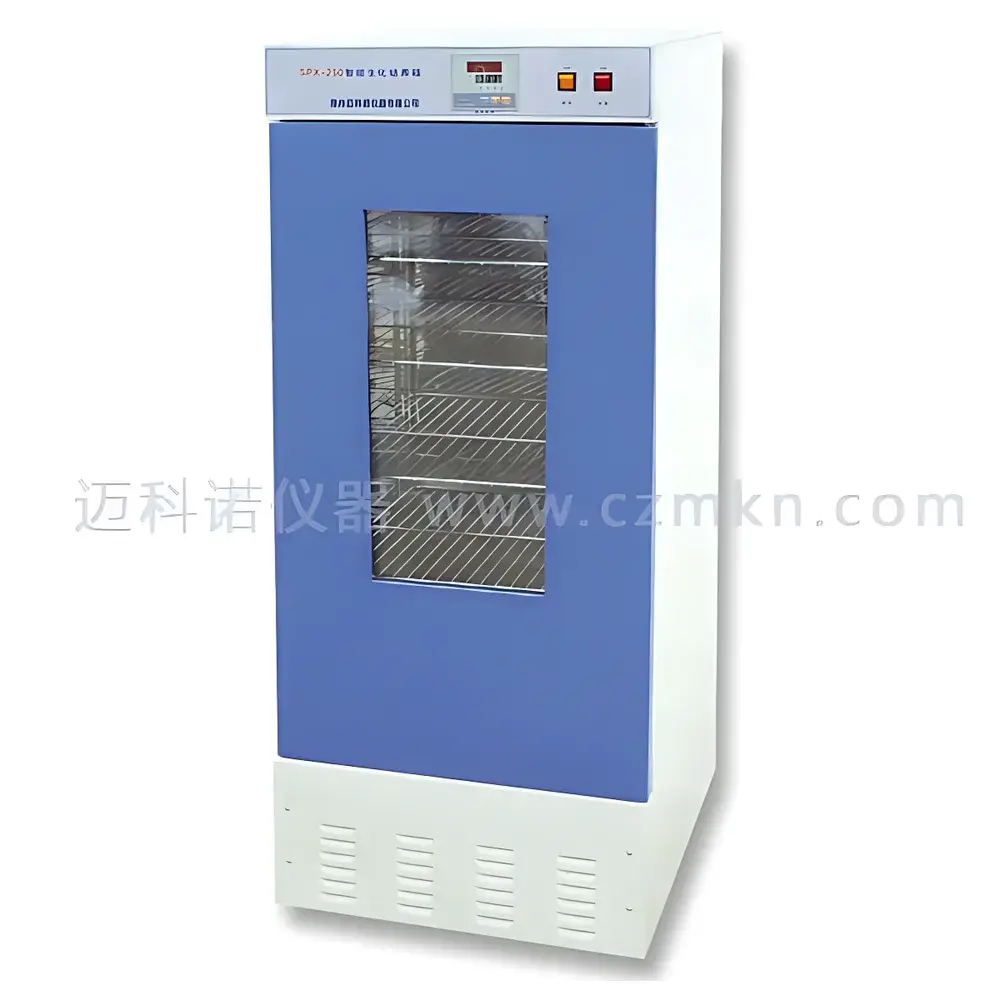
Maikenuo SPX-150 Intelligent Biochemical Incubator
| Origin | Zhejiang, China |
|---|---|
| Manufacturer Type | Authorized Distributor |
| Country of Origin | China |
| Model | SPX-150 |
| Capacity | 150 L |
| Temperature Range | 5–50 °C |
| Temperature Control Accuracy | ±0.5 °C |
| Temperature Uniformity | ±0.5 °C |
| Power Supply | AC 220 V ±10%, 50 Hz ±2% |
| Rated Power | ≤500 W |
| Operating Ambient Temperature | 0–40 °C |
| Max. Relative Humidity | <85% RH |
| Construction | Cold-rolled steel exterior with powder coating, stainless steel interior chamber |
| Insulation | Polyurethane foam |
| Display | LED digital display (optional LCD upgrade available) |
| Air Circulation | Optimized forced-air convection system |
| Safety Features | Compressor delay start, power interruption protection |
Overview
The Maikenuo SPX-150 Intelligent Biochemical Incubator is a precision-controlled, dual-mode (heating and cooling) environmental chamber engineered for stable, long-term cultivation of biological samples under defined thermal conditions. It operates on a Peltier-free refrigeration principle combined with resistive heating elements and microprocessor-based PID temperature regulation—ensuring consistent thermal homogeneity across the entire 150 L working volume. Designed for routine use in academic life science laboratories, quality control units in biopharmaceutical manufacturing, and environmental microbiology testing facilities, the SPX-150 supports applications requiring strict adherence to ISO 17025-compliant incubation protocols and GLP-aligned operational traceability. Its thermally insulated chamber, sealed double-glazed observation door, and optimized air distribution architecture collectively minimize thermal gradients and external interference—critical for reproducible microbial growth kinetics, enzyme activity assays, and cell line maintenance.
Key Features
- Microprocessor-controlled PID temperature regulation with ±0.5 °C accuracy and ±0.5 °C uniformity across the chamber—validated per ASTM E2302-21 guidelines for incubator performance verification.
- Forced-air convection system with uniquely positioned blower and baffle design to ensure uniform airflow distribution and eliminate cold/hot spots.
- Robust mechanical construction: powder-coated carbon steel exterior and electropolished 304 stainless steel interior—resistant to corrosion from repeated disinfectant exposure (e.g., 70% ethanol, 1% sodium hypochlorite).
- High-efficiency polyurethane foam insulation (≥40 mm thickness) providing low thermal conductivity (<0.022 W/m·K) and minimizing energy consumption during continuous operation.
- Dual-safety compressor control circuitry featuring automatic delay restart (≥3 min) and instantaneous power-loss recovery—preventing mechanical stress and extending refrigeration system service life.
- Integrated interior LED lighting with independent switch control—enabling non-invasive visual monitoring without opening the chamber door or disrupting thermal equilibrium.
Sample Compatibility & Compliance
The SPX-150 accommodates standard laboratory vessels including Petri dishes (up to 150 mm), culture flasks (T-75, T-175), multi-well plates, and test tubes—without compromising airflow or temperature stability. Its operating range (5–50 °C) covers common requirements for mesophilic bacterial cultures (e.g., E. coli, Bacillus subtilis), fungal propagation (e.g., Aspergillus niger), mammalian cell passaging (37 °C ±0.3 °C), and low-temperature biochemical assays (e.g., enzyme storage at 4–8 °C). The unit complies with IEC 61010-1:2010 for electrical safety in laboratory equipment and meets essential environmental performance criteria referenced in ISO 8573-1 (compressed air quality) for cleanroom-adjacent installations. While not certified for GMP manufacturing environments out-of-the-box, its design supports integration into 21 CFR Part 11-compliant data management workflows when paired with validated external logging systems.
Software & Data Management
The SPX-150 features an embedded microcontroller with real-time clock functionality and non-volatile memory for storing up to 99 user-defined temperature setpoints and runtime logs. Though it does not include built-in USB or Ethernet connectivity, its LED interface supports manual calibration offset entry and alarm history review (e.g., over-temperature, door-open, power failure events). For regulatory environments requiring audit trails, third-party analog voltage output (0–5 V) is available via optional module—enabling connection to programmable logic controllers (PLCs) or SCADA systems compliant with FDA 21 CFR Part 11 Annex 11 requirements. All operational parameters—including actual chamber temperature, setpoint, elapsed time, and fault codes—are retained post-power-cycle for continuity of experimental integrity.
Applications
- Microbiological culture maintenance and enumeration (ISO 4833-1:2013, AOAC 977.27)
- Environmental monitoring of water and soil samples per EPA Method 1681
- Stability testing of diagnostic reagents and clinical assay kits (CLSI EP25-A)
- Plant tissue culture initiation and callus proliferation under controlled thermal regimes
- Pre-incubation of ELISA plates and Western blot membranes prior to detection steps
- Long-term storage of temperature-sensitive enzymes and restriction endonucleases
FAQ
What is the minimum ambient temperature required for reliable refrigeration operation?
The unit requires an ambient temperature below 30 °C to maintain stable cooling at 5 °C; operation above 35 °C ambient may result in reduced cooling capacity and extended stabilization time.
Can the SPX-150 be used for CO₂-dependent cell culture?
No—this model lacks gas-tight sealing, humidity control, and CO₂ injection capability. It is intended for non-humidified, atmospheric-air incubation only.
Is the temperature sensor calibrated traceable to NIST standards?
Factory calibration uses reference-grade thermistors traceable to national metrology institutes; users may perform field verification using a Class A platinum resistance thermometer (PT100) per ISO/IEC 17025 procedures.
What maintenance intervals are recommended for optimal performance?
Compressor oil level and condenser coil cleaning should be performed annually; door gasket integrity and temperature uniformity mapping are recommended every six months in GLP-regulated labs.
Does the incubator support remote monitoring or alarm notification?
Not natively—but optional relay outputs (dry contact) can trigger external audible/visual alarms or building management systems upon fault detection.
Related Products



