
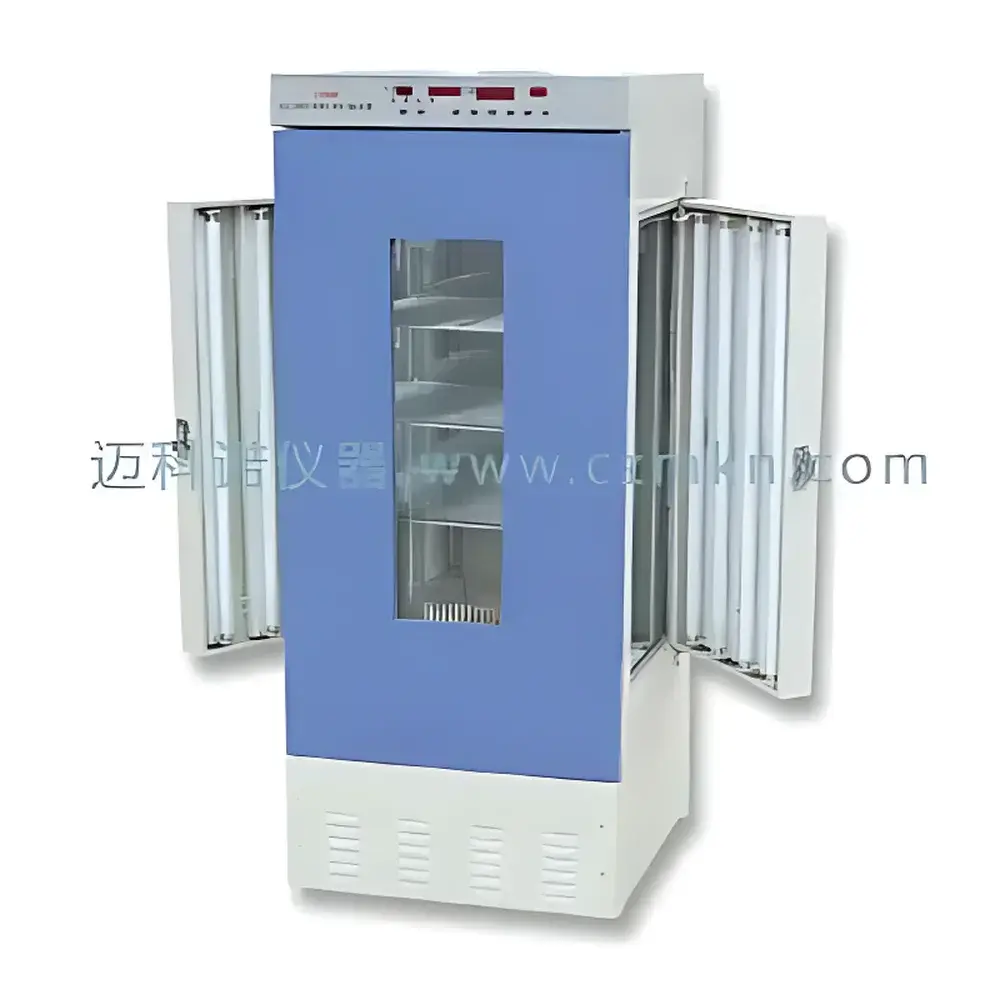
MKN GPX-250 Digital Display Plant Growth Chamber
| Brand | MKN |
|---|---|
| Model | GPX-250 |
| Capacity | 250 L |
| Power Supply | AC 220 V ±10%, 50 Hz ±2% |
| Temperature Control Range | 10–50 °C (with full illumination), 5–50 °C (dark) |
| Temperature Accuracy | ±1 °C |
| Temperature Uniformity | ±1 °C |
| Illuminance | ≥5000 lx |
| Operating Ambient Temperature | 0–40 °C |
| Operating Ambient Relative Humidity | ≤85% |
| Construction | Powder-coated carbon steel exterior, stainless steel interior chamber |
| Insulation | Polyurethane foam |
| Lighting System | Replaceable energy-saving lamps with dual side-access doors |
| Air Circulation | Dedicated forced-air convection system |
| Safety Features | Compressor delay start and power interruption protection |
Overview
The MKN GPX-250 Digital Display Plant Growth Chamber is a precision-engineered environmental control system designed for reproducible, long-term cultivation of photobiological samples under tightly regulated temperature and illumination conditions. Built upon a dual-mode thermoregulation architecture—combining Peltier-assisted heating and vapor-compression refrigeration—the chamber maintains stable thermal setpoints across its full operational range (5–50 °C in dark mode; 10–50 °C under illumination). Its core function is to replicate diurnal light–temperature cycles essential for plant physiology studies, seed germination assays, photomorphogenesis experiments, and standardized biological oxygen demand (BOD) testing. The unit complies with fundamental design principles outlined in ISO 17025-accredited laboratory environments and supports GLP-aligned experimental protocols through traceable digital temperature logging and stable photometric output.
Key Features
- Microprocessor-based temperature controller with LED digital display ensures real-time monitoring and ±1 °C setpoint accuracy and uniformity—critical for inter-laboratory reproducibility.
- Robust dual-layer chamber construction: exterior powder-coated carbon steel provides mechanical durability; interior 304 stainless steel surfaces ensure corrosion resistance, ease of decontamination, and compliance with biosafety hygiene standards.
- High-efficiency illumination system delivers ≥5000 lx at working plane level using replaceable energy-saving lamps, accessible via dual hinged side doors—minimizing workflow disruption during lamp maintenance.
- Optimized forced-air convection architecture ensures homogeneous thermal distribution throughout the 250 L working volume, eliminating vertical or lateral gradients that compromise growth uniformity.
- Polyurethane foam insulation (≥50 mm thickness) achieves low thermal transmittance (U-value < 0.4 W/m²·K), reducing energy consumption and improving ambient temperature independence.
- Integrated compressor protection circuitry includes time-delay restart logic and voltage fluctuation tolerance (±10% AC input), extending service life under variable grid conditions common in academic and industrial lab facilities.
- Double-glazed, argon-filled observation door provides thermal isolation while enabling non-invasive visual inspection—compatible with routine documentation under controlled lighting conditions.
Sample Compatibility & Compliance
The GPX-250 accommodates standard-sized plant trays (up to 450 × 450 mm footprint), microbial culture plates, BOD bottles, and small-scale hydroponic modules. Its temperature and illumination profiles meet foundational requirements for ASTM D5210 (BOD testing), ISO 11737-1 (microbiological sampling), and OECD 208 (terrestrial plant toxicity testing). While not certified to IEC 61000-4 electromagnetic compatibility standards out-of-box, the unit operates within Class B emission limits suitable for shared laboratory spaces. All electrical components conform to GB 4793.1–2007 (equivalent to IEC 61010-1), ensuring safe operation in educational and research settings.
Software & Data Management
The GPX-250 operates via embedded firmware with no external PC dependency. Temperature setpoints, illumination status, and runtime hours are logged internally with timestamped records retained for up to 30 days. Data export is not supported natively; however, the LED interface enables manual transcription into LIMS or ELN platforms compliant with 21 CFR Part 11 when paired with validated SOPs for observational data capture. Audit trail functionality is maintained through physical logbook integration per GLP Annex 11 guidance.
Applications
- Controlled-environment plant phenotyping—including Arabidopsis thaliana, rice, maize, and model legumes under defined photoperiods.
- Seed viability and germination rate standardization per ISTA guidelines.
- BOD5 incubation at 20 °C ±1 °C for wastewater quality assessment.
- Mycelial growth studies requiring simultaneous light exposure and thermal regulation (e.g., fungal phototropism).
- Algal culture maintenance under photoautotrophic conditions for biofuel feedstock screening.
- Teaching laboratories conducting environmental physiology labs aligned with AP Biology or undergraduate botany curricula.
FAQ
What is the maximum allowable ambient temperature for continuous operation?
The chamber is rated for uninterrupted use at ambient temperatures between 0 °C and 40 °C. Operation above 40 °C may impair refrigeration efficiency and trigger thermal cutoff safeguards.
Can the illumination intensity be adjusted or dimmed?
No—the lighting system operates at fixed nominal output (≥5000 lx). Intensity modulation requires external neutral-density filters or third-party programmable LED retrofit kits.
Is the unit compatible with CO₂ enrichment systems?
The GPX-250 does not include gas ports or sealed gas-tight construction; integration with CO₂ control requires aftermarket modification and validation per ISO 14644 cleanroom protocols.
Does the controller support ramp-and-soak temperature programming?
No—this model implements single-setpoint thermostatic control only. Multi-stage thermal profiling necessitates external programmable logic controllers or data acquisition systems.
What maintenance intervals are recommended for optimal performance?
Lamp replacement every 6,000 operating hours; condenser coil cleaning every 6 months in dust-prone environments; calibration verification annually using NIST-traceable thermistors.




