
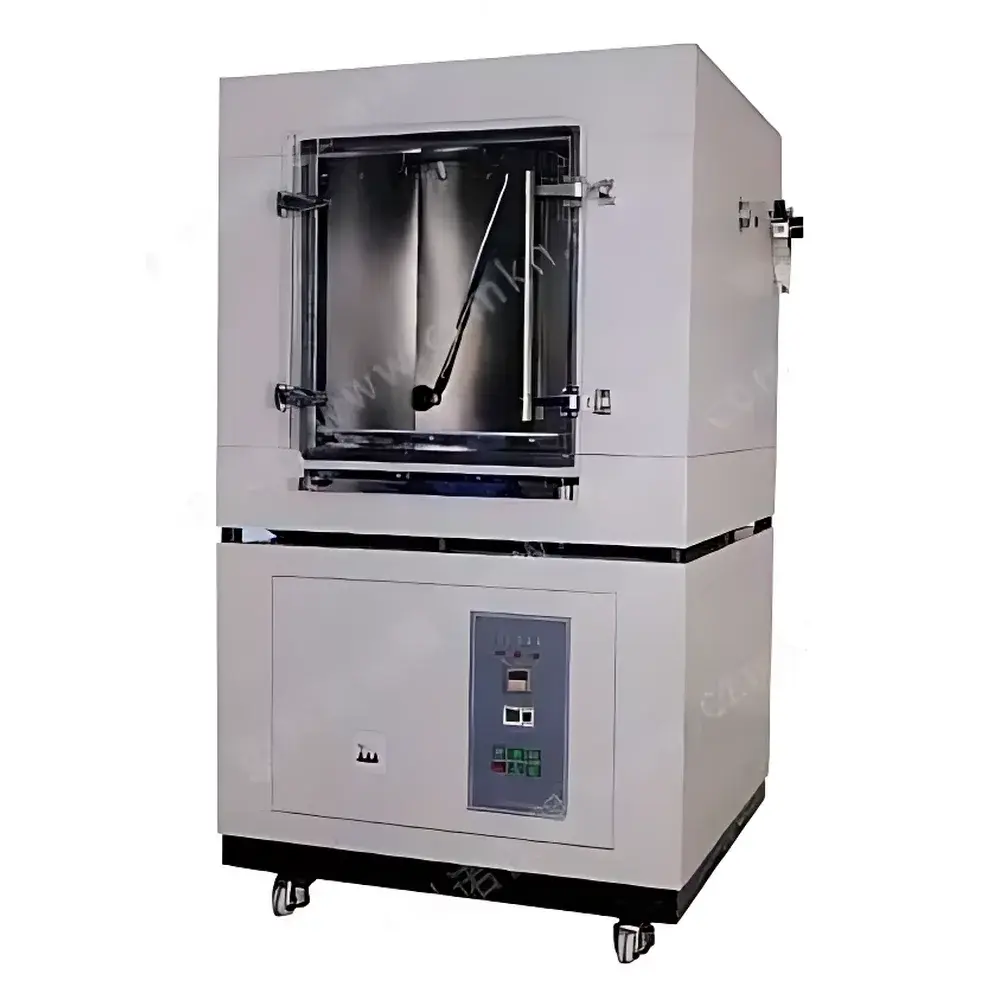
Sand and Dust Test Chamber SC-150
| Origin | Zhejiang, China |
|---|---|
| Manufacturer Type | Authorized Distributor |
| Origin Category | Domestic (PRC) |
| Model | SC-150 |
| Pricing | Available Upon Request |
| Inner Chamber Material | Stainless Steel |
| Outer Casing | Powder-Coated Steel |
| Viewing Window | Tempered Glass |
| Temperature Range | 15–35 °C |
| Relative Humidity | 45–75% RH |
| Dust Loading | 2–4 kg/m³ |
| Sieve Mesh | Nominal Wire Diameter 50 µm, Nominal Aperture 75 µm |
| Test Dust Types | Dry Talcum Powder, Silicate Cement, Fly Ash |
| Controller | Moeller (Germany) Programmable Logic Controller (PLC) |
| Control Functions | Adjustable Blow Cycle (ON/OFF), Vibration Timing, Total Test Duration, Power Cycling (ON/OFF/ON) |
| Electrical Components | Schneider AC Contactors & Push Buttons (France), Fuji Time Relays, Panasonic Dust-Resistant Sockets |
| Dust Blowing Mode | Continuous or Periodic |
Overview
The Sand and Dust Test Chamber SC-150 is an engineered environmental test system designed to evaluate the ingress protection (IP) performance of enclosures, components, and complete assemblies against airborne particulate matter under controlled, repeatable conditions. It operates on the principle of forced-air suspension and directed dust circulation—simulating real-world exposure to sand, silt, and fine industrial dust in arid, desert, or construction-site environments. The chamber complies with key international and national standards governing dust resistance, including GB/T 2423.37–1989 (equivalent to IEC 60068-2-68 Ed.2.0 for sand and dust testing), GB 4208–2008 (IEC 60529:2013) for IP5X and IP6X classification verification, and GB 10485–2007 (which specifies dust test procedures for automotive and industrial equipment). Its design supports both functional evaluation—such as seal integrity, actuator reliability, and optical clarity retention—and compliance validation for regulatory submissions in automotive, aerospace, defense, and industrial electronics sectors.
Key Features
- Robust dual-layer construction: mirror-finished stainless steel inner chamber for corrosion resistance and easy cleaning; powder-coated carbon steel outer casing for mechanical durability and thermal stability.
- Tempered glass observation window with integrated anti-static coating ensures clear, distortion-free visual monitoring without compromising structural integrity or safety.
- Moeller (Germany) PLC-based control system provides deterministic sequencing logic, enabling precise configuration of blow duration, rest intervals, vibration activation, total test runtime, and power cycling patterns—critical for reproducing standardized test profiles per GB/T 2423.37 and ISO 20623.
- Dust dispersion mechanism utilizes calibrated air nozzles and adjustable flow regulators to maintain uniform particle suspension within the specified concentration range (2–4 kg/m³), validated using gravimetric sampling and ISO 12103-1 A2 (Arizona Road Dust) or equivalent reference materials.
- Electrical subsystem integrates Schneider contactors and push buttons (CE-certified), Fuji time relays (±0.1% timing accuracy), and Panasonic IP65-rated dust-resistant sockets—ensuring long-term operational reliability in high-particulate environments.
- Configurable dust containment architecture minimizes operator exposure and simplifies post-test cleanup, supporting GLP-aligned laboratory workflows.
Sample Compatibility & Compliance
The SC-150 accommodates a broad range of test specimens up to 150 L internal volume—including vehicle lighting assemblies, instrument clusters, ECU housings, door latches, steering column modules, and sealed battery enclosures. Its chamber geometry and airflow dynamics are optimized for uniform dust distribution around complex geometries, facilitating accurate assessment of sealing interfaces, gasket compression behavior, and vent membrane performance. The system supports full-cycle testing per IP5X (limited ingress protection against dust) and IP6X (dust-tight) requirements, with traceable calibration records available for audit readiness. All operational parameters—including temperature, humidity, dust mass concentration, and sieve specifications (50 µm wire diameter, 75 µm aperture)—are documented in accordance with ISO/IEC 17025:2017 clause 7.8 and support traceability to NIM (National Institute of Metrology, China) reference standards.
Software & Data Management
While the SC-150 employs a hardware-based Moeller PLC controller without embedded PC software, it features RS-485 communication capability for integration into centralized lab management systems via Modbus RTU protocol. Optional data logging modules enable timestamped recording of cycle status, elapsed time, and actuator states—supporting 21 CFR Part 11-compliant electronic records when paired with validated third-party acquisition software. Test logs include operator ID, sample ID, start/stop timestamps, parameter set version, and deviation flags—meeting GLP documentation requirements for quality assurance departments in automotive Tier-1 suppliers and medical device manufacturers subject to MDR Annex II audits.
Applications
- Automotive: Validation of headlamp and taillamp housing seals against desert sand ingress; evaluation of HVAC flap actuators under sustained dust loading; verification of infotainment display front-glass adhesion integrity.
- Industrial Electronics: IP rating certification for explosion-proof motor controllers, solar inverter enclosures, and railway signaling junction boxes.
- Aerospace & Defense: Pre-deployment screening of avionics cooling vents, UAV payload bay doors, and ground-support equipment housings exposed to runway dust or desert deployment zones.
- Consumer Appliances: Durability assessment of outdoor-rated power tools, robotic vacuum cleaner sensors, and smart home gateway enclosures.
- Research & Development: Material compatibility studies between elastomeric gaskets and abrasive particulates; development of dust-resistant conformal coatings and nanostructured hydrophobic surfaces.
FAQ
Does the SC-150 meet IEC 60529 IP6X certification requirements?
Yes—the chamber’s airflow uniformity, dust concentration control, and test duration repeatability have been verified against the procedural criteria in IEC 60529 Annex B, supporting formal IP6X test reports issued by CNAS-accredited laboratories.
Can the SC-150 be used with non-standard test dusts such as silica sand or volcanic ash?
Yes, provided the particle size distribution falls within the 75 µm nominal aperture tolerance and moisture content remains below 0.5% w/w. Users must validate dispersion behavior and settling rate for each alternative dust type per ISO 12103-1 guidelines.
Is temperature and humidity control actively regulated during testing?
No—the SC-150 maintains ambient chamber conditions (15–35 °C, 45–75% RH) passively; active climate control is not integrated. For tests requiring elevated temperature or low-humidity conditions, external preconditioning of samples and chamber equilibration are recommended prior to dust exposure.
What maintenance intervals are recommended for the PLC and pneumatic components?
Moeller PLC firmware should be backed up quarterly; air filters require replacement every 200 operational hours; nozzle orifices must be inspected and cleaned after each test series using 50 µm ultrasonic filtration verification.
Is third-party calibration and IQ/OQ documentation available?
Yes—factory-issued Installation Qualification (IQ) and Operational Qualification (OQ) protocols are provided, along with NIST-traceable calibration certificates for time relays, pressure regulators, and dust mass measurement systems.



