
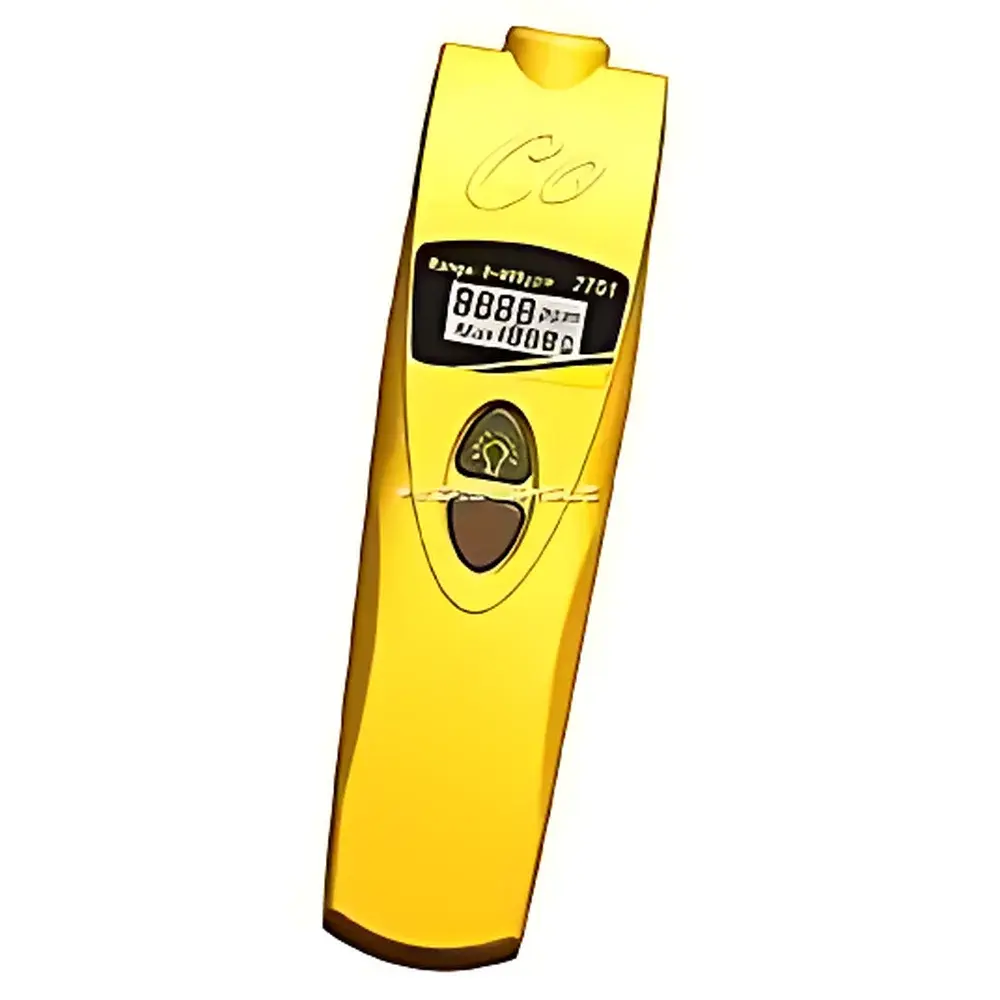
MKN AZ7701 Portable Carbon Monoxide (CO) Analyzer
| Brand | MKN |
|---|---|
| Model | AZ7701 |
| Type | Portable Single-Gas Analyzer |
| Detection Gas | Carbon Monoxide (CO) |
| Measurement Range | 0–1000 ppm |
| Resolution | 1 ppm |
| Accuracy | ±20% (0–100 ppm) or ±15% (100–1000 ppm) |
| Response Time | <30 s (T90) |
| Operating Temperature | −40 to +70 °C |
| Operating Humidity | 5–99% RH |
| Dimensions | 175 × 47 × 28 mm (L×W×T) |
| Power Supply | 3 × AAA batteries |
| Alarm | Audible (≥75 dB) and visual (LED + backlight) |
| Sensor | Imported Japanese electrochemical CO sensor |
| Display | Backlit digital LCD |
Overview
The MKN AZ7701 Portable Carbon Monoxide (CO) Analyzer is a field-deployable, single-gas detection instrument engineered for reliable real-time monitoring of carbon monoxide concentrations in ambient air. Utilizing a high-stability electrochemical sensing principle, the device delivers direct, diffusion-based measurement of CO without requiring external sampling pumps or gas conditioning systems. Its core transducer is an imported Japanese electrochemical cell optimized for selectivity against common interferents—including hydrogen, nitrogen dioxide, and volatile organic compounds—ensuring robust performance in complex environmental and occupational settings. Designed for compliance with basic industrial hygiene and indoor air quality (IAQ) assessment requirements, the AZ7701 supports continuous concentration readout, user-configurable alarm thresholds, and immediate visual/audible alerting upon exceedance. The instrument operates across an extended environmental envelope (−40 °C to +70 °C, 5–99% RH), making it suitable for both cold-storage facilities and high-temperature industrial perimeters.
Key Features
- Electrochemical CO sensor with proven long-term baseline stability and low cross-sensitivity to H₂, NO₂, and ethanol
- Digital backlit LCD display enabling clear visibility under low-light or high-glare conditions
- User-adjustable dual-level alarm system: configurable upper threshold with simultaneous LED flash and audible tone (≥75 dB at 30 cm)
- Low-battery indicator and automatic power-down after 15 minutes of inactivity to conserve battery life
- Compact ergonomic housing (175 × 47 × 28 mm) with IP54-rated ingress protection against dust and water splashes
- Calibration-ready design: supports zero calibration using certified nitrogen gas and span calibration with traceable 100 ppm CO standard gas
Sample Compatibility & Compliance
The AZ7701 is validated for use in undiluted ambient air samples only; it is not intended for stack emissions, confined-space entry (without supplemental O₂ monitoring), or high-humidity condensing environments (>99% RH). While not certified to ATEX or IECEx intrinsic safety standards, its low-power architecture (≤100 mW average draw) and absence of ignition sources render it appropriate for general indoor/outdoor workplace monitoring per OSHA 29 CFR 1910.1000 and NIOSH REL guidelines. The instrument meets CE marking requirements for electromagnetic compatibility (EMC Directive 2014/30/EU) and RoHS 2011/65/EU restrictions on hazardous substances. For regulatory reporting, raw data output complies with ISO 16000-26 (indoor air — determination of CO) methodology prerequisites when operated within specified environmental limits and calibrated per manufacturer-recommended intervals (every 6 months or after exposure to >2000 ppm CO).
Software & Data Management
The AZ7701 operates as a standalone field instrument with no embedded Bluetooth, USB, or wireless connectivity. All operational parameters—including alarm setpoints, unit selection (ppm only), and backlight timeout—are configured via tactile membrane buttons. No proprietary software or drivers are required. For documentation purposes, users may manually log timestamped readings alongside environmental conditions (T, RH) in accordance with GLP-aligned field notebooks. When integrated into broader IAQ audit protocols, the device supports traceable calibration records aligned with ISO/IEC 17025 clause 6.4.6 (monitoring equipment control), provided calibration certificates include uncertainty budgets and traceability to NIST-traceable CO standards.
Applications
- Indoor air quality surveys in schools, offices, and residential buildings following ASHRAE Standard 62.1
- Post-combustion verification near gas-fired heaters, stoves, and emergency generators
- Leak detection and routine maintenance checks in parking garages, tunnels, and loading docks
- First-responder preliminary screening during fire aftermath or suspected CO poisoning incidents
- Baseline ambient monitoring for environmental impact assessments near traffic corridors or industrial zones
FAQ
What is the recommended calibration frequency for the AZ7701?
Calibration is advised every six months under normal use, or immediately after exposure to CO concentrations exceeding 2000 ppm, sensor contamination, or mechanical shock.
Can the AZ7701 measure CO in oxygen-deficient environments?
No. Electrochemical CO sensors require ≥10% v/v ambient oxygen for stable operation; use is restricted to normoxic air (20.9% O₂) unless supplemented by a dedicated O₂ monitor.
Is the sensor replaceable by the end user?
Yes—the electrochemical cell is a field-swappable module with standardized pinout; replacement requires no soldering or firmware reconfiguration.
Does the device support data logging?
No. The AZ7701 provides real-time analog readout only; external logging requires manual recording or integration with third-party dataloggers via optional 0–1 V analog output (not included in base configuration).
What does the ±20% accuracy specification mean in practice?
At 50 ppm CO, the measured value falls within 40–60 ppm with 95% confidence under controlled lab conditions (23 °C, 50% RH, clean air background); field accuracy may vary due to temperature gradients and airborne particulates.
Related Products







