
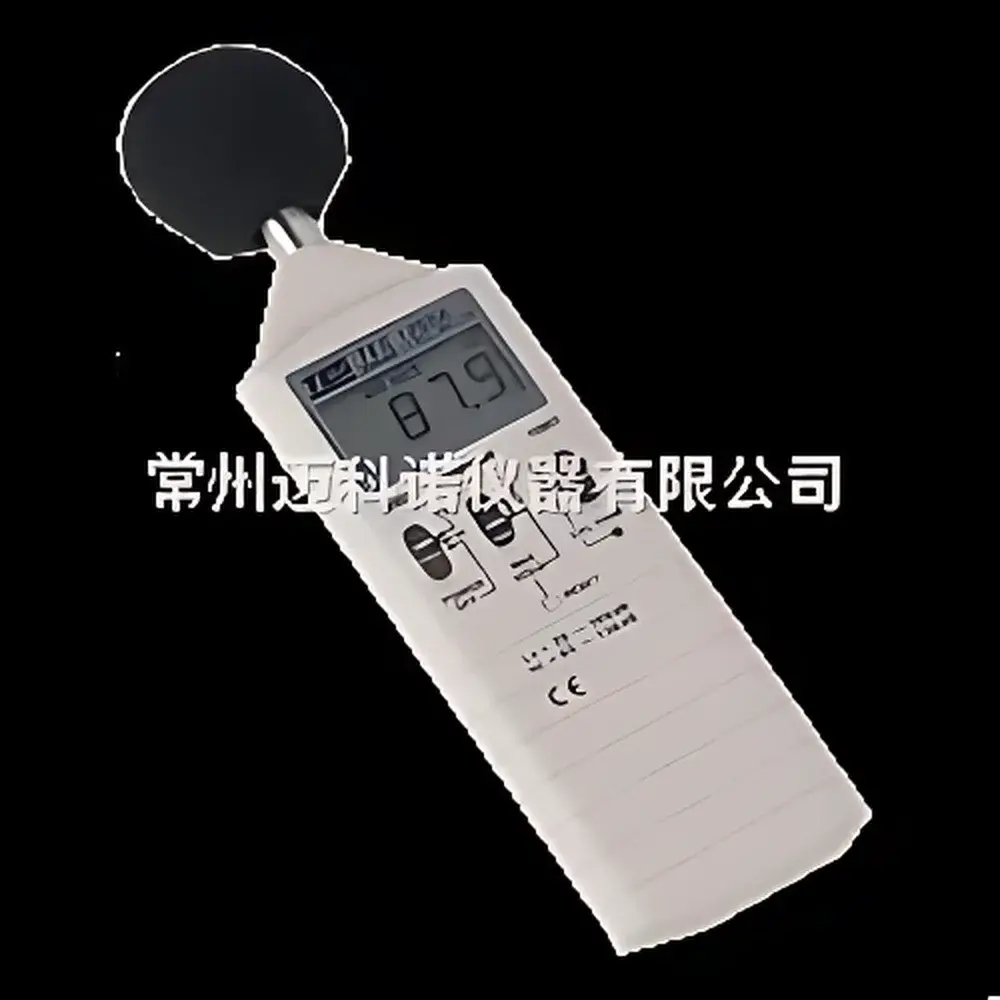
TES-1350A Digital Sound Level Meter by MKN
| Brand | MKN |
|---|---|
| Model | TES-1350A |
| Compliance | IEC 651 Type 2 |
| Measurement Range (A-weighted, LO) | 35–100 dBA |
| Measurement Range (C-weighted, HI) | 65–130 dB(C) |
| Frequency Range | 31.5 Hz – 8 kHz |
| Resolution | 0.1 dB |
| Accuracy | ±2 dB |
| Dynamic Range | 65 dB |
| Weighting Networks | A and C |
| Time Weighting | Fast & Slow |
| Max Hold Function | Yes |
| Microphone Type | Polarized Condenser |
| Internal Calibration | 94.0 dB @ 1 kHz |
| AC Output | ~0.65 Vrms (per range), Zout = 600 Ω |
| DC Output | ~10 mV/dB (nominal), Zout = 100 Ω |
| Operating Temp./RH | 0–40 °C, <80% RH |
| Storage Temp./RH | −10–60 °C, <70% RH |
| Display | 3½-digit LCD |
| Power Supply | 9 V alkaline battery |
| Dimensions (L×W×H) | 240 × 68 × 25 mm |
| Weight | 215 g |
| Accessories | Carrying case, test rod, 9 V battery, instruction manual, windscreen |
Overview
The TES-1350A Digital Sound Level Meter by MKN is a portable, general-purpose acoustic measurement instrument engineered for field and laboratory use in occupational health, environmental noise assessment, and basic industrial hygiene applications. It operates on the principle of electroacoustic transduction via a polarized condenser microphone, converting incident sound pressure into proportional electrical signals that are digitally processed and displayed in decibel (dB) units. The device conforms to IEC 651:1979 Class 2 specifications—establishing its suitability for non-critical measurements where moderate accuracy and repeatability are required. Its dual weighting networks (A and C), selectable time constants (Fast/Slow), and maximum hold functionality enable users to characterize both steady-state and transient noise sources across a frequency band spanning 31.5 Hz to 8 kHz. Designed for operational simplicity and mechanical robustness, the TES-1350A delivers consistent performance under typical ambient conditions without requiring active temperature compensation or real-time spectral analysis.
Key Features
- IEC 651 Type 2 compliance ensures traceable metrological performance for routine noise surveys and regulatory screening.
- Dual acoustic weighting networks: A-weighting (optimized for human hearing sensitivity at moderate sound pressure levels) and C-weighting (broadband response suitable for peak impact noise evaluation).
- Two measurement ranges: Low-range mode (35–100 dBA / 35–100 dBC) and high-range mode (65–130 dBC), supporting flexible deployment across diverse acoustic environments.
- 0.1 dB resolution provides sufficient granularity for comparative assessments and trend monitoring over time.
- Maximum hold function captures and retains peak sound pressure level readings during dynamic events—critical for identifying intermittent or impulsive noise hazards.
- Internal 94.0 dB @ 1 kHz calibration source enables rapid functional verification prior to field deployment, reducing reliance on external calibrators for daily checks.
- Analog outputs (AC and DC) support integration with data loggers, chart recorders, or custom acquisition systems—facilitating long-term noise exposure profiling in compliance with OSHA or local occupational safety protocols.
- Compact form factor (240 × 68 × 25 mm) and lightweight construction (215 g) ensure ergonomic handling during extended walk-through surveys.
Sample Compatibility & Compliance
The TES-1350A is intended for air-borne sound pressure level (SPL) measurements in open-air, indoor, and semi-enclosed environments. It is not designed for underwater acoustics, structural vibration analysis, or infrasound (20 kHz) applications. Its polarized condenser microphone exhibits stable sensitivity within its specified operating temperature and humidity range (0–40 °C, <80% RH), making it suitable for standard factory floors, construction perimeters, urban roadside monitoring, and office noise audits. While not certified to ISO 9612 or ANSI S1.25 for detailed noise dosimetry, its IEC 651 Type 2 designation aligns with preliminary assessment requirements outlined in many national environmental protection agency guidelines and workplace safety frameworks. Users performing legally defensible measurements should supplement instrument use with documented calibration history, microphone windscreen application (included), and adherence to standardized measurement geometry (e.g., 1 m distance from source, free-field orientation).
Software & Data Management
The TES-1350A operates as a standalone analog-digital hybrid meter and does not include embedded firmware-based data storage or USB/WiFi connectivity. However, its analog output interfaces enable compatibility with third-party logging platforms compliant with IEEE 1057 or NIST-traceable DAQ systems. The DC output (~10 mV/dB) supports linear voltage-to-level conversion in spreadsheet-based post-processing or SCADA-integrated dashboards. For auditability, users are advised to manually record measurement context—including date/time, location, weighting/time settings, and environmental conditions—in accordance with GLP principles. While the device lacks FDA 21 CFR Part 11-compliant electronic signatures or audit trails, its mechanical simplicity and deterministic analog signal path contribute to measurement transparency and troubleshooting efficiency in regulated maintenance logs.
Applications
- Ongoing noise mapping of manufacturing zones to identify areas exceeding local occupational exposure limits (e.g., 85 dBA TWA per OSHA 29 CFR 1910.95).
- Pre-commissioning acoustic validation of HVAC systems, generators, and compressors against facility design specifications.
- Community noise impact studies near transportation corridors, power substations, or event venues—supporting municipal noise ordinance enforcement.
- Educational demonstrations of sound propagation, attenuation, and frequency-dependent perception in physics and environmental science curricula.
- Baseline documentation for hearing conservation programs, including periodic retesting and equipment maintenance verification.
FAQ
What standards does the TES-1350A comply with?
It meets IEC 651:1979 Class 2 requirements for sound level meters, indicating suitability for general-purpose noise measurement where high precision is not mandated.
Can this meter be used for octave-band or FFT analysis?
No—it provides only broadband RMS sound pressure level values with A/C weighting; spectral decomposition requires dedicated analyzers.
Is the included windscreen necessary for accurate measurements?
Yes—the foam windscreen minimizes turbulence-induced artifacts at wind speeds above 1 m/s and is essential for outdoor measurements per ISO 1996-2.
How often should the internal calibration be performed?
Before each measurement session or when ambient conditions change significantly; external calibrator verification is recommended at least annually.
Does the device support battery life monitoring?
No—the LCD does not indicate remaining battery capacity; users should replace the 9 V battery proactively after ~100 hours of cumulative operation or upon display dimming.







