
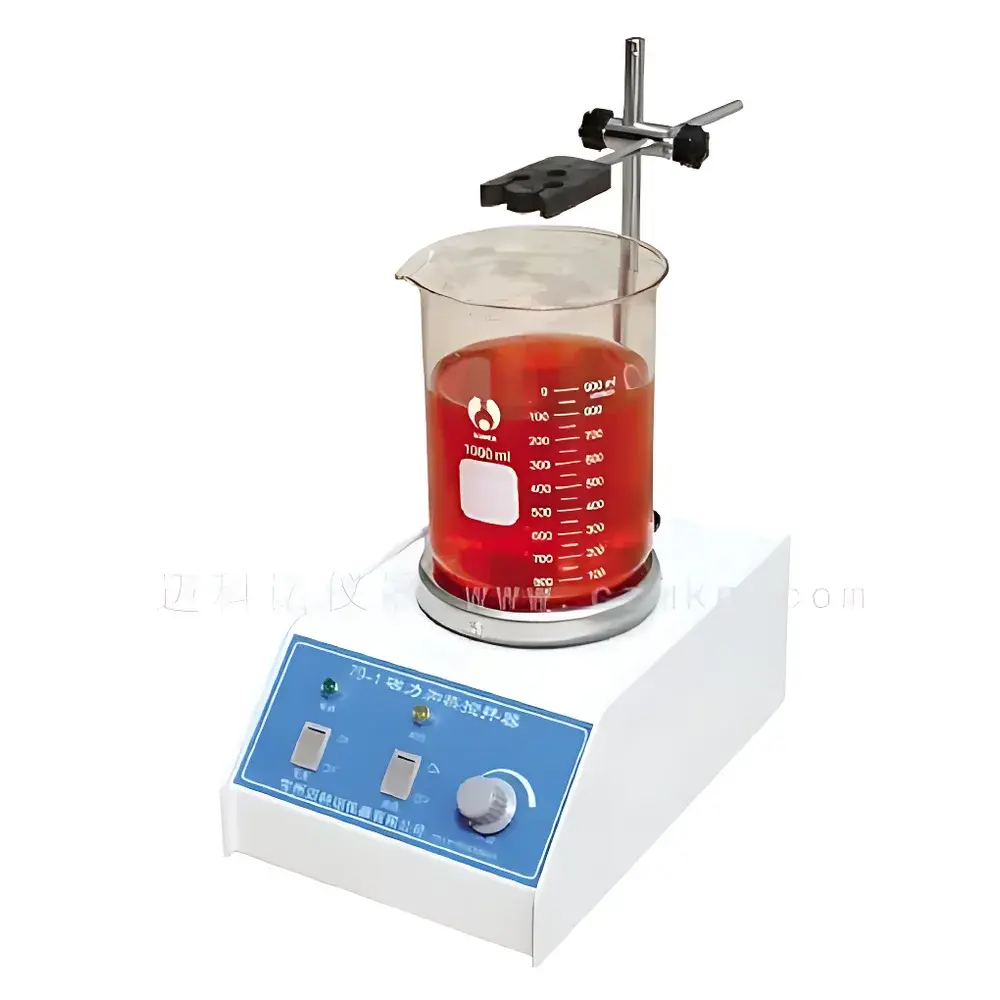
MKN 79-2 Dual-Direction Magnetic Hotplate Stirrer
| Brand | MKN |
|---|---|
| Model | 79-2 |
| Power Supply | 220 V ±10%, 50 Hz ±2% |
| Max. Volume Capacity | 3000 mL |
| Speed Range | 0–1200 rpm, infinitely variable, bidirectional |
| Heating Power | 300 W |
| Stirring Plate Material | Stainless Steel |
| Stir Bar Compatibility | PTFE-coated magnetically driven stir bars |
| Origin | Jiangsu, China |
Overview
The MKN 79-2 Dual-Direction Magnetic Hotplate Stirrer is an engineered laboratory instrument designed for precise, reproducible mixing and temperature-controlled homogenization of liquid samples in sealed or open vessels. It operates on the principle of magnetic coupling—where a rotating permanent magnet beneath a thermally stable ceramic or stainless-steel plate induces synchronous rotation of a PTFE-coated magnetic stir bar immersed in the sample. Unlike gear-driven mechanical stirrers, this device eliminates shaft seals and moving parts in contact with the sample, ensuring contamination-free operation and compatibility with inert, corrosive, or sterile environments. The dual-direction functionality enables alternating clockwise and counterclockwise rotation sequences—critical for preventing vortex formation, improving suspension uniformity in heterogeneous mixtures (e.g., colloidal dispersions, cell culture media, or polymer solutions), and mitigating sedimentation during extended heating cycles.
Key Features
- Dual-direction rotational control: Programmable or manual switching between clockwise and counterclockwise rotation to enhance mixing efficiency in viscous or particle-laden media.
- DC brushless motor drive: Delivers low acoustic noise (<45 dB(A) at 1 m), high torque consistency across speed range, and extended service life without carbon brush wear or electrical arcing.
- Stainless-steel heating plate: Corrosion-resistant, non-porous surface with uniform thermal distribution; supports direct placement of glass, metal, or plastic containers up to 3000 mL volume.
- PTFE-coated magnetic stir bars: Chemically inert, temperature-stable up to 250 °C, and optimized for strong magnetic coupling even at low speeds (≤50 rpm) or high viscosities (up to ~10,000 mPa·s).
- Infinitely variable speed regulation: Analog or digital control interface enabling fine-grained adjustment from standstill (0 rpm) to 1200 rpm with ±2 rpm repeatability under constant load conditions.
- Integrated 300 W resistive heating element: Provides rapid thermal response and stable setpoint maintenance within ±3 °C accuracy across ambient to 150 °C operating range (dependent on vessel geometry and ambient draft).
Sample Compatibility & Compliance
The MKN 79-2 accommodates a broad spectrum of sample types—including aqueous buffers, organic solvents (e.g., ethanol, acetone, chloroform), acidic or alkaline reagents (pH 1–14), and biological suspensions—when used with chemically compatible PTFE- or glass-coated stir bars. Its sealed-vessel operation capability aligns with GLP-compliant workflows requiring minimal headspace exposure or volatile loss. While not certified to IEC 61000-6-3 (EMC) or UL 61010-1 out-of-the-box, the unit meets basic safety requirements for Class I laboratory equipment per GB 4793.1–2007 (Chinese national standard equivalent to IEC 61010-1). For regulated environments (e.g., pharmaceutical QC labs), users are advised to validate thermal and rotational performance per internal SOPs aligned with ASTM E2915 or ISO/IEC 17025 calibration frameworks.
Software & Data Management
The MKN 79-2 operates as a standalone analog/digital hybrid instrument without embedded firmware or network connectivity. It does not support data logging, remote control, or audit trail generation. All operational parameters—speed, direction, and heating setpoint—are adjusted manually via front-panel rotary dials or push-button toggles. Consequently, it is suitable for routine benchtop applications where procedural consistency relies on operator training and documented protocols rather than electronic recordkeeping. For laboratories requiring 21 CFR Part 11 compliance, integration with external data acquisition systems (e.g., USB-connected thermocouple loggers or programmable power supplies) is feasible but requires third-party validation.
Applications
- Preparation of homogeneous buffer solutions and reagent dilutions in molecular biology and clinical diagnostics.
- Heating-assisted dissolution of solid-phase reagents (e.g., agarose, polymers, salts) with controlled agitation to prevent localized overheating or bumping.
- Stabilization of temperature-sensitive reactions—such as enzyme kinetics assays or titration endpoints—where consistent thermal input and gentle mixing minimize denaturation or endpoint drift.
- Dispersion of nanoparticles or microparticles in carrier fluids for materials science characterization (e.g., DLS, zeta potential measurement).
- Supporting ASTM D2196 (viscosity of paints) or USP (dissolution testing) preliminary steps involving heated, agitated dissolution media preparation.
FAQ
Can the MKN 79-2 be used with flammable solvents?
Yes—provided the heating plate surface temperature remains below the autoignition point of the solvent and the workspace is adequately ventilated. Do not exceed 60 °C when using low-boiling-point solvents such as diethyl ether or pentane.
Is the unit compatible with glass-bottom petri dishes or microplate heaters?
No—the 79-2 is designed for single-vessel use with diameters ≥60 mm. It lacks multi-zone heating or micro-well targeting; dedicated microplate thermal stirrers are recommended for such applications.
Does the bidirectional mode operate automatically or require manual intervention?
Manual toggle only: Direction is selected via dedicated front-panel switch; no timed or sensor-triggered alternation is built in.
What is the maximum viscosity this stirrer can handle effectively?
Up to approximately 10,000 mPa·s using a 40 mm PTFE stir bar at 200–400 rpm in a 1000 mL beaker; performance declines above this threshold due to magnetic coupling limits.
Is calibration documentation provided with the unit?
No factory calibration certificate is included. Users must perform in-house verification of speed accuracy (via tachometer) and plate temperature (via calibrated RTD probe) per their quality management system requirements.



