
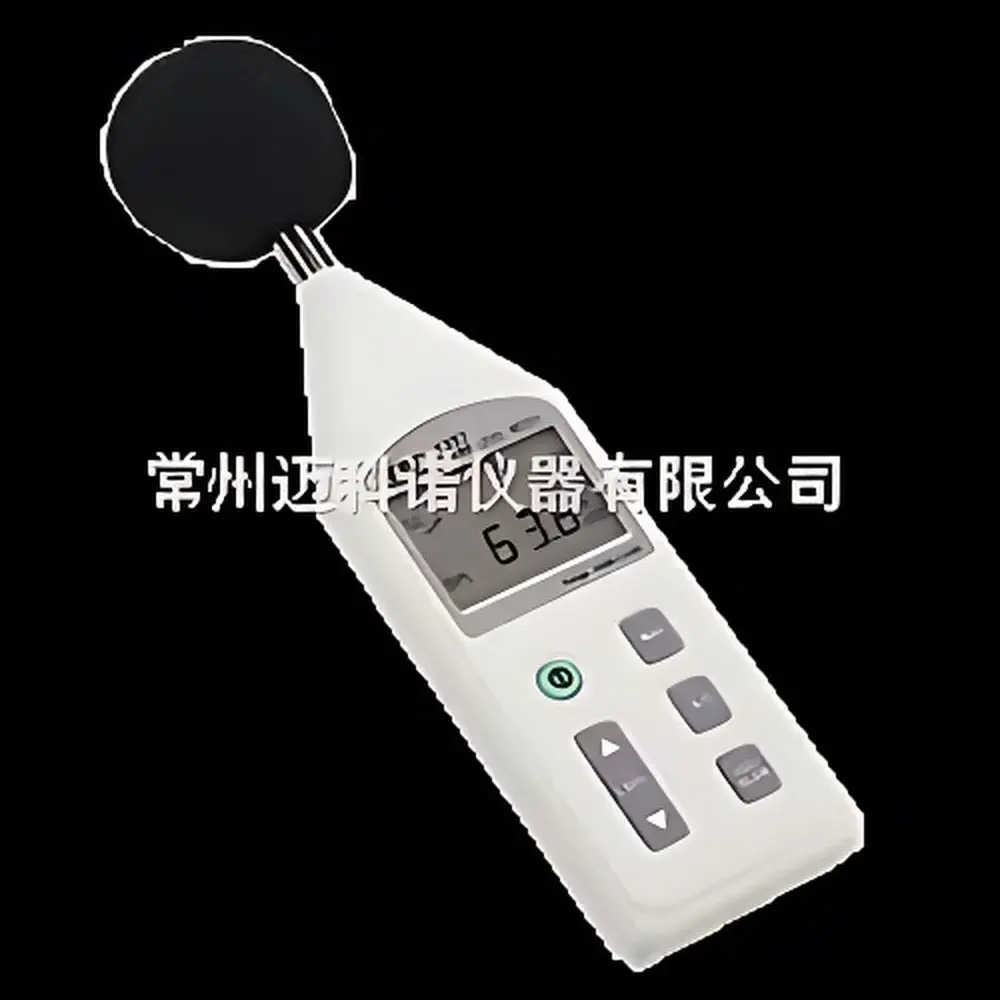
MKN TES-1357 Precision Sound Level Meter
| Brand | MKN |
|---|---|
| Model | TES-1357 |
| Measurement Range | 30–130 dB (A-weighted), 35–130 dB (C-weighted) |
| Resolution | 0.1 dB |
| Frequency Response | 31.5 Hz – 8 kHz |
| Accuracy | ±1.5 dB (ref. 94 dB @ 1 kHz) |
| Weighting Networks | A and C per IEC 651 Type 2 & ANSI S1.4 Type 2 |
| Time Weighting | Fast / Slow |
| Display | 4-digit LCD, refresh rate 2 Hz |
| Microphone | 1/2″ polarized condenser |
| Output | AC/DC, 2 Vrms full-scale, 10 mV/dB |
| Power | 4 × AA batteries (1.5 V) or 6 V DC adapter |
| Battery Life | ~20 h |
| Operating Conditions | 5–40 °C, 10–90% RH |
| Dimensions | 265 × 72 × 21 mm |
| Weight | 310 g |
Overview
The MKN TES-1357 Precision Sound Level Meter is a handheld, general-purpose acoustic measurement instrument engineered for field and laboratory applications requiring reliable, repeatable sound pressure level (SPL) quantification in accordance with internationally recognized electroacoustic standards. It operates on the principle of converting acoustic pressure fluctuations—captured by a stable 1/2″ polarized condenser microphone—into proportional electrical signals, which are then conditioned, frequency-weighted, time-weighted, and digitally processed to yield calibrated decibel readings. Designed to meet IEC 651 Type 2 and ANSI S1.4 Type 2 specifications, the TES-1357 delivers traceable accuracy of ±1.5 dB relative to 94 dB at 1 kHz, supporting compliance-driven workflows in occupational safety, environmental noise assessment, product noise certification, and facility acoustics evaluation.
Key Features
- High-resolution 0.1 dB digital readout with 4-digit LCD display updated every 500 ms, enabling precise real-time monitoring of fluctuating noise sources.
- Dual-frequency weighting networks (A and C) implemented in analog hardware prior to digitization, ensuring conformity with standardized human hearing sensitivity curves and low-frequency energy capture respectively.
- Selectable time weighting modes—Fast (125 ms integration) and Slow (1 s integration)—to accommodate both transient impulse noise and steady-state broadband emissions.
- Four overlapping measurement ranges (30–80 dB, 50–100 dB, 60–110 dB, 80–130 dB) with automatic or manual range selection, minimizing clipping risk across diverse acoustic environments.
- Simultaneous analog and digital output: AC-coupled (2 Vrms full-scale) and DC-coupled (10 mV/dB) signals support connection to data loggers, spectrum analyzers, or oscilloscopes for extended temporal analysis.
- Visual overload detection via “OVER” and “UNDER” indicators, complemented by an analog bar graph (20 samples/sec) representing 1 dB per division for rapid trend interpretation.
- Robust mechanical design with ergonomic housing (265 × 72 × 21 mm), IP54-rated ingress protection against dust and light splashing, and integrated battery compartment for four standard AA cells.
Sample Compatibility & Compliance
The TES-1357 is optimized for air-coupled sound pressure measurements in ambient, indoor, and industrial settings. Its 31.5 Hz–8 kHz frequency response covers the dominant spectral content of most regulatory-relevant noise sources—including HVAC systems, construction equipment, transportation infrastructure, and manufacturing machinery. The device complies with IEC 651:1979 (Type 2) and ANSI S1.4-1983 (Type 2) for sound level meters, making it suitable for preliminary assessments under OSHA 1910.95, ISO 1996-2:2017 (environmental noise), and EU Directive 2002/49/EC (Environmental Noise Directive). While not certified for legal metrology or court-admissible evidence without periodic third-party calibration, its performance stability supports routine monitoring, baseline surveys, and internal QA/QC protocols aligned with ISO/IEC 17025-accredited laboratories’ auxiliary instrumentation requirements.
Software & Data Management
The TES-1357 operates as a standalone instrument with no embedded firmware-based data storage or USB connectivity. However, its analog and DC outputs enable seamless integration into external acquisition systems compliant with FDA 21 CFR Part 11 (when paired with validated software), GLP/GMP audit trails, or ISO 17025-compliant calibration management platforms. Users may record continuous time-series SPL data using compatible DAQ hardware (e.g., National Instruments USB-6009 or Keysight 34972A), with post-processing performed in MATLAB, Python (SciPy), or commercial tools such as Brüel & Kjær PULSE or HEAD Acoustics ArtemiS. Calibration verification is supported via standard pistonphones (e.g., B&K 4228) or acoustic calibrators traceable to NIST or PTB reference standards.
Applications
- Occupational health and safety: Workplace noise exposure assessment per OSHA 29 CFR 1910.95 and EU Physical Agents (Noise) Directive 2003/10/EC.
- Environmental noise mapping: Community noise surveys near airports, railways, highways, and industrial zones per ISO 1996-1 and ISO 1996-2.
- Product noise testing: Pre-compliance screening of consumer electronics, appliances, and power tools against CISPR, EN 50370, or ISO 3744 limits.
- Building acoustics: Verification of sound insulation performance in partitions, façades, and HVAC ductwork per ISO 140 series test methods.
- Educational labs: Undergraduate and vocational training in acoustics, environmental engineering, and occupational hygiene curricula.
FAQ
Is the TES-1357 suitable for octave-band or 1/3-octave spectral analysis?
No—the TES-1357 provides only broadband A- and C-weighted SPL values. Spectral decomposition requires a dedicated real-time analyzer or FFT-based sound level meter.
Does it support data logging internally?
No—internal memory or SD card slot is not included. External logging must be achieved via analog/DC output interfacing.
What is the recommended calibration interval?
Annual calibration against a traceable acoustic calibrator (e.g., 1 kHz, 94 dB or 114 dB) is advised; more frequent verification is required in high-use or harsh-environment deployments.
Can it measure peak sound pressure levels (Lpeak)?
No—this model does not implement peak-hold circuitry or true peak detection per IEC 61672-1:2013; it reports only time-weighted Leq-equivalent values.
Is the microphone replaceable or field-calibratable?
The integrated 1/2″ condenser microphone is not user-replaceable; calibration must be performed at the system level using a coupler or free-field calibrator.







