Xinhua 1000S Textile-Specific Electronic Balance
| Key | Origin: Zhejiang, China |
|---|---|
| Manufacturer Type | Distributor |
| Product Origin | Domestic (China) |
| Model | 1000S |
| Price Range | USD 570–700 (FOB) |
| Instrument Type | Textile-Dedicated Analytical Balance |
| Capacity | 1000 g |
| Readability | 0.01 g |
| Pan Diameter | 130 mm |
| Power Supply | AC 220 V, 50 Hz |
| Optional Accessories | RS232/RS485 Interface, Thermal Printer, Draft Shield |
Overview
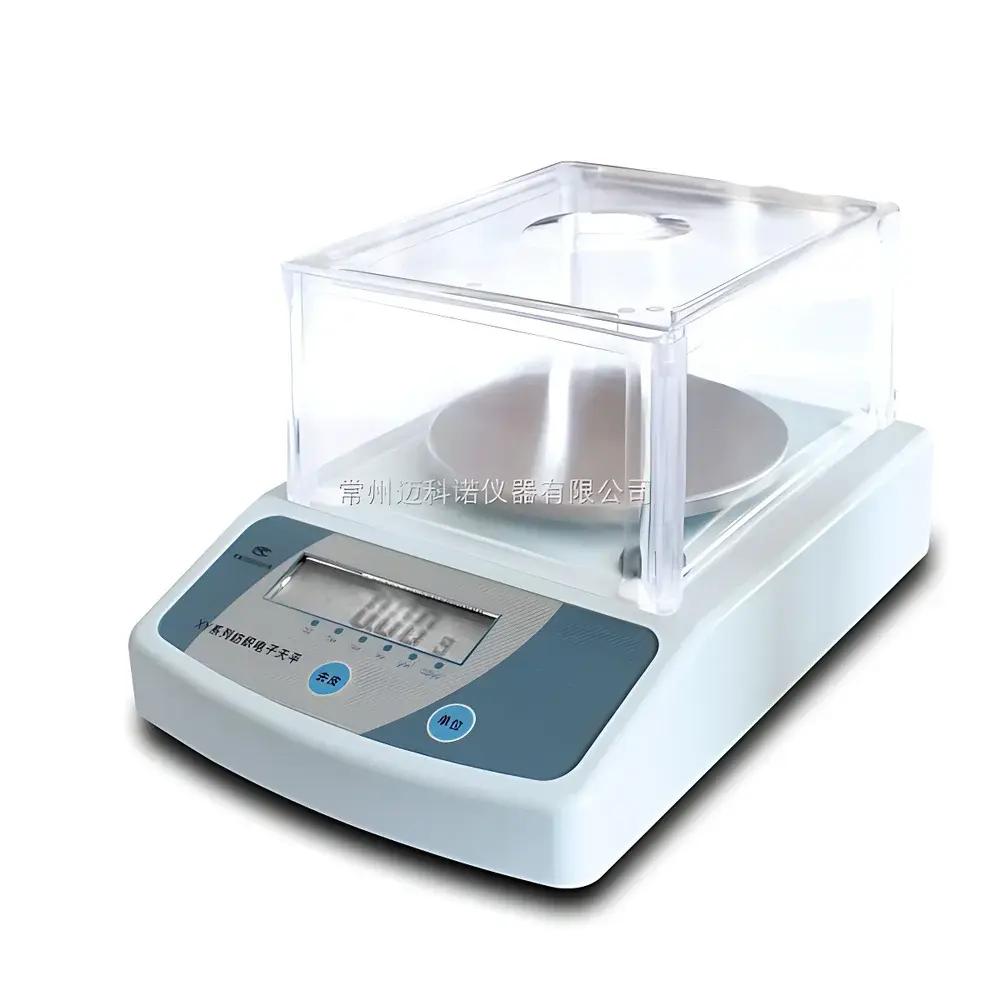
The Xinhua 1000S Textile-Specific Electronic Balance is an industrial-grade analytical balance engineered for precise mass measurement in textile quality control and R&D environments. Unlike general-purpose laboratory balances, the 1000S integrates dedicated textile unit conversion algorithms rooted in standardized fiber metrology—enabling direct calculation of linear density and area density metrics without manual formula application or external software. Its core measurement principle adheres to electromagnetic force compensation (EMFC), ensuring high reproducibility and long-term stability under continuous operation in factory labs or academic textile testing facilities. Designed to meet routine ASTM D1907 (linear density of yarns), ISO 2060 (yarn linear density—tex system), and GB/T 14343 (synthetic filament yarn test methods), the 1000S serves as a foundational instrument for compliance-driven textile laboratories requiring traceable, repeatable mass data.
Key Features
- Seven built-in textile-specific unit conversions: Ounce (oz), Tex (g/km), Metric Count (Nm), English Cotton Count (Ne), Denier (D), Grams per Square Meter (g/m²), and Ounces per Square Yard (oz/yd²)
- High-resolution EMFC sensor with 0.01 g readability and 1000 g maximum capacity, optimized for yarn hank weighing, fabric swatch analysis, and fiber bundle sampling
- Large 130 mm diameter stainless-steel weighing pan with chamfered edges to minimize fiber snagging and facilitate rapid sample placement
- Dual-mode operation: Standard weighing mode and textile conversion mode—with automatic unit selection based on entered sample length or area input
- Robust housing with IP42-rated enclosure for resistance to dust accumulation common in spinning mills and weaving workshops
- Integrated tare function with memory retention across power cycles, supporting multi-step sequential weighing protocols (e.g., conditioned vs. unconditioned samples)
Sample Compatibility & Compliance
The 1000S accommodates a broad spectrum of textile specimens—including staple fiber bundles, continuous filament yarns (polyester, nylon, viscose), woven/knitted fabric coupons (5 cm × 5 cm to 10 cm × 10 cm), and nonwovens—without requiring specialized fixtures. Its calibration protocol supports two-point internal calibration using certified weights traceable to NIM (National Institute of Metrology, China), aligning with ISO/IEC 17025 requirements for accredited testing laboratories. While not certified for GLP/GMP-regulated pharmaceutical applications, the balance meets essential criteria for ISO 9001-certified textile QA/QC departments, including documented calibration intervals, operator-accessible calibration logs, and stable zero-tracking under ambient temperature fluctuations (15–30 °C).
Software & Data Management
Data output is supported via standard RS232 or optional RS485 serial interface, enabling seamless integration with LIMS platforms or custom Excel-based reporting templates used in textile mills. The balance transmits ASCII-formatted strings containing net weight, selected unit, timestamp (if external clock signal provided), and operator ID field—compatible with FDA 21 CFR Part 11-compliant audit trail systems when paired with validated third-party middleware. Optional thermal printer support allows generation of hard-copy test records with batch ID, date/time stamp, and unit identifier—critical for internal process audits and customer-facing test reports. No proprietary software installation is required; raw data streams are human-readable and parseable via Python, LabVIEW, or MATLAB scripts.
Applications
- Determination of yarn linear density (Tex, Ne, Denier) per ASTM D1907 and ISO 2060
- Surface density (g/m²) measurement of knits, wovens, and technical textiles per ISO 3801 and GB/T 3923.1
- Moisture regain correction workflows by comparing oven-dry vs. conditioned mass values
- Quality assurance of spun yarn batches prior to dyeing or weaving
- Academic research on fiber blend ratios, twist measurement validation, and fabric shrinkage analysis
- Supplier qualification testing for OEKO-TEX® Standard 100 or GOTS-certified materials where mass-per-unit-area thresholds apply
FAQ
Is the 1000S compliant with international textile testing standards?
Yes—the unit conversion logic and measurement repeatability conform to ASTM D1907, ISO 2060, and GB/T 14343. Calibration certificates include NIM-traceable reference weights.
Can the balance store multiple calibration points for different textile units?
No—it uses a single mass calibration point; unit conversions are algorithmic and derived from SI base units, not stored calibration curves.
What is the warm-up time required for optimal accuracy?
Minimum 30 minutes after power-on under stable ambient conditions (20 ± 2 °C, <60% RH) to achieve full specification performance.
Does the balance support automatic environmental compensation (e.g., temperature, humidity)?
No—it relies on user-controlled lab conditions per ISO 139 (standard atmospheric conditions for textile testing); no onboard sensors for ambient monitoring.
Is firmware upgradable in the field?
Firmware updates are performed via RS232 connection using manufacturer-provided utility; version history and update logs are retained in non-volatile memory.