
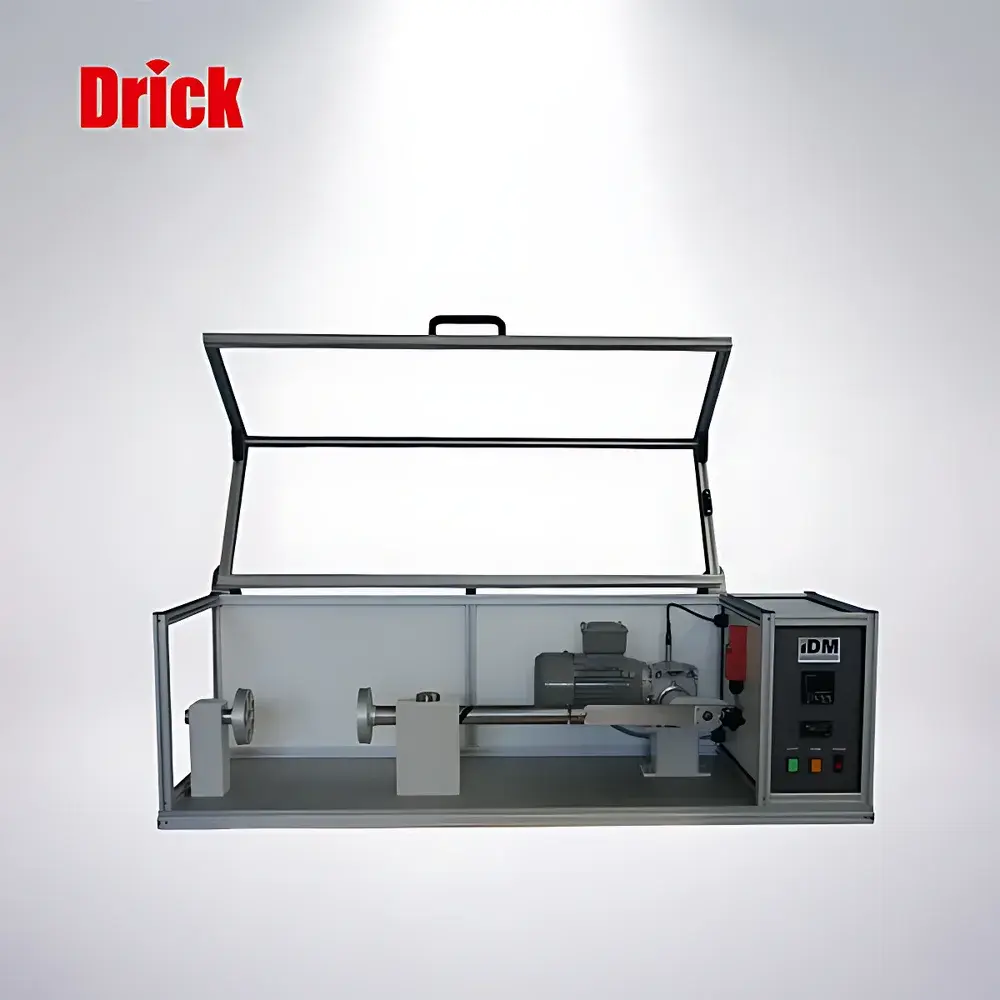
IDM G0002 Packaging Material Rub Resistance Tester
| Brand | IDM |
|---|---|
| Origin | Shandong, China |
| Manufacturer Type | Authorized Distributor |
| Country of Origin | China |
| Model | IDM G0002 |
| Price | Upon Request |
| Rubbing Frequency | 45 cycles/min |
| Horizontal Stroke | 155 mm or 80 mm |
| Rubbing Angle | 440° (at 155 mm stroke) or 400° (at 80 mm stroke) |
| Digital Counter | Yes |
| Stainless Steel Sample Cutter Dimensions | 280 mm × 200 mm |
| Reference Standard | ASTM F392 |
| Electrical Supply | 220/240 VAC @ 50 Hz or 110 VAC @ 60 Hz (customizable) |
| Overall Dimensions (H×W×D) | 300 mm × 1200 mm × 350 mm |
| Weight | 38 kg |
Overview
The IDM G0002 Packaging Material Rub Resistance Tester is an engineered laboratory instrument designed to quantitatively evaluate the mechanical durability of flexible packaging materials under controlled cyclic flexing, folding, and rubbing stress. It operates on the principle of standardized mechanical abrasion simulation—reproducing real-world handling conditions encountered during film conversion, pouch forming, filling, transportation, and storage. Based on the internationally recognized ASTM F392 test method (“Standard Test Method for Flexing Endurance of Flexible Barrier Materials”), the device subjects conditioned specimens to repetitive, bi-directional angular displacement along a fixed horizontal stroke path. This induces localized microstructural fatigue—including polymer chain disruption, coating delamination, and surface microcracking—which directly correlates with post-test changes in barrier integrity (e.g., oxygen transmission rate, water vapor transmission rate) or physical defect formation (e.g., pinhole count increase). The instrument delivers repeatable, traceable, and operator-independent test outcomes essential for material qualification, supplier benchmarking, and regulatory documentation in food, pharmaceutical, and medical device packaging development.
Key Features
- Precisely calibrated dual-stroke configuration: selectable 155 mm (440° angular rotation) or 80 mm (400° angular rotation) travel paths—enabling method flexibility across substrate thicknesses and stiffness ranges.
- Stable 45-cycle-per-minute oscillation frequency, maintained within ±1 rpm tolerance via brushless DC motor and closed-loop timing control—ensuring inter-laboratory reproducibility.
- Integrated digital cycle counter with non-volatile memory retention, supporting batch-level test logging and immediate verification of completed cycles without manual recording.
- Corrosion-resistant stainless steel sample cutter (280 mm × 200 mm) included as standard—guaranteeing consistent specimen geometry per ASTM F392 Section 7.2 requirements.
- Modular electrical architecture compliant with IEC 61000-6-3 (EMC) and IEC 61000-6-2 (immunity), with optional voltage configuration (110 VAC / 60 Hz or 220–240 VAC / 50 Hz) for global deployment.
- Robust aluminum-alloy frame and low-vibration base design minimize mechanical drift during extended testing sessions (>1,000 cycles), preserving dimensional stability of test fixtures.
Sample Compatibility & Compliance
The IDM G0002 accommodates single-layer and multilayer flexible substrates up to 300 µm nominal thickness, including polyethylene (PE), polypropylene (PP), polyester (PET), aluminum foil laminates, metallized films, and functional barrier coatings (e.g., SiOx, AlOx). Specimens are clamped using pneumatic-free, torque-controlled gripping plates to prevent edge slippage without introducing compressive artifacts. All operational parameters align with ASTM F392-22, and the system supports full audit trail generation when integrated with validated LIMS or ELN platforms. While not inherently GLP/GMP-certified, the instrument meets foundational hardware prerequisites for FDA 21 CFR Part 11-compliant environments when paired with appropriate software validation packages and procedural SOPs.
Software & Data Management
The IDM G0002 operates as a standalone electromechanical platform with no embedded firmware or proprietary software—eliminating cybersecurity risks and licensing dependencies. Cycle counts are displayed on a high-contrast LED interface and can be manually recorded or exported via RS-232 serial output (optional adapter available) into third-party data acquisition systems (e.g., LabVIEW, MATLAB, or custom Python scripts). For regulated users, IQ/OQ documentation templates and calibration checklists conforming to ISO/IEC 17025:2017 Annex A.2 are provided upon request. Traceable calibration certificates for stroke length, angular displacement, and timing accuracy are issued by accredited metrology labs upon installation verification.
Applications
- Quantitative comparison of rub resistance between competing film formulations during R&D stage screening.
- Validation of coating adhesion integrity in vacuum-metallized PET prior to thermoforming trials.
- Assessment of sealant layer performance in retortable pouch structures subjected to post-sterilization flex fatigue.
- Root-cause analysis of pinhole formation in high-barrier pharmaceutical blister lidding foils after simulated distribution vibration + flex cycles.
- Supporting technical dossiers for EU MDR Annex I (General Safety and Performance Requirements) and USP packaging integrity assessments.
FAQ
Does the IDM G0002 comply with ISO 11607-1 for sterile barrier system validation?
No—the instrument implements ASTM F392 only. ISO 11607-1 requires additional environmental conditioning (e.g., humidity control, temperature ramping) and alternative failure criteria; supplementary fixtures or climate chambers would be required for full compliance.
Can test parameters be modified beyond the two standard stroke options?
No—stroke length and corresponding angular amplitude are mechanically fixed to maintain force equilibrium and avoid actuator overload. Custom configurations require factory re-engineering and separate validation.
Is the stainless steel cutter certified for food-contact use?
Yes—the cutter is fabricated from AISI 304 stainless steel and supplied with a material test report (MTR) confirming conformity to EN 10088-1 and FDA 21 CFR 178.3570 for indirect food contact applications.





