
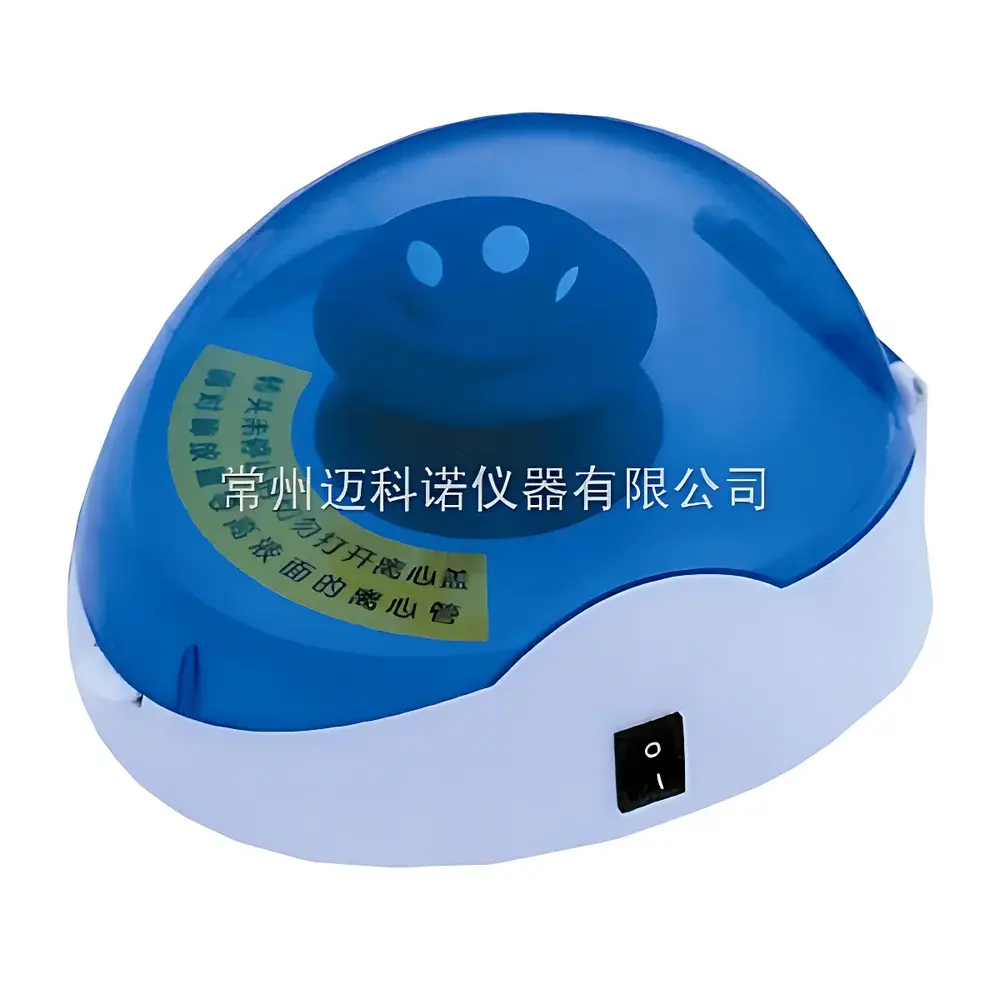
Mini-80 Portable Palm-Sized Centrifuge
| Origin | Zhejiang, China |
|---|---|
| Manufacturer Type | Authorized Distributor |
| Country of Origin | China |
| Model | Mini-80 |
| Relative Centrifugal Force (RCF) | 2300 × g |
| Max Speed | 8000 rpm |
| Sample Capacity | 6 × 1.5/2.0 mL tubes |
| Dual Rotor Configurations | 2 × 8 × 0.2 mL PCR strips + 6 × 0.2 mL adapters + 6 × 0.5 mL adapters |
| Noise Level | <50 dB(A) |
| Drive System | Brushless DC Motor |
| Rotor Material | Carbon Fiber Composite |
| Dimensions | 125 × 125 × 140 mm (W × D × H) |
| Weight | 0.95 kg |
Overview
The Mini-80 Portable Palm-Sized Centrifuge is an ultra-compact, benchtop-ready centrifugation solution engineered for rapid microsample processing in resource-constrained or high-mobility laboratory environments. Designed around a brushless DC motor and precision-engineered carbon fiber rotor assembly, the Mini-80 delivers consistent relative centrifugal force (RCF) up to 2300 × g at 8000 rpm—sufficient for pelleting nucleic acids, precipitating proteins, clarifying lysates, and concentrating small-volume biological suspensions. Its operation adheres to fundamental principles of radial acceleration-based sedimentation, where rotational kinetic energy induces differential migration of particles based on mass, density, and hydrodynamic radius. Unlike floor-standing or refrigerated centrifuges, the Mini-80 prioritizes portability, immediate startup, and silent operation without compromising mechanical stability or thermal management—making it suitable for use inside biosafety cabinets, field-deployed diagnostic stations, teaching labs, and point-of-care molecular workflows.
Key Features
- Ultra-portable footprint (125 × 125 × 140 mm) and lightweight construction (0.95 kg), enabling one-handed operation and effortless relocation between workstations.
- Carbon fiber composite rotor with integrated balancing design ensures structural integrity across repeated acceleration/deceleration cycles and eliminates metal fatigue concerns associated with aluminum rotors.
- Patented acoustic damping architecture reduces operational noise to <50 dB(A) at 1 m distance—compliant with ISO 7779 and compatible with quiet-zone laboratory environments.
- Dual-mode speed control: fixed-speed presets at 7000 rpm and 8000 rpm, selected via tactile push-button interface with LED status indication; no external power supply required beyond standard 100–240 V AC input.
- Intelligent rotor recognition logic prevents unsafe operation when incompatible adapters are installed; automatic stall detection halts rotation if lid interlock fails or tube imbalance exceeds tolerance.
- IP20-rated enclosure meets IEC 61010-1 safety standards for laboratory electrical equipment, including protection against solid object ingress and operator contact hazards.
Sample Compatibility & Compliance
The Mini-80 supports standardized microcentrifuge tube formats commonly used in molecular biology and clinical diagnostics. It accommodates six 1.5 mL or 2.0 mL conical tubes simultaneously using its primary rotor, and features interchangeable accessory configurations—including two 8-position PCR strip carriers (for 0.2 mL strips), six 0.2 mL individual tube adapters, and six 0.5 mL adapters—to maximize flexibility across assay types. All rotor components comply with ISO 15195:2019 (requirements for centrifuge rotors) and are validated for autoclaving at 121 °C for 20 minutes (excluding motor housing). The device conforms to CE marking directives (2014/30/EU EMC, 2014/35/EU LVD), RoHS 2011/65/EU, and fulfills essential requirements under GLP-compliant environments when paired with documented calibration and maintenance logs.
Software & Data Management
As a standalone electromechanical instrument, the Mini-80 does not incorporate embedded firmware, touchscreen interfaces, or network connectivity. Its operational parameters are fixed and non-programmable, eliminating data integrity risks associated with unvalidated software layers. This architecture aligns with FDA 21 CFR Part 11 guidance for instruments where electronic records are not generated—ensuring audit-trail simplicity and reducing validation burden in regulated QC/QA settings. For laboratories requiring traceability, optional external logging via USB-connected timer relays or environmental monitoring systems can be implemented per internal SOPs. Calibration verification is performed annually using NIST-traceable tachometers and RCF calculators per ASTM E29-23 guidelines.
Applications
- Routine spin-down of PCR reaction mixtures prior to thermal cycling.
- Quick sedimentation of column-based DNA/RNA purification eluates to minimize carryover.
- Pre-centrifugation of serum or plasma samples in decentralized testing labs lacking full-scale centrifugation infrastructure.
- Microvolume solvent extraction steps in organic synthesis and analytical sample prep.
- Student laboratory instruction in centrifugation theory, rotor dynamics, and RCF calculation (RCF = 1.118 × r × (N/1000)², where r = radius in mm, N = rpm).
- Field-deployable support for mobile biocontainment units conducting rapid pathogen screening.
FAQ
Is the Mini-80 certified for use in ISO Class 5 cleanrooms?
Yes—the unit’s sealed motor housing, low particle shedding design, and absence of lubricants or vented cooling paths meet ISO 14644-1 requirements for airborne particulate cleanliness when operated within controlled laminar flow hoods.
Can the rotor be sterilized using ethylene oxide (EtO)?
No—carbon fiber rotors are incompatible with EtO due to material absorption risks; only steam autoclaving (121 °C, 15–20 min) or 70% ethanol wipe-down is recommended.
Does the Mini-80 require routine calibration?
Per ISO/IEC 17025:2017 Clause 6.5.2, speed and RCF verification must be conducted at least annually using accredited metrology tools; documentation should include date, technician ID, and deviation thresholds.
What safety certifications apply to the Mini-80?
It carries CE marking under Low Voltage Directive 2014/35/EU and Electromagnetic Compatibility Directive 2014/30/EU, and complies with IEC 61010-1:2010 for laboratory electrical safety.
Is rotor imbalance compensation built into the control logic?
The Mini-80 employs passive mechanical balancing via symmetrical rotor geometry and active stall detection—not dynamic real-time correction—but tolerates ±5% mass asymmetry across loaded positions without vibration escalation.



