
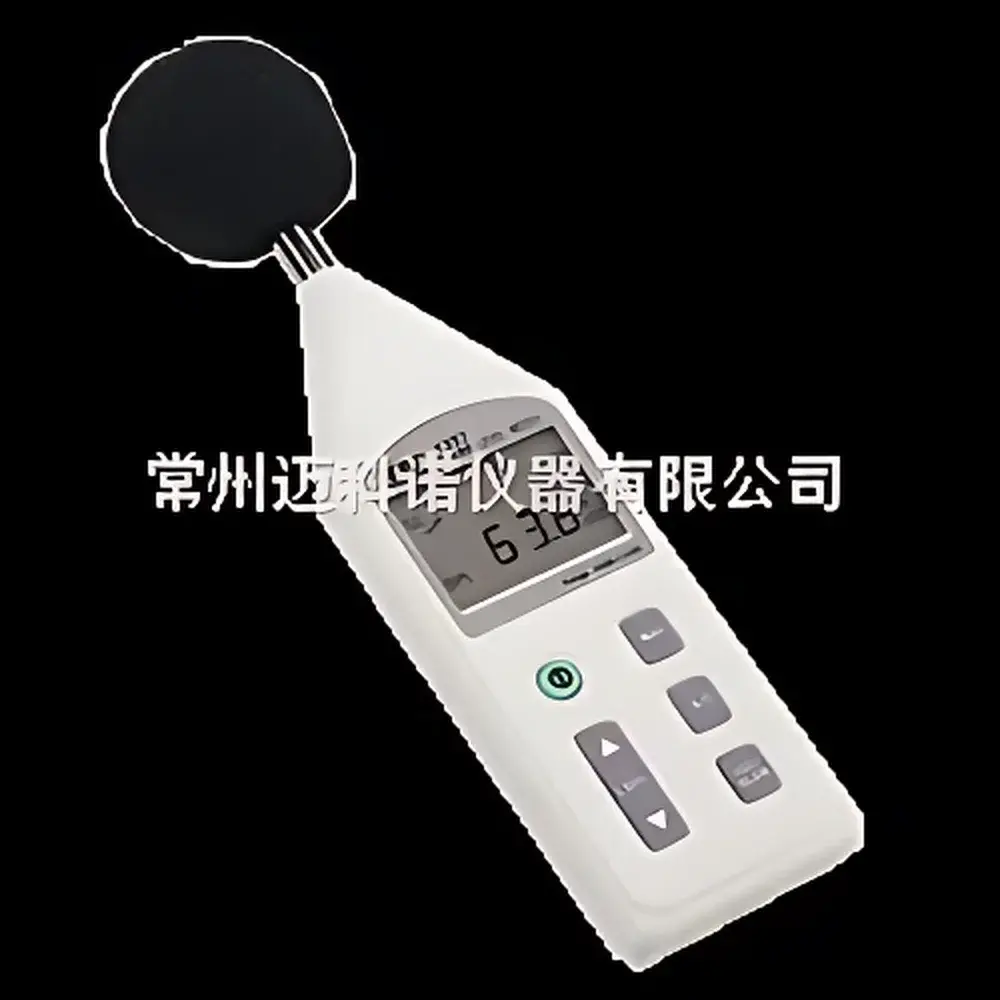
TES-1359 Digital Sound Level Meter by MKN
| Brand | MKN |
|---|---|
| Model | TES-1359 |
| Compliance | IEC 61672-1:2002 Class 2, IEC 60651:1979 Type 2, ANSI S1.4:1983 Type 2 |
| Measurement Range | 30–130 dB |
| Dynamic Range | 60 dB |
| Frequency Range | 31.5 Hz – 8 kHz |
| Resolution | 0.1 dB (digital), 1 dB (analog bar graph) |
| Weighting | A and C |
| Time Weighting | Fast & Slow |
| Microphone | 1/2″ electret condenser |
| Display | 4-digit LCD + 60-segment bar graph |
| Output | AC 1 Vrms (full-scale), DC 10 mV/dB |
| Power | 4 × AA batteries (~50 h) or AC adapter |
| Operating Temp./RH | −10 °C to 50 °C / <90% RH |
| Dimensions | 265 × 72 × 21 mm |
| Weight | 310 g |
Overview
The TES-1359 Digital Sound Level Meter by MKN is a portable, general-purpose acoustic measurement instrument engineered for precision and reliability in occupational health, environmental noise assessment, industrial hygiene, and basic acoustical surveys. It operates on the fundamental principle of converting sound pressure variations into proportional electrical signals via a calibrated 1/2″ electret condenser microphone, followed by analog signal conditioning, frequency-weighting filtering (A or C), time-weighting integration (Fast or Slow), and digital conversion. The device conforms strictly to IEC 61672-1:2002 Class 2—the internationally recognized standard for sound level meters used in routine environmental and workplace noise monitoring—and is also compatible with legacy specifications including IEC 60651:1979 Type 2 and ANSI S1.4:1983 Type 2. Its 60 dB dynamic range and five overlapping measurement ranges (30–90 dB through 70–130 dB, each spaced at 10 dB intervals) enable robust performance across diverse acoustic environments—from quiet office interiors to high-noise manufacturing zones—without manual range switching during transient events.
Key Features
- High-resolution 4-digit LCD display with 0.1 dB resolution and simultaneous 60-segment analog bar graph updating at 8 Hz for real-time amplitude tracking
- Dual frequency weighting (A and C) supporting both regulatory compliance (e.g., OSHA, EU Directive 2003/10/EC) and broad-spectrum analysis
- Configurable time weighting: Fast (125 ms) and Slow (1 s) response modes per IEC 61672-1, enabling accurate assessment of fluctuating or steady-state noise sources
- Peak-hold and Max-hold functions for capturing short-duration impulsive events or maximum exposure levels during time-weighted averaging
- Over-range (Ov) and under-range (Un) indicators for immediate visual feedback on measurement validity
- Standardized analog outputs: AC output (1 Vrms full-scale) for oscilloscope or data logger interfacing, and DC output (10 mV/dB) for direct voltage-based recording systems
- Ergonomic handheld design (265 × 72 × 21 mm, 310 g) with integrated windscreen mount and battery compartment accessible via included flat-head screwdriver
Sample Compatibility & Compliance
The TES-1359 is designed for air-coupled sound pressure measurements in ambient and indoor environments. It does not support immersion, high-temperature, or explosive atmospheres. Its 1/2″ electret condenser microphone meets the sensitivity, linearity, and free-field response requirements specified in IEC 61094-4 for Class 2 instrumentation microphones. Calibration verification is supported using standard 94 dB or 114 dB pistonphone or acoustic calibrators (optional accessories). The instrument satisfies metrological traceability requirements for field use under ISO/IEC 17025-accredited laboratories when operated within its stated environmental limits (−10 °C to 50 °C, <90% RH non-condensing). While not certified for GLP/GMP audit trails or FDA 21 CFR Part 11 electronic records, it provides documented measurement data suitable for internal reporting, preliminary compliance screening, and baseline environmental impact assessments aligned with national frameworks such as China’s HJ 640–2012 and EU’s Environmental Noise Directive (2002/49/EC).
Software & Data Management
The TES-1359 operates as a standalone meter without embedded firmware-upgradable software or USB connectivity. Data acquisition relies on external logging via its analog outputs: the DC output (10 mV/dB) permits direct connection to programmable logic controllers (PLCs), chart recorders, or analog-input data loggers; the AC output (1 Vrms) supports spectral analysis when coupled with FFT analyzers or oscilloscopes. No proprietary software bundle is supplied; however, third-party DAQ platforms (e.g., LabVIEW, MATLAB Data Acquisition Toolbox, or open-source Python libraries such as PyDAQmx) can interface seamlessly using standard analog input modules. All measurement parameters—including selected weighting, time constant, range, and instantaneous dB value—are retained on-screen during operation but are not stored internally. Users must implement external timestamping and metadata annotation manually or via synchronized external systems.
Applications
- Workplace noise exposure evaluation per OSHA 29 CFR 1910.95 and EU Physical Agents (Noise) Directive
- Environmental noise mapping near transportation corridors, construction sites, and urban residential zones
- Pre-commissioning acoustic checks for HVAC systems, generators, and industrial machinery
- Classroom and office acoustic quality audits for LEED IEQ credit documentation
- Educational laboratory instruction in physics and environmental science curricula
- Baseline community noise surveys supporting municipal noise ordinances and zoning reviews
FAQ
What standards does the TES-1359 comply with?
It meets IEC 61672-1:2002 Class 2, IEC 60651:1979 Type 2, and ANSI S1.4:1983 Type 2—making it suitable for general-purpose noise monitoring where Class 1 instrumentation is not mandated.
Can the TES-1359 measure impulse or peak noise?
It supports Max-hold mode for capturing peak SPL over user-defined observation periods but lacks true peak detection circuitry per IEC 61672-1 Annex C; therefore, it is not recommended for firearms or explosion-level impulse assessment.
Is calibration traceable to national standards?
Yes—when calibrated using an accredited acoustic calibrator (e.g., 94 dB @ 1 kHz), results are traceable to NIM (China), NIST (USA), or PTB (Germany) through the calibrator’s certificate.
Does the meter include data logging capability?
No internal memory or logging function is provided; continuous data capture requires external analog recording equipment connected to the DC or AC output ports.
What accessories are required for field calibration?
A Class 1 or Class 2 acoustic calibrator (94 dB or 114 dB at 1 kHz) is essential for pre- and post-measurement verification; optional windscreen, tripod mount, and extension cable enhance usability in outdoor or fixed-position deployments.
Related Products







