
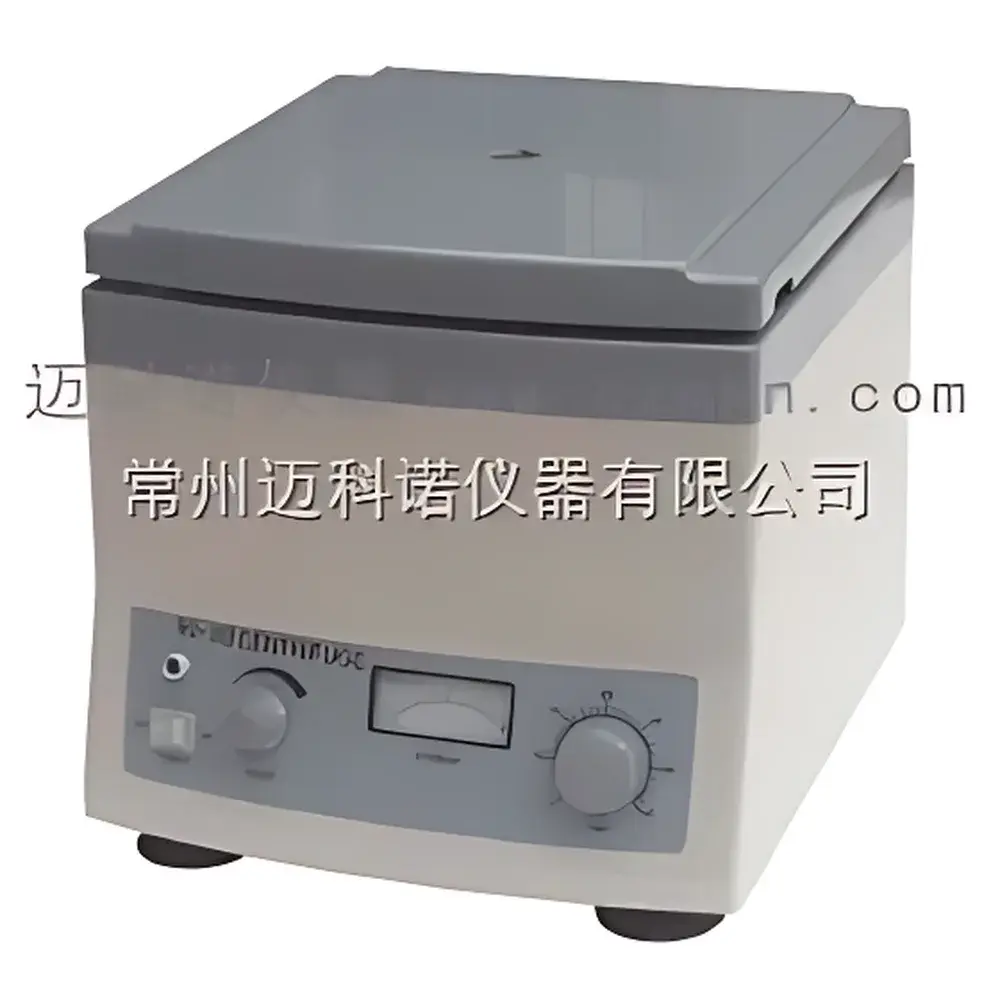
MKN 80-2B Benchtop Centrifuge
| Brand | MKN |
|---|---|
| Model | 80-2B |
| Max Speed | 0–4000 rpm |
| Relative Centrifugal Force (RCF) | 2325 × g |
| Capacity | 12 × 20 mL (or 12 × 15 mL) |
| Timer Range | 0–60 min |
| Power | 135 W |
| Noise Level | ≤60 dB(A) |
| Input Voltage | AC 220 V, 50 Hz, 2 A |
| Rotor Material | Anodized Aluminum |
| Drive | Dedicated Brushed DC Motor |
| Safety | Mechanical Lid Interlock Switch, Dual Fuses, Imbalance Protection |
Overview
The MKN 80-2B is a compact, benchtop centrifuge engineered for routine separation tasks in academic laboratories, clinical diagnostics support units, pharmaceutical QC labs, and environmental testing facilities. It operates on the principle of sedimentation under controlled centrifugal force—generating up to 2325 × g at its maximum rotational speed of 4000 rpm—to separate suspended particles, cells, or precipitates from liquid phases based on density differentials. Designed for reliability in high-throughput environments with limited bench space, the unit features a rigid polypropylene housing with reinforced structural geometry, minimizing vibration transmission and ensuring stable operation during extended runs. Its brushed DC motor delivers consistent torque across the full speed range without electronic commutation complexity, supporting mechanical simplicity and long-term serviceability.
Key Features
- Robust anodized aluminum rotor compatible with standard 15 mL and 20 mL conical tubes (12-place configuration)
- Mechanical analog speed indicator with calibrated dial and pointer—enabling immediate visual verification without digital latency or calibration drift
- Graduated mechanical timer (0–60 minutes) with audible end-of-run signal and automatic rotor deceleration
- Integrated safety interlock system: lid must be fully closed and latched before motor activation; immediate power cutoff upon lid opening during operation
- Dual redundant fusing (main line + motor circuit) compliant with IEC 61010-1 requirements for laboratory electrical equipment
- Dynamic imbalance detection mechanism halts rotation if mass asymmetry exceeds ±5% per tube pair, preventing bearing wear and rotor deformation
- Noise-dampened enclosure design achieves ≤60 dB(A) at 1 m distance—suitable for open-plan lab layouts without acoustic isolation
Sample Compatibility & Compliance
The 80-2B accommodates common polypropylene and polycarbonate centrifuge tubes (15 mL and 20 mL formats), including both round-bottom and conical designs. It is validated for use with aqueous buffers, saline solutions, diluted plasma, cell culture supernatants, and food homogenates—provided samples are pre-balanced to within ±0.1 g per opposing position. The device meets essential safety and electromagnetic compatibility requirements per IEC 61010-1:2010 (Edition 3) and EN 61326-1:2013 for laboratory electrical equipment. While not certified for biosafety level 3 (BSL-3) containment or aerosol-generating protocols, it supports GLP-aligned workflows when operated with documented SOPs, maintenance logs, and user training records.
Software & Data Management
As a mechanically controlled instrument, the 80-2B does not incorporate embedded microprocessors, network interfaces, or data logging capabilities. All operational parameters—including speed setting, timer duration, and run initiation—are managed via front-panel dials and switches. This architecture eliminates firmware dependencies, cybersecurity vulnerabilities, and software validation burdens typically associated with 21 CFR Part 11 compliance. For laboratories requiring traceability, manual entry into paper-based or LIMS-integrated run logs is recommended. Calibration verification (speed accuracy, timer deviation, RCF consistency) should be performed annually using NIST-traceable tachometers and stopwatch standards.
Applications
- Pre-analytical processing of whole blood specimens to isolate serum or plasma prior to immunoassay or clinical chemistry analysis
- Sedimentation of microbial pellets from broth cultures for downstream DNA extraction or viability assays
- Clarification of plant tissue extracts and food emulsions prior to HPLC or GC sample introduction
- Concentration of colloidal suspensions and nanoparticle dispersions in materials science prototyping
- Routine removal of insoluble debris from environmental water samples before filtration or spectroscopic quantification
FAQ
Is the 80-2B suitable for clinical diagnostic use under CLIA or ISO 15189 requirements?
Yes—when operated within validated speed/time parameters and maintained per manufacturer-recommended intervals, it fulfills the mechanical separation requirements for specimen preparation in accredited medical labs.
Can the rotor be autoclaved?
No—the anodized aluminum rotor is not autoclave-rated; cleaning is restricted to 70% ethanol wipe-down and air drying.
What is the expected service life under continuous daily use?
With proper balancing, regular bearing lubrication (every 12 months), and avoidance of corrosive solvents, the motor and mechanical assembly typically exceed 8,000 operating hours.
Does the unit include a rotor identification system?
No—rotor recognition is manual; users must confirm compatibility between the installed rotor and selected speed settings using the included technical manual.
Is replacement fuse specification documented?
Yes—the main fuse is 2 A, slow-blow, 250 V AC; the motor fuse is 1.6 A, fast-acting, 250 V AC—both are standard IEC 60127-2 types.



